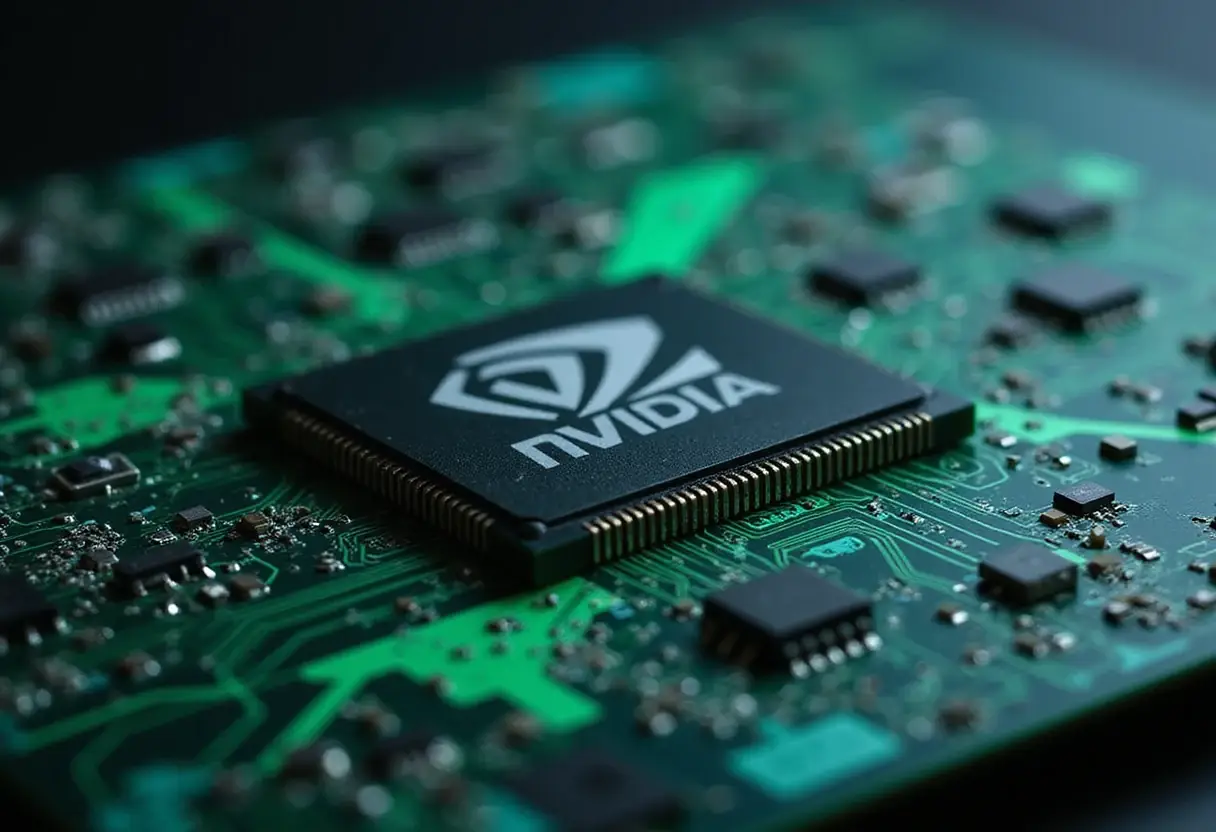
32 Nvidia B300 GPUs detected inside China Telecom network
Lava identified 32 export-restricted Nvidia B300 GPUs in China Telecom’s network but cannot locate them. Nvidia cites court cases showing diversion below 0.5% and calls smuggling a nonfactor.
- By
- Sophie Lindqvist
- Filed
- Channel
- Chips & Policy
- Read
- 4 min read
By Sophie Lindqvist
Lava, an Israeli security firm, identified 32 Nvidia Blackwell Ultra B300 GPUs inside the network of China Telecom, the state-owned Chinese telecommunications operator. Lava said it could not determine where the chips were physically located.
That limitation matters. Lava reported visibility inside China Telecom’s network, not a physical inventory count at a named facility. The source gives no server address, city or installation site. It also does not explain how the chips entered the operator’s system or whether China Telecom knew of their restricted status.
What does the export-control finding establish?
The Information reported that U.S. export controls already bar the B300 from export to China. Under the described sales regime, Nvidia may sell such chips only to approved, or “whitelisted,” buyers that accept restrictions against transferring them to sanctioned parties, including Chinese recipients.
A 2025 report estimated that Chinese companies had smuggled $1 billion worth of Nvidia AI chips into China over three months. The B200 was the most sought-after model then. Distributors were already preparing to sell B300-series chips when those products became available.
How significant does Nvidia say smuggling is?
Nvidia did not deny Lava’s findings, but it disputed their significance. A spokesperson told Tom’s Hardware:
“Governments, researchers, and media have all found insignificant diversion of controlled US products, less than one half of one percent in recent court cases — a drop in the bucket compared to the ocean of domestic compute China already has.”
The spokesperson also called smuggling a nonfactor, citing tens of millions of GPUs in service in approved countries and government blocking on both sides of the globe.
Nvidia’s percentage came from recent court cases, not from Lava’s 32-chip detection. The source provided no B300 shipment total, country breakdown or resale value for these devices. The company’s claim therefore cannot be tested against this finding from the available information.
How did Lava detect chips it cannot place?
Lava identified the B300s through Nvidia’s DCGM Exporter, software that data-center operators use to monitor server health and performance. The report says the tool sometimes remains accessible beyond the data-center network and does not always require password authentication.
Those features explain the detection. They do not locate inventory. Nvidia previously confirmed that it was developing a tool that would allow its chips to be located. Nvidia has not released that tool, leaving Lava unable to identify where within China Telecom’s system the 32 GPUs operate.
Why did buyers target the B300?
Nvidia announced the data-center GPU in March 2025 and expected shipments by the end of that year. The company marketed the B300 as one of the most powerful accelerators available. Nvidia said it offered 50% more memory and 50% more FP4 compute than the preceding B200.
At the launch, Nvidia also cited the DeepSeek R1 large language model and said:
“Built for the age of reasoning.”
These remain vendor claims. The source contains no independently verified performance data, B300 shipment total, system price or benchmark against competing accelerators. Its commercial value cannot be quantified from the material provided.
What has smuggling done to supply chains?
According to the source’s chronology, authorities in Taiwan indicted nine people in August 2026 over illegal B300 exports to China. The smuggling process used Flying Tiget Tech, a Taiwanese server trading firm with whitelisted status for GPU purchases.
The source places Supermicro’s announcement just days after the indictments. Supermicro confirmed that it had fired several employees after an internal investigation into smuggling. Neither the company nor the source identified the employees, their roles or the number affected.
The source says demand for Nvidia accelerators has pushed prices for five-year-old A100 servers up threefold. Some systems now cost as much as $82,000. Buyers have also retooled gaming GPUs for AI workloads where the hardware permits. These responses show scarcity extending beyond the disputed B300 channel, although the source provides no unit-sales or transaction data.
The next commercial test is whether Nvidia’s unreleased location tool and prosecutions of approved resellers can close distribution gaps. Until enforcement and chip-location tracking improve, scarcity should keep pressure on accelerator pricing, while the 32-chip finding leaves one commercial question unanswered: who supplied China Telecom and on what terms.
Source: Tom's Hardware
More from Sophie Lindqvist
Show full bio
News editor covering money, funding and market shifts around Semiconductors, chip manufacturing, hardware, AI compute at Chip Dispatch.
733 articles
Related articles
officials-nvidia-missed-red-flags-in-china-chip-smuggling-4b661353
Officials: NVIDIA Missed Red Flags in China Chip Smuggling
us-arrests-tech-ceo-over-alleged-300m-nvidia-chip-smuggling-to-china-9d52a6af
US Arrests Tech CEO Over Alleged $300M Nvidia Chip Smuggling to China
us-moves-to-block-nvidia-ai-chip-shipments-to-chinese-firms-abroad-7b4ba3ec
US Moves to Block Nvidia AI Chip Shipments to Chinese Firms Abroad
us-charges-man-with-illegally-shipping-nvidia-chips-to-china-1f6de6b4
US Charges Man With Illegally Shipping Nvidia Chips to China