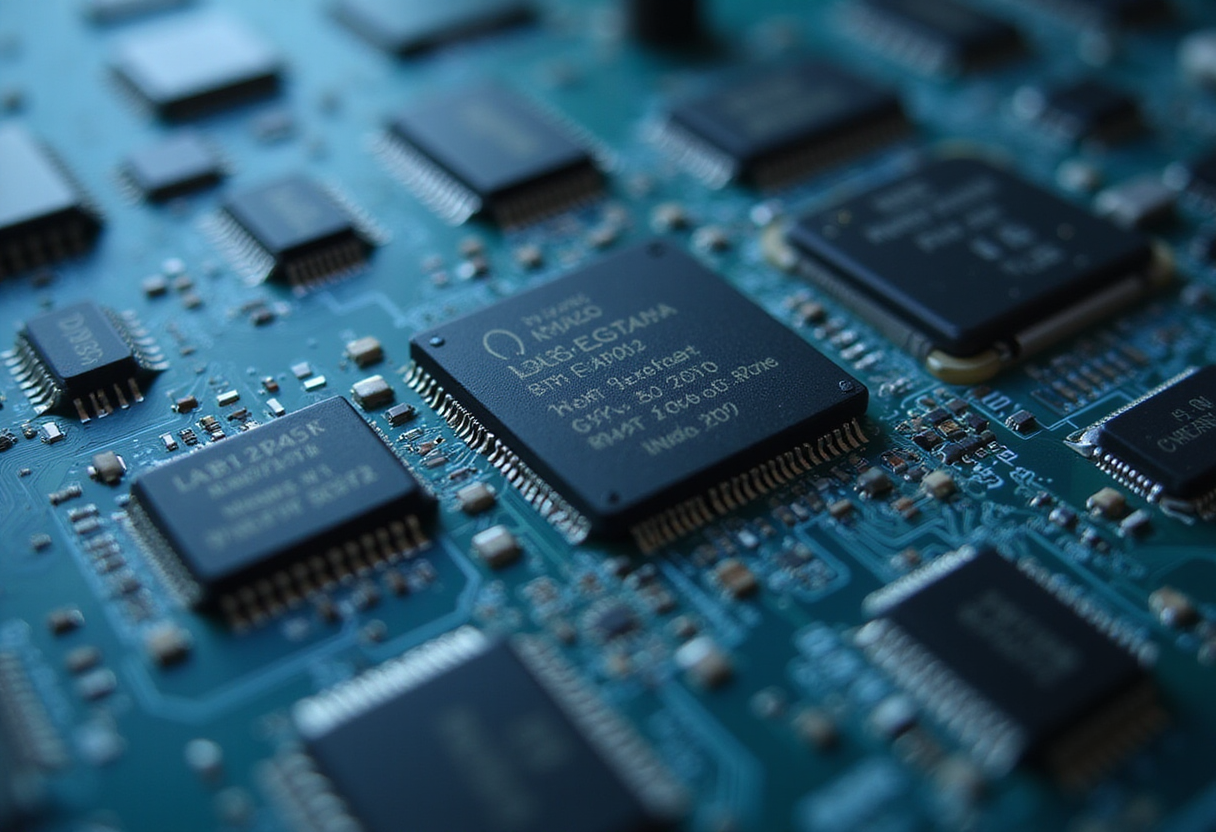
AI Chip Race Pulls Vietnam Deeper Into Semiconductor Supply Chain
Samsung Electro-Mechanics, LG Innotek and Intel are adding substrate production, packaging and memory testing capacity in Vietnam as the AI boom redraws the chip supply chain.
- By
- Tom Whitfield
- Filed
- Channel
- Semiconductors
- Read
- 4 min read
Samsung Electro-Mechanics will spend 2.51 trillion won ($1.84 billion) expanding FCBGA substrate production in Vietnam, part of a 6.78 trillion won ($4.97 billion) program announced September 29 to serve the AI server market. The Vietnam facility is scheduled to be completed and begin operations in June 2030.
The investment reflects a structural shift in memory manufacturing. Samsung Electronics forecasts that HBM, the high-bandwidth memory stacked alongside AI processors, could account for nearly 30% of the industry's DRAM wafer capacity by 2027, up from around 20% today. Because HBM and conventional DRAM draw from the same wafer capacity, the reallocation tightens supply of commodity DRAM used in smartphones, computers and servers. New processes that yield more memory capacity per wafer partly offset that pressure, according to the source.
Demand is running hot. South Korean semiconductor exports jumped 259.4% year-on-year in the first 20 days of September, against a 78.3% rise in total exports. A Reuters poll of 18 economists forecast September exports up roughly 62%, with AI-driven semiconductor demand remaining a main growth engine.
Vietnam is capturing a growing slice of the capacity buildout across several supply-chain stages.
Packaging substrates land in Hai Phong and beyond
FCBGA is the packaging substrate that sits beneath a chip and connects it to a circuit board. Samsung Electro-Mechanics said the products are evolving toward larger sizes, more layers and greater complexity for AI chips and high-performance servers, and it expects AI infrastructure investment to continue for the next two to three years. Of the total program, 4.27 trillion won ($3.13 billion) goes to its Sejong facility in South Korea, which retains the high-performance, more complex FCBGA products, while Vietnam adds global supply capacity.
LG Innotek is following. In June it announced plans to expand semiconductor packaging substrate production at factories in Hai Phong, producing RF-SiP, FC-CSP and FC-BGA substrates. By end of July, its project at DEEP C Hai Phong 2 had received an investment certificate worth about $1 billion. It will be LG Innotek's first packaging substrate plant outside South Korea, with pilot production targeted for Q3 2027 and mass production for Q3 2028. The company said FC-BGA demand in particular is rising as major technology companies increase AI and computing infrastructure spending.
Intel is also reallocating. According to the management board of Ho Chi Minh City's Saigon Hi-Tech Park, Intel is moving some assembly, packaging and testing activities from Costa Rica to Vietnam to produce chips for data-center servers and next-generation networking systems, and is transferring advanced packaging and testing technologies to strengthen the HCMC facility. The move forms part of Intel's strategy to concentrate assembly and testing at larger sites in Vietnam and Malaysia.
Memory testing added to the mix
In May, documents seen by Reuters showed Samsung Electronics plans to invest about VND39 trillion ($1.5 billion) in a chip testing facility in Vietnam, focused on DRAM and NAND, with operations expected from November 2027. There is no evidence this decision directly results from the shift toward HBM, but it gives Vietnam additional memory testing capacity precisely as global manufacturers reallocate advanced capacity toward AI products.
The macro backdrop is favorable. Registered foreign direct investment in Vietnam reached $40.63 billion in the first eight months of 2026, up 55.4% year-on-year. Manufacturing and processing accounted for about $20.18 billion of newly registered and additional capital, or 59.5% of those categories, and about $14.24 billion of realized FDI — 82.6% of total disbursements.
Vietnam still has no chip fabrication, the most critical link in the chain. Japanese technology expert Tsuda Kenji, editor-in-chief of News & Chips, was quoted by foreign media saying Vietnam should select specific links — such as chip manufacturing and packaging — where it can build competitive advantage, rather than spreading resources across the entire chain, and should develop domestic equipment and materials suppliers to build a local ecosystem.
The near-term benefits show up mainly in capital inflows and relocated capacity, not output. With Samsung Electro-Mechanics starting operations in June 2030 and LG Innotek reaching mass production in 2028, the impact on industrial output and exports will hinge on execution — and on whether the global AI investment cycle itself holds its pace.
Original: i.ex-cdn.com
More from Tom Whitfield
Show full bio
Staff writer covering consumer brands and retail at Chip Dispatch.
158 articles
Related articles
ai-chip-demand-drives-83-5-surge-in-south-korean-exports-e6503066
AI Chip Demand Drives 83.5% Surge in South Korean Exports
ai-chip-demand-drives-83-5-surge-in-south-korean-exports-a42d139d
AI Chip Demand Drives 83.5% Surge in South Korean Exports
south-korea-commits-576-billion-to-ai-chip-production-12d0fc8c
South Korea Commits $576 Billion to AI Chip Production
korea-s-chip-exports-top-60-billion-in-a-single-month-93971c9d
Korea's Chip Exports Top $60 Billion in a Single Month