Arista's $13.3 Billion Fiscal Guide Bets on Ethernet AI
Arista raised fiscal 2026 revenue guidance to $13.3 billion after 58.5% Q3 growth, forecasting $18.5 billion in 2027. Ethernet gains, AI fabrics and campus sales expand against supply commitments.
- By
- Nathan Brooks
- Filed
- Channel
- Tech Business
- Read
- 5 min read
By Nathan Brooks
Arista Networks raised fiscal 2026 revenue guidance to $13.3 billion after reporting record third-quarter 2026 revenue of $3.66 billion, up 58.5% from a year earlier. Earnings reached $1.20 per share, above market expectations.
The company’s initial fiscal 2027 outlook calls for 38% to 40% revenue growth, or roughly $18.5 billion. That figure remains guidance, not contracted revenue, but Ethernet demand is moving from a product argument to a budget line.
What is driving Arista’s growth?
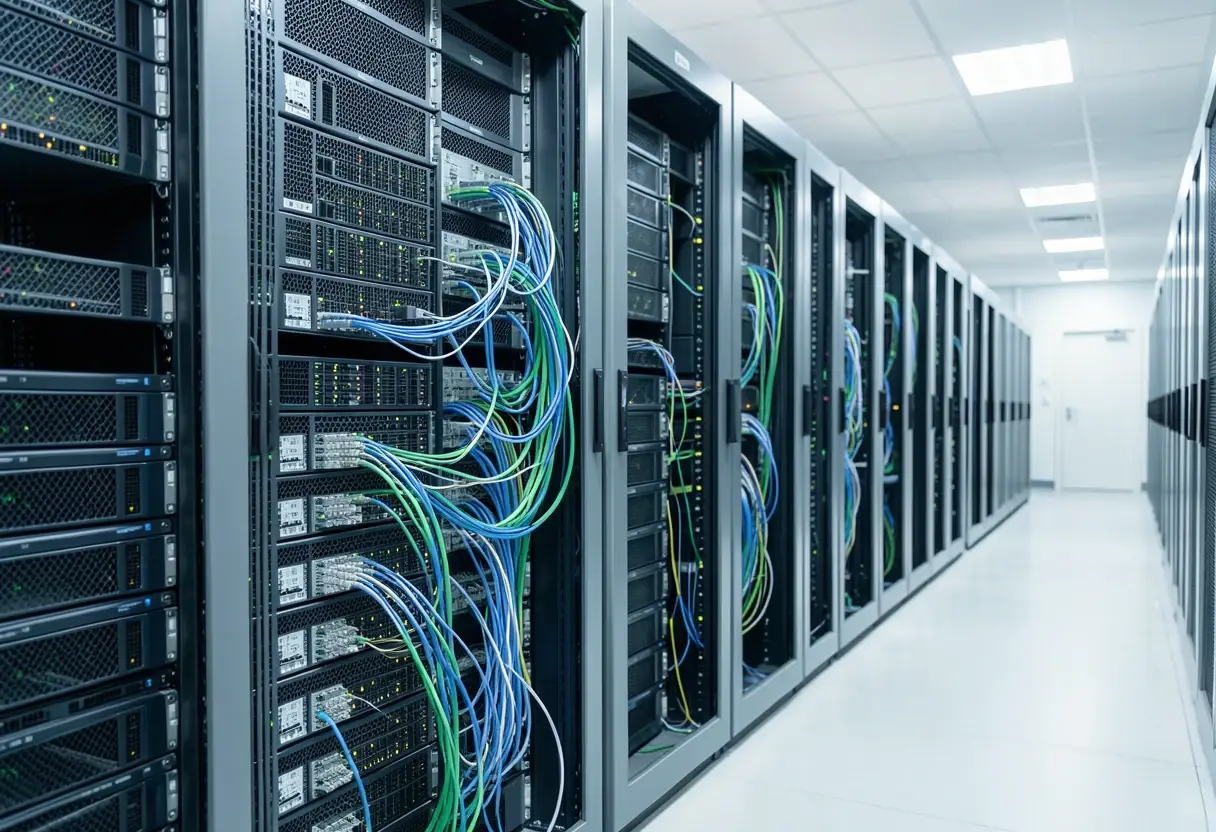
Building AI infrastructure requires more than fast processors. Connecting tens of thousands of processing units into one supercomputer demands ultra-low latency and high throughput, which made proprietary fabrics the preferred answer for years.
Cloud service providers now increasingly favor standards-based Ethernet because it lets them mix components and avoid dependence on one vendor ecosystem. Open Ethernet has the appeal of a standard, although standards also make competing systems easier to compare.
Arista supports that approach with its Extensible Operating System, or EOS, which gives cloud operators programmable control over data flow. The software can speed deployment and reduce power consumption in high-density facilities while separating network intelligence from switching hardware, allowing complex AI workloads to scale without sacrificing stability.
How large is the AI fabric opportunity?
Management expects “AI fabric revenue to double to about $7 billion by 2027,” the company said. Etherlink has passed 100 active customers. Over the next few years, Arista forecasts more than 10 gigawatts of deployment across multiple accelerator types.
On the earnings call, management said Microsoft and Meta “continue to account for more than 10% of revenue each.” Leadership also sees room for one or two more hyperscale customers at that same revenue concentration.
Multi-year purchase commitments and deep hyperscale integration offer revenue visibility rarely seen in enterprise technology. The same concentration carries a warning label, because additional large customers would deepen dependence on buyers whose capital spending can move faster than product roadmaps.
Can campus sales offset hyperscaler risk?
The enterprise campus business offers a partial counterweight. Arista expects its cognitive campus segment to grow about 60%, driven by demand for secure, automated, zero-trust infrastructure, and to approach $2 billion in revenue by 2027.
Campus growth would reduce reliance on hyperscale orders, although it cannot erase it. The two engines serve different buyers and sales cycles, which makes the revenue mix steadier, not immune.
What do the supply commitments mean?
Inventory has risen to $3.2 billion and forward purchase commitments have expanded to $11.4 billion. The commitments are more than three times inventory, placing substantial component demand on suppliers before customers take delivery.
In a tight market, that strategy can secure parts for multi-year buildouts and protect customer schedules. It also creates risk if hyperscaler spending slows: reserved capacity and components remain committed while the order book cools. Supply assurance has a balance-sheet price.
Management cited strong operating cash flow and is executing a $1.5 billion share-repurchase authorization, with roughly $817 million still available. The buyback signals confidence in cash generation and supports the equity, but it does not soften procurement exposure.
Can margins absorb the hardware mix?
Arista expects a heavier hardware mix to pull gross margins down to 62% to 64% in 2027. Management still projects operating margins near 49%, relying on operating-expense discipline to absorb lower hardware margins while revenue expands.
The forecast implies that hardware will grow faster than higher-margin software. Investors must decide whether scale and expense control can preserve operating profit while Ethernet systems become the physical core of AI clusters.
Is the premium valuation justified?
MarketBeat’s quoted snapshot put Arista at $170.70, with a 7.2% price change, a 45.89 price-to-earnings ratio and no dividend. Its 52-week range ran from $114.52 to $217.41, although the accompanying analysis rounded the trailing P/E to about 43.
The data service also listed:
- A Buy consensus and $240.24 price target, implying 40.7% upside.
- A 4.5693-of-5 MarketRank score and an overall 91st-percentile ranking.
- “Healthy” short interest, 0.76 news sentiment and 25.19% projected earnings growth.
- Insider activity classified as selling shares.
The premium leaves little room for a stumble. If hyperscalers reduce capital spending, a company carrying roughly 43 times trailing earnings and $11.4 billion of purchase commitments could face both weaker revenue and a sharper valuation adjustment.
Arista joined the S&P 100 in late 2026. MarketBeat argued that index inclusion could require passive institutional accumulation and provide steadier trading volume, though the article gave no flow estimate. The inclusion is confirmed; the expected buying is not.
The underlying analysis urged investors to consider Arista for a watchlist because networking suppliers sit physically inside continuing AI data-center expansion. It also carried a pointed retail aside: Arista was not among five stocks that top-rated analysts favored before December 1, although it retained a Buy rating.
A separate promoted report covered seven blue-chip companies across technology, retail, consumer staples, healthcare, networking, sporting goods and utilities. In the comparison table, Microsoft was $530.61, with a 1.0% decline, 27.69 P/E, 0.69% yield, Moderate Buy rating and $609.54 target. Microsoft’s MarketRank score was 4.7958.
Meta was $610.15, up 0.8%, with a 20.80 P/E, 0.34% yield, Moderate Buy rating and $833.12 target. Its MarketRank score was 4.9687.
The test through 2027 is operational. Arista must convert more than 10 gigawatts of forecast deployments into Etherlink orders, deliver the $7 billion AI-fabric target and grow campus revenue toward $2 billion without turning $11.4 billion in purchase commitments into excess capacity. Ethernet has momentum. Capacity, margins and customer spending will decide whether the valuation has room.
Source: marketbeat.com
More from Nathan Brooks
Show full bio
Senior reporter covering people, launches and day-to-day practice in Semiconductors, chip manufacturing, hardware, AI compute at Chip Dispatch.
738 articles
Related articles
arista-reports-3-66-billion-quarter-targets-10-gw-of-ai-networking
Arista Reports $3.66 Billion Quarter, Targets 10 GW of AI Networking
arista-drops-2-7-as-ethernet-challenges-nvidia-s-rack-architecture-972f4a4d
Arista Drops 2.7% as Ethernet Challenges Nvidia's Rack Architecture
memory-capacity-ceiling-slows-ai-spending-forecasts-gartner-data-shows-fae40af6
Memory Capacity Ceiling Slows AI Spending Forecasts, Gartner Data Shows
bain-ai-must-find-6-trillion-a-year-to-pay-for-datacentres-581649a4
Bain: AI Must Find $6 Trillion a Year by 2031 to Pay for Datacentres