BOS Semiconductors Joins Arm's 80-Firm Physical AI Program
BOS Semiconductors has joined Arm's 'Total Design for Physical AI' program, one of more than 80 firms in an ecosystem unveiled September 8 in Shanghai that spans AI models, sensors, compute hardware and digital twins.
- By
- Sophie Lindqvist
- Filed
- Channel
- Semiconductors
- Read
- 3 min read
BOS Semiconductors has joined Arm's "Total Design for Physical AI" program, becoming one of more than 80 companies in an ecosystem Arm unveiled September 8 at its Everywhere China event in Shanghai.
The Korean fabless chip designer, which develops AI processors for vehicles and robots, confirmed the move September 29, 2026. Arm designed the initiative to cut fragmentation in the physical AI stack by linking AI model developers, software vendors, sensor makers, computing hardware suppliers, virtual-platform providers and digital-twin specialists under one partner banner.
What does the partnership deliver?
Arm's program gives members access to validated building blocks, virtual platforms and integration support. For fabless designers, that shared infrastructure compresses the path from specification to working silicon.
BOS plans to use its membership to expand beyond automotive AI into robotics, drones and industrial autonomous systems. The company already runs an ASIC line; the Arm ecosystem extends its reach into system-level partners it would otherwise negotiate with one at a time.
Why is physical AI the focus?
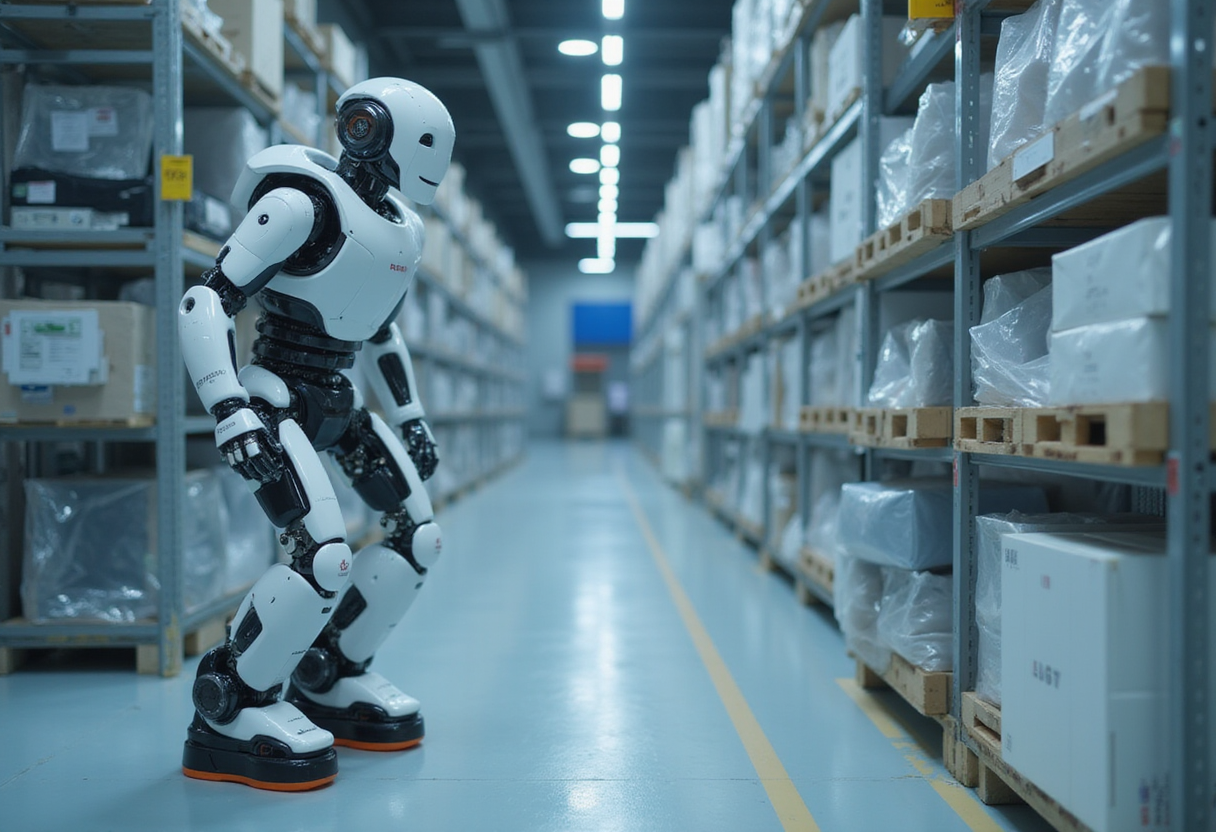
Physical AI refers to machine-learning systems embedded in machines that sense, decide and act in the real world — distinct from cloud-resident generative models. Workloads are heterogeneous: low-latency inference for vehicle path planning, real-time perception for drones, closed-loop control for industrial arms. That diversity rewards custom silicon over off-the-shelf GPUs.
Chae Jeong-Seok, vice president of BOS's Strategic Marketing Office, framed the strategy in those terms: "BOS Semiconductors is expanding its AI semiconductor business from automobiles into various physical AI fields, including robotics, drones and industrial autonomous systems. As physical AI expands into more applications and requirements become more diverse across different fields, the importance of SoCs and application-specific integrated circuits (ASICs) optimized for customers' systems will continue to grow."
How does the ecosystem actually work?
Arm's Total Design for Physical AI crosses the full compute stack. Members interact across:
- AI model and software frameworks for training and inference
- Sensor and edge-compute silicon
- Virtual platforms and digital twins for pre-silicon validation
- System integration and certification support
Neither Arm nor BOS has disclosed the financial terms of membership. BOS has also not confirmed which process node, foundry partner or production volume it intends to use for new designs built through the program. Arm has separately said the ecosystem numbers more than 80 firms and is intended to accelerate physical AI development and adoption.
Where does BOS sit competitively?
BOS is one of a small group of Korean fabless designers targeting custom AI silicon for automotive and industrial customers. Bear Robotics, also Korean, joined the same Arm ecosystem, according to the partner list Arm circulated at the Shanghai event.
The broader commercial question is whether a Korean fabless player can win ASIC slots against larger custom-silicon competitors among Arm's U.S., Taiwanese and mainland Chinese partners. Arm's ecosystem model rewards breadth rather than exclusivity; BOS differentiates through customer-specific tailoring rather than volume silicon.
What becomes visible next?
The first measurable signal will be product announcements from BOS that name specific robotics, drone or industrial partners and disclose foundry, node and tape-out timing — the concrete steps that convert ecosystem membership into shipped silicon through 2027.
Original: mk.co.kr
More from Sophie Lindqvist
Related articles
doosan-robotics-bets-on-homegrown-ai-chips-for-korean-physical-ai-72868f26
Doosan Robotics Bets on Homegrown AI Chips for 'Korean Physical AI'
verifaix-banks-5-million-to-build-ai-driven-chip-verification-platform-8b53367d
VerifAIX Banks $5 Million to Build AI-Driven Chip Verification Platform
synopsys-and-tsmc-team-on-agentic-ai-for-advanced-chip-design-d3fc5aff
Synopsys and TSMC Team on Agentic AI for Advanced Chip Design
sima-ai-banks-150-million-to-scale-physical-ai-chips-c5a094d3
SiMa.ai Banks $150 Million to Scale Physical AI Chips