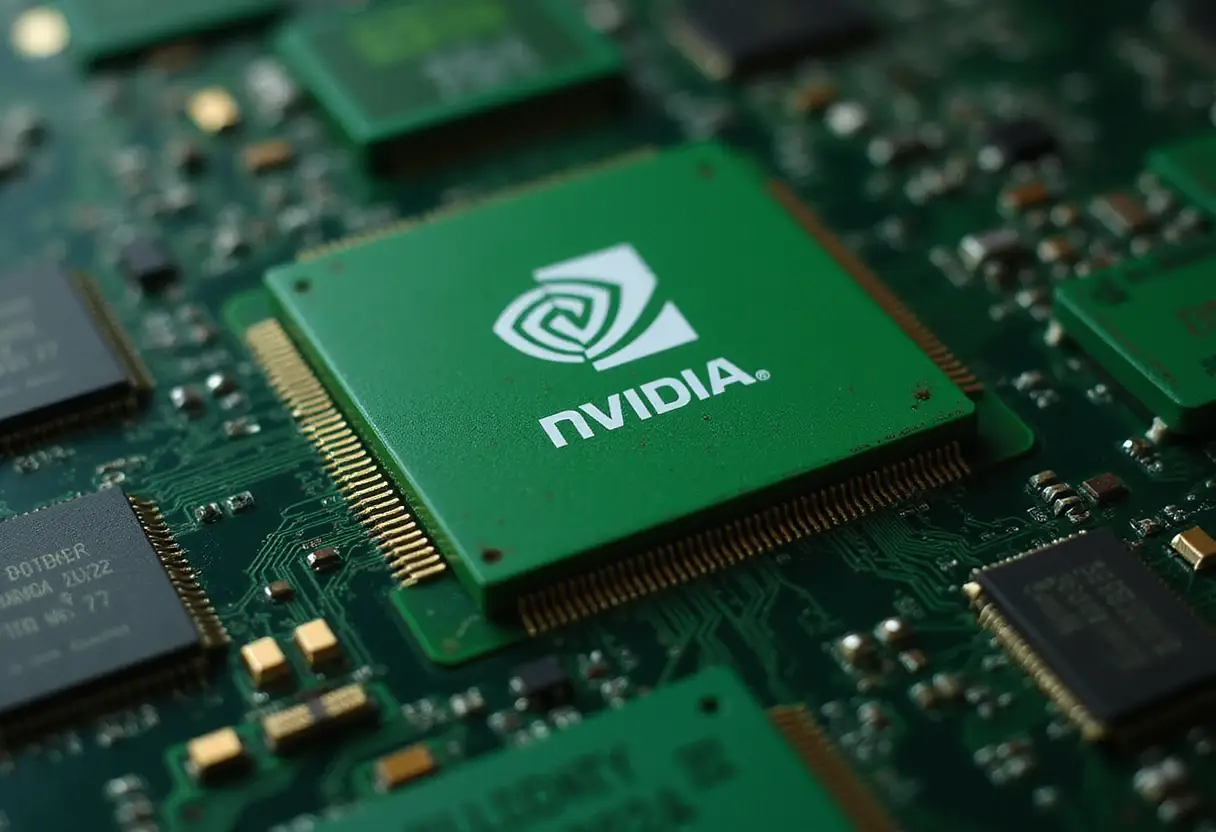
China’s $5,000-and-Up RTX 5090 Cards Become Unofficial AI Hardware
Chinese firms and workshops are dismantling $1,999 GeForce RTX 5090 cards for their 32GB of GDDR7, paying $5,000 or more as AI hardware shortages thin retail GPU supply and fuel scam risks.
- By
- Rebecca Stone
- Filed
- Channel
- AI & Compute
- Read
- 3 min read
By Rebecca Stone
At $5,000 and up, a GeForce RTX 5090 costs more than twice its $1,999 recommended retail price as Chinese technology companies and specialist workshops strip its 32GB of GDDR7 memory for AI servers.
The report describes a trade that has moved beyond hobbyist tinkering. Buyers are taking boards in bulk, specialists manually remove the graphics chips and high-speed GDDR7 packages, and the recovered components go onto purpose-built server boards for tight installation in modern data-center racks.
Why does a gaming card matter to AI?
The attraction is memory speed and capacity, not gaming performance. Each RTX 5090 supplies 32GB of GDDR7, a scarce resource for deploying and training local language models; the report says insufficient VRAM limits computing capabilities.
The $5,000-and-up figure is a reported purchase price, not Nvidia’s list price or a verified transaction average. Buyers were snapping up boards solely for their fast-memory arrays, even though the $1,999 recommendation had disappeared from the market.
No unit totals, shipment forecasts, conversion yields or revenue estimates accompanied the account. Nor did it identify a named Chinese buyer, specialist workshop or commercial supplier.
How are consumer boards turned into AI accelerators?
Specialists physically remove both the graphics chips and GDDR7 memory chips from consumer printed circuit boards. They solder the extracted silicon onto specialized server boards designed for tight installation in modern data-center racks, creating a locally assembled AI accelerator.
That process has gained momentum because official shipments of specialized accelerators face strict trade restrictions while the local Chinese market has a severe shortage of specialized computing equipment. The memory on the cards therefore serves a practical purpose beyond graphics.
Official restrictions are not the same as a complete halt to hardware access. The report says Chinese buyers are still obtaining cards and converting them even under tighter controls, turning consumer inventory into an industrial workaround for AI demand.
Why are gamers seeing empty graphics-card shelves?
Large-scale dismantling has provoked a strong response from gamers and regular users, who face what the report describes as a near-total absence of graphics cards on consumer shelves.
Secondary marketplaces have begun filling with empty PCBs stripped of processors and memory modules. Those bare boards attract unscrupulous sellers and scammers, adding fraud risk to a shortage already visible at the retail counter.
Community criticism has focused on Nvidia’s allocation strategy. Gamer accusations amount to the claim that the company is “redirecting silicon wafers toward the needs of the enterprise AI segment,” the report said, though it supplied no fab investment, wafer volume, production allocation or Nvidia statement.
That distinction matters. The account documents a market response, not a disclosed Nvidia decision to move wafers from gaming to enterprise AI, and it gives no shipment number from which to calculate how many cards have been cannibalized.
Will trade restrictions stop the flow?
No, according to the experts cited by the report: strict regulatory bans “are not stopping imports, but rather stimulating the creation of industrial chains for the artisanal modification of mass-market consumer electronics.”
The commercial effect is a two-sided squeeze. AI developers gain access to 32GB GDDR7 modules through a channel the report says remains constrained by official accelerator supply, while gaming buyers face scarce inventory and prices at $5,000 and up.
Conversion also brings risk. Manual chip removal and board assembly create an aftermarket populated by stripped PCBs, and the report documents no Nvidia support, certified configuration, reliability data or supplier list for these systems.
What could happen next?
The source offers no capacity forecast for the dismantling industry, so the scale of future conversions remains uncertain. Yet the present pricing signal is clear: a card with a $1,999 recommended price is being bought at more than 2.5 times that amount for its 32GB of memory.
Unless official AI-accelerator shipments or retail graphics-card supply ease, the $5,000-and-up pull is likely to keep feeding the conversion trade, sustaining thin consumer shelves and the secondary-market flow of stripped boards.
Source: Google News: AI chips
More from Rebecca Stone
Show full bio
Correspondent covering technology and product news in Semiconductors, chip manufacturing, hardware, AI compute at Chip Dispatch.
728 articles
Related articles
chinese-workshops-dismantle-rtx-5090s-by-the-thousand-for-ai-servers
Chinese Workshops Dismantle RTX 5090s by the Thousand for AI Servers
nvidia-may-kill-off-rtx-5090-as-ai-chips-take-priority-4f13174a
Nvidia May Kill Off RTX 5090 as AI Chips Take Priority
chinese-firms-bought-over-1-million-nvidia-gaming-chips-this-year-44c1d4a9
Chinese Firms Bought Over 1 Million Nvidia Gaming Chips This Year
chinese-firms-bought-1-million-nvidia-gaming-chips-report-says-bf452bcf
Chinese Firms Bought 1 Million Nvidia Gaming Chips, Report Says