Four Priced AI Systems, One Unverified List: The Real US Hardware Record
A viral Top 10 AI hardware list ships with no methodology. Verified listings: four priced systems from $5,499 to $8,499, plus HPE racks with 72 Blackwell GPUs.
- By
- Rebecca Stone
- Filed
- Channel
- AI & Compute
- Read
- 4 min read
The verified US AI hardware market spans a $5,499 developer kit and an $8,499 desktop supercomputer, with rack systems holding 72 GPUs — but a viral "Top 10 AI Hardware Manufacturers in the USA 2026" list ships with no methodology, no revenue cutoff and no shipment data behind any of its ten slots.
That gap between a catchy ranking and shippable hardware is where buyers should start. The list, carried by outlets including Nubia Magazine, names NVIDIA, AMD, Intel, Google, AWS, Microsoft, SambaNova Systems, Groq and Graphcore, plus one more. What we can actually check is narrower: five companies — NVIDIA, Microsoft, HPE, ASUS and MSI — publish official product pages with real prices or configurations. The rest have no verified figures anywhere in the material.
NVIDIA CEO Jensen Huang framed the stakes at a Milken Institute event: "Most people think that NVIDIA is a GPU company because we invented the GPU. But if you look at the systems we're creating today, there are seven different types of chips." He added in the same transcript: "AI is not just an application. AI actually reinvented the computer industry."
What the verified listings show?
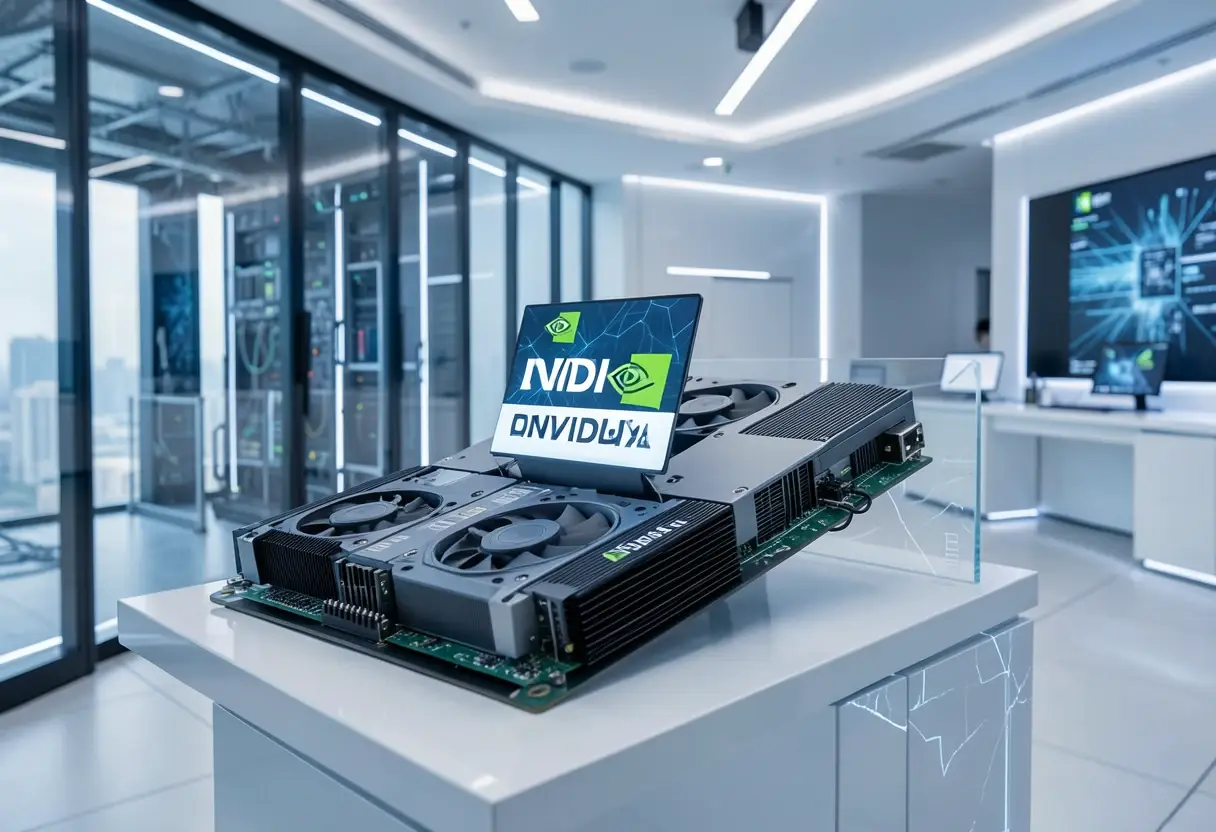
NVIDIA appears twice, both at the small end. The DGX Spark lists at $6,950.00, built on the GB10 Grace Blackwell superchip, 1 PFLOPS of FP4 compute, 128GB of coherent unified memory, 4TB of self-encrypting NVMe M.2 storage and a ConnectX-7 Smart NIC. The Jetson Thor Developer Kit lists at $5,499.00, with 2070 TFLOPS of sparse FP4, a 2560-core Blackwell GPU and a 40W–130W envelope that points squarely at robotics and embedded work.
Microsoft's entry is the surprise. The Surface RTX Spark N1X lists at $5,999.99 with a 6144-core GPU, 20-core CPU, 128GB of unified memory and a 2TB SSD — same memory as the DGX Spark, $950.01 cheaper.
MSI's EdgeXpert-13SUS lists at $8,499.00. That's $1,549, roughly 22 percent, above the DGX Spark for near-identical headline specs: GB10 Grace Blackwell, Arm 20-core CPU, 128GB LPDDR5x, 4TB Gen5 NVMe. The listing doesn't explain the premium. ASUS's Ascent GX10 (64GB) claims support for models up to 100 billion parameters, but carries no verified price.
HPE offers the widest range. ProLiant for AI configurations include 8x NVIDIA B200, 8x B300 and 8x AMD MI355X options, alongside the Compute XD685, XD690 and XD700. Its rack-scale family spans six systems, including the NVIDIA GB200 NVL72 by HPE — 72 Blackwell GPUs and 36 Grace CPUs linked by NVLink — plus the GB300 NVL72, Vera Rubin NVL72 and the AMD Helios AI Rack. No public prices. Quotes remain the norm.
What does the price math say?
Divide by memory and compute, with caveats attached:
- Microsoft Surface RTX Spark N1X: $5,999.99; $46.87 per GB of unified memory; no FP4 figure listed
- NVIDIA DGX Spark: $6,950.00; $54.30 per GB; $6.95 per FP4 TFLOP
- MSI EdgeXrepert-13SUS: $8,499.00; $66.40 per GB; no per-teraflop comparison possible
- NVIDIA Jetson Thor: $5,499.00; $2.66 per sparse FP4 TFLOP — a figure that assumes workloads can skip zeros and shouldn't sit beside dense claims
Why can't the ranking be confirmed?
Three gaps sink it. No methodology. No official prices, specs or on-record quotes for AMD, Intel, Google, AWS, SambaNova, Groq or Graphcore within the ranking. And nothing establishing these firms as the "best" US manufacturers by any measurable standard. The definition wobbles too: Graphcore is generally described as UK-based, while AWS and Google are service providers as much as hardware makers. MSI and ASUS are Taiwan-based firms selling into the US market.
AMD shows up only indirectly — inside HPE's MI355X nodes and the Helios rack, confirming its silicon ships through a major US server maker's catalog. AMD CEO Lisa Su, in a Stanford GSB conversation, stressed the breadth: "Our goal in life is to make sure that we have the right computing for the right application."
The tiers split cleanly: desktop AI (NVIDIA, Microsoft, MSI, ASUS) with public prices on three of four; edge and robotics (NVIDIA) with a public price; server and rack (HPE with NVIDIA and AMD silicon) with none. Two patterns hold — NVIDIA silicon appears in nearly every row, and pricing transparency collapses as systems grow, which means any ranking built on public prices will favor small-box vendors by construction.
Expect the 22 percent GB10 price gap to narrow as buyers compare listings side by side, and expect rack-scale pricing to stay quote-only for the NVL72 and Helios class.
Source: Google News: AI chips
More from Rebecca Stone
Show full bio
Correspondent covering technology and product news in Semiconductors, chip manufacturing, hardware, AI compute at Chip Dispatch.
742 articles
Related articles
chinese-firms-bought-1-million-nvidia-gpus-in-a-year-ft-reports-37878097
Chinese Firms Bought 1 Million Nvidia GPUs in a Year, FT Reports
amazon-seeks-investors-to-take-8-billion-of-nvidia-chips-off-its-books-18459bf5
Amazon Seeks Investors to Take $8 Billion of Nvidia Chips Off Its Books
chinese-giants-reportedly-commit-35-billion-to-nvidia-rtx-pro-5500-d88231d2
Chinese Giants Reportedly Commit $35 Billion to Nvidia RTX PRO 5500
bytedance-alibaba-and-tencent-order-35-billion-of-nvidia-chips-ac7455ea
ByteDance, Alibaba and Tencent Order $35 Billion of Nvidia Chips