Genesis AI Raises $500M Series A at $3.5B Valuation for Factory Robots
Genesis AI raised $500M at a $3.5B valuation, with Nvidia, AMD Ventures and Samsung Next backing its Eno robot for factories, warehouses and labs.
- By
- Tom Whitfield
- Filed
- Channel
- Startups & Funding
- Read
- 4 min read
Genesis AI has raised $500 million in Series A funding at a $3.5 billion valuation to build robots for factories and warehouses. The round, announced Tuesday, brings the startup's disclosed funding to $605 million since its 2024 inception. It previously raised $105 million in a round announced in July 2025.
Premji Invest, Khosla Ventures and Eclipse co-led the financing. The participant list is unusually broad for a Series A, spanning public-market investors and strategic backers with a direct interest in computing hardware: T. Rowe Price Associates, Durable Capital Partners, Bpifrance, HSG, Nvidia, AMD Ventures, Zoom, Samsung Next and Ericsson all took part. Individual backers include Eric Schmidt, Eric Yuan, Jerry Yang, Xavier Niel and Zach Kirkhorn.
The presence of Nvidia, AMD Ventures and Samsung Next signals that chipmakers and their adjacent investors see robotics as a demand driver for AI compute. The strategic logic is straightforward: robots that train in simulation and learn from motion data consume processing capacity at every stage.
How does the technology work?
Genesis develops both robots and the AI software that controls them. Its approach combines recordings of human hand movements with training in simulated environments, where robots practice skills before attempting them in the physical world.
The method grew out of a problem CEO Zhou Xian hit during his robotics research: there is not enough data showing how robots should move and handle objects. Language models train on vast amounts of text. Robots need a different kind of data, covering touch, grip and the consequences of physical actions.
Genesis uses cameras and gloves to capture people's hand and finger movements as they work, along with touch information. The company says its robotic hand closely matches the human hand and the recording glove, which makes it easier for robots to learn those movements. Historically, collecting such data meant hiring people to control robots remotely, Xian said. Genesis instead collects it from people doing their regular jobs.
Those recordings train the company's AI model, called GENE. A separate simulation package, Genesis World, trains and tests robot skills in virtual environments, a process the company claims is faster than using physical machines alone. The takeaway: Genesis is betting that better data pipelines, not just bigger models, decide who wins in physical AI.
What is the product and the business model?
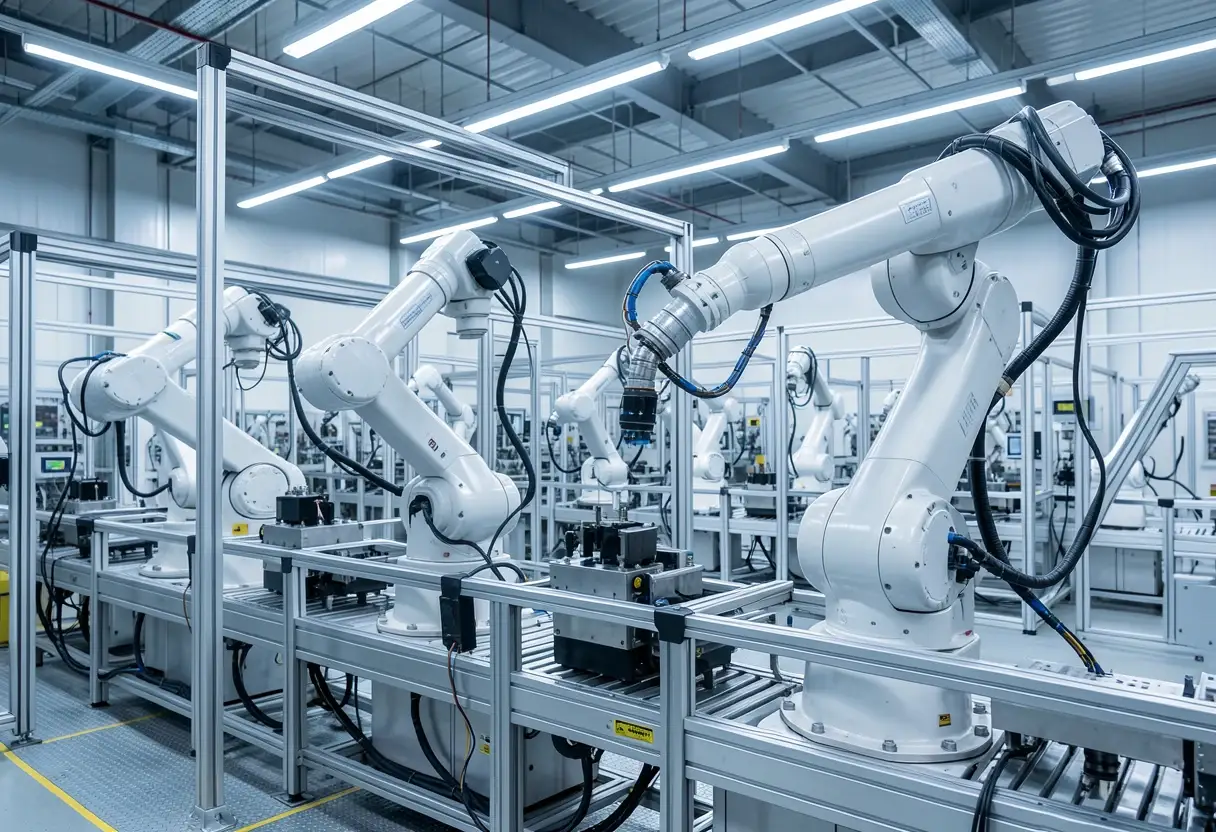
The company's first robot, Eno, targets manufacturing, logistics and laboratories. Genesis is ramping up Eno production for industrial customers, and it plans to expand later into hospitality and healthcare, then consumer and outdoor uses.
Rather than selling robots outright, Genesis is exploring a rental model in which customers pay for the robot and its software as a combined service. It has announced a partnership with LG CNS and counts other Fortune 500 companies in its prospective pipeline, according to Xian. He declined to disclose revenue and did not provide a paying customer count.
"We just want to bring something more elegant, more timeless," Xian told Crunchbase News. "In the end, this is a very full-stack company. … We have to build all different pieces across the entire stack to make sure we can tightly integrate our technology stack together, and hopefully build the most well-polished and reliable product."
The company plans to spend the new capital on computing infrastructure, higher robot production and hiring. It currently employs close to 100 people and is headquartered in Paris, with offices in San Carlos, California.
Where did the company come from?
Genesis traces its origins to a research collaboration Xian started in 2022 while pursuing a robotics Ph.D. at Carnegie Mellon University. The project brought together researchers from more than a dozen universities to build robotics simulation tools.
After graduating at the end of 2024, Xian teamed up with co-founder Theophile Gervet and formed the company. Genesis launched formally in March 2025 and moved beyond simulation into AI software and robot hardware. Xian argues the components must be built together to work reliably: "That requires the intelligence, hardware and everything that goes into training and testing the robots to work as one system," he said.
What does the funding say about the market?
The round lands in a hot market. Global venture funding to robotics startups totaled $9.9 billion in Q3 2026, more than double the $4.3 billion invested in Q3 2025, according to Crunchbase data. Most of that investment went to companies based in China and the U.S., and the closely related field of physical AI has also drawn a surge of venture money this year.
Premji Invest partner Vedant Agrawal said in a release that his firm was drawn to demonstrations of robots completing extended tasks independently. "Completing full tasks in real time, not just short clips, is what turns a robot into something a business can rely on," he said.
That standard — sustained, reliable task completion — is now the test investors will apply as Genesis converts a $3.5 billion valuation into paying industrial customers.
Source: news.crunchbase.com
More from Tom Whitfield
Show full bio
Staff writer covering companies, deals and strategy in Semiconductors, chip manufacturing, hardware, AI compute at Chip Dispatch.
1,018 articles
Related articles
agentic-ai-startup-mirendil-raises-1b-series-a-to-top-weekly-funding
Agentic AI Startup Mirendil Raises $1B Series A to Top Weekly Funding
amd-buys-world-labs-for-8-2bn-to-anchor-its-physical-ai-push-37b3512c
AMD Buys World Labs for $8.2bn to Anchor Its Physical AI Push
bigendian-secures-6-million-to-build-ai-socs-320f879e
BigEndian Secures $6 Million to Build AI SoCs
nvidia-and-unity-join-emulate-s-700m-round-at-3-7b-valuation
Nvidia and Unity Join Emulate's $700M Round at $3.7B Valuation