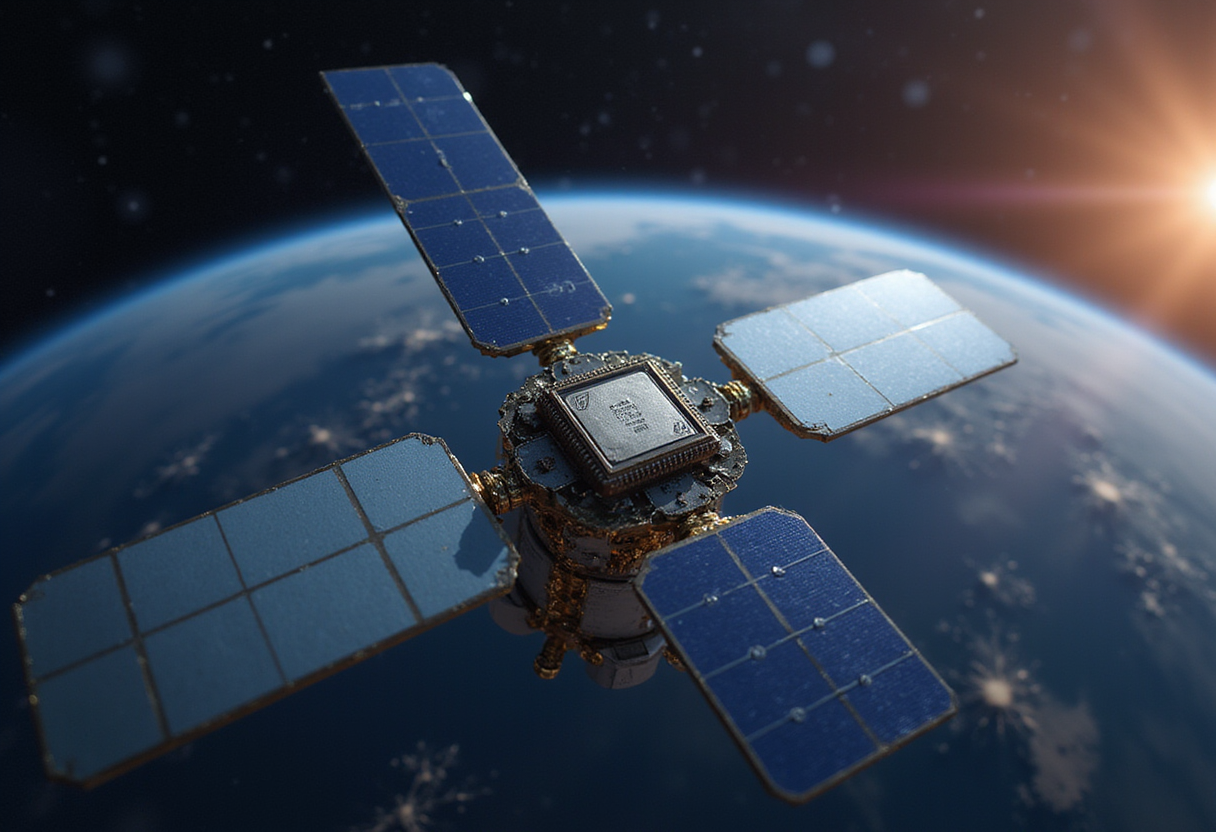
Google Puts Four AI Chips Into Orbit on Single Satellite
Google has launched a satellite carrying four AI chips into orbit, testing whether commercial AI silicon can survive and process data in the space environment.
- By
- Grace Kim
- Filed
- Channel
- AI & Compute
- Read
- 2 min read
Google has launched a satellite carrying four AI chips into orbit, according to a report from The National picked up by UA.NEWS — a concrete, if small, first step toward running AI inference in space rather than beaming raw data to ground-based data centers.
The confirmed fact is narrow: four AI chips, one satellite, one launch. The source report does not specify the chip family, the process node, the satellite's orbital parameters, the launch provider, or the mission's duration. Everything beyond the chip count itself remains outside what the report establishes.
Why put AI chips on a satellite?
The commercial logic behind orbital AI compute is straightforward. Earth-observation satellites generate far more imagery than their downlinks can transmit. Processing that data on board — filtering clouds, detecting objects, compressing only what matters — lets an operator return conclusions instead of raw pixels, multiplying the effective value of scarce bandwidth.
For Google specifically, in-orbit silicon also serves as a durability test. Radiation degrades semiconductor devices, and conventional data-center chips are not hardened for the space environment. Flying commercial AI accelerators, even in small numbers, generates data on how long unmodified or lightly modified silicon survives and how performance degrades over time.
What remains unconfirmed
Readers should treat this as an early, thinly detailed development rather than a product announcement. The report does not state:
- Which AI chip Google flew (TPU family or other silicon)
- Which satellite bus or launch vehicle carried the payload
- The intended workload or mission timeline
- Any performance, power, or revenue figures
Any claims on those points would be speculation beyond the source.
The competitive context
Google is not alone in testing orbital compute. Space-tech ventures and defense primes have been racing to add edge AI capability to satellites, betting that on-board inference becomes a standard requirement for imaging constellations, telecommunications, and national-security missions. Chip vendors capable of qualifying parts for radiation tolerance stand to gain a new, if initially small, market segment beyond terrestrial data centers.
The launch signals where this market is heading: if orbital AI proves reliable, satellite operators will demand more capable processors per spacecraft, and the volume of radiation-tolerant AI silicon could grow from experimental payloads into constellation-scale procurement. How quickly that happens depends on results Google and its peers have not yet published.
Source: Google News: AI chips
More from Grace Kim
Show full bio
Market editor covering industry trends and analytics at Chip Dispatch.
262 articles
Related articles
google-launches-satellite-carrying-ai-chips-to-test-them-in-space-657af2e3
Google Launches Satellite Carrying AI Chips to Test Them in Space
google-sends-four-ai-chips-into-orbit-to-test-them-139ddc95
Google Sends Four AI Chips Into Orbit to Test Them
google-puts-its-ai-chips-in-orbit-validation-is-next-0ac6813e
Google Puts Its AI Chips in Orbit — Validation Is Next
google-orbits-ai-chips-on-satellite-to-test-them-in-space-ce56da24
Google Orbits AI Chips on Satellite to Test Them in Space