Korean Voice-AI Startup Voinosis Wins Seoul Pitch for TechCrunch Battlefield Slot
Voinosis won DETO 2026 in Seoul with a voice-based brain health AI claiming 88% screening accuracy, earning a shot at TechCrunch's Startup Battlefield 200.
- By
- Grace Kim
- Filed
- Channel
- Startups & Funding
- Read
- 3 min read
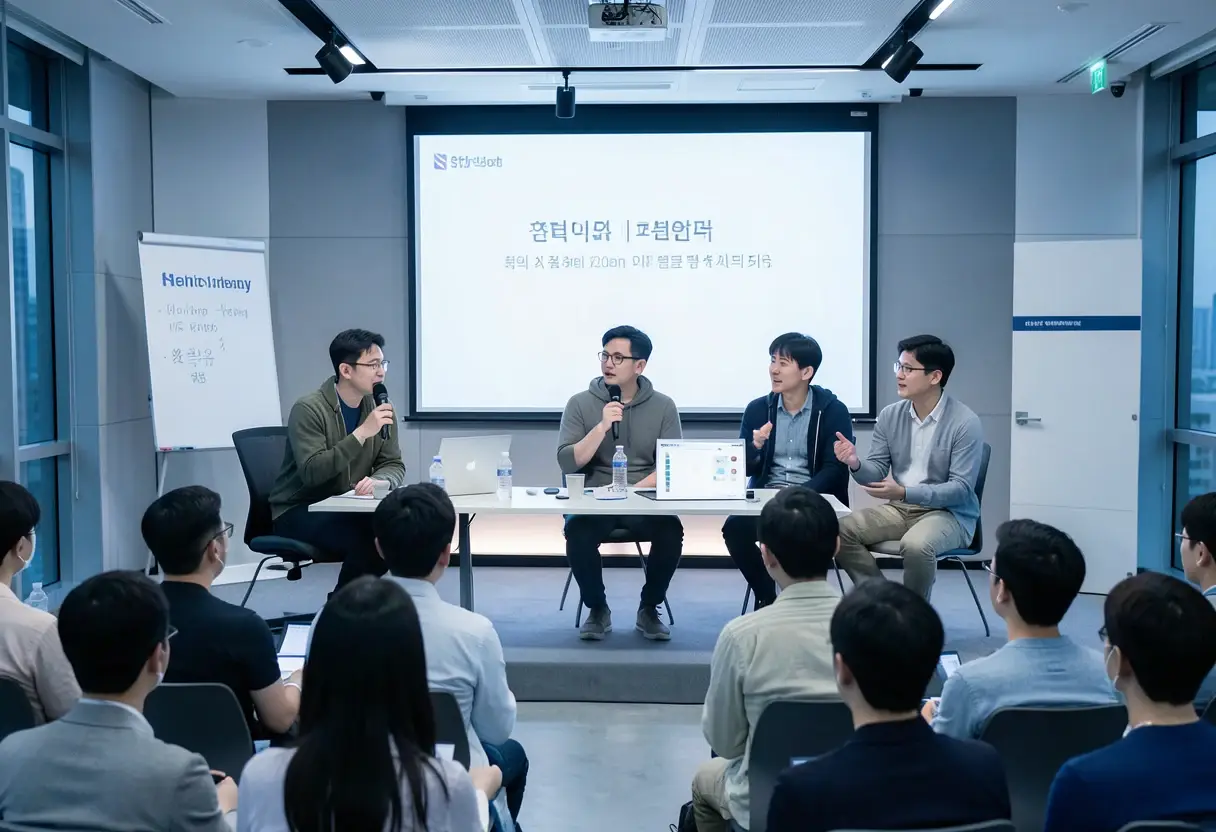
Nine early-stage South Korean startups pitched this week at DETO 2026, a technology conference in Seoul, for a place in TechCrunch's Startup Battlefield 200 at next year's Disrupt conference. Voinosis, a healthcare AI company that screens brain health through voice analysis, won the competition.
The Battlefield 200 draws hundreds of applicants worldwide each year, all seeking a pitch slot in front of venture capitalists and the international tech community at Disrupt. The nine Seoul contestants span deep tech: healthcare, fintech, energy, semiconductors and AI. Every one of them plans a U.S. market entry as part of broader international expansion.
What did the winner pitch?
Voinosis develops an AI tool that analyzes speech patterns — pitch, pauses, rhythm and response times — to detect changes linked to brain health. Each voice check takes less than five minutes.
The company says it has tested the technology in Greek, Japanese and English, and the product requires no separate training per language. In a clinical study of 146 participants, the startup claims 88% accuracy in screening for potential cognitive issues.
Voinosis targets hospitals, senior living facilities, insurers and individual consumers. It plans to link voice checks with cognitive training, assessments and treatment delivered by healthcare professionals. Founder Grace Shin spent more than 25 years as an otologic surgeon. The startup is raising a Series A round and has already secured a South Korean pharmaceutical company as a strategic investor.
Who else pitched in Seoul?
The remaining eight startups, listed alphabetically, cover a wide technical spread.
- Awesome Lab — Seoul-based maker of ThermoFlux, a heating system that uses water electrolysis and ionization to generate heat for buildings, water supply and industrial processes. The company claims lower energy consumption and carbon emissions. For the U.S. market, it plans to supply core OEM modules and develop products jointly with boiler, water heater and HVAC companies.
- Crosshub — Developer of IDBlock, a platform combining identity verification and payment services using Self-Sovereign Identity (SSI) and zero-knowledge proof. The platform lets travelers prove identity across borders without sharing unnecessary personal data, and Crosshub is integrating it with payment systems to improve access to financial services abroad.
- DeepFusion AI — Builder of a 4D radar-based imaging system with additional sensors for autonomous mobility, robotaxi, maritime surveillance and defense. The system combines RF sensors with radar and lidar to detect objects, movement or distance without a direct line of sight, packed into a single customizable unit.
- EFLOW — Developer of special motors that produce more torque in less space, for robots, drones, satellites and other mobility applications. The startup also builds actuators that control robotic joint movement.
- Otiton Medical — Maker of two medical devices: one measures body temperature; the other captures ear canal images and analyzes the eardrum. The company says its AI was trained on roughly 55,000 eardrum images, and the device holds South Korean medical certification.
- Riibotics — Warehouse robotics startup that says it can deploy robots within a day by streamlining setup: infrastructure, warehouse mapping, system integration through custom middleware, task programming and safety checks.
- Ternell — A Ulsan-based semiconductor startup founded in 2019 by KyungRok Kim, a former Samsung Electronics engineer. Ternell is developing T-SRAM, a memory type that adds a third state to the conventional two states for more efficient data storage in AI chips. The company reports tests with 28-nanometer chips showed a 33% to 102% increase in memory capacity per area and a 55% to 71% reduction in energy needed to access data, compared with conventional SRAM.
- Testbank — Edtech startup building Solve, an app that converts printed study materials such as workbooks and test-prep books into interactive digital versions. Its AI identifies question and answer spaces in publishers' PDF files while preserving the original layout, letting users write answers on the page and receive automatic grading.
What comes next?
Voinosis now carries the Seoul endorsement into next year's Startup Battlefield 200 selection. The other eight will pursue their own U.S. market entries, from Awesome Lab's OEM module strategy to Ternell's push to cut AI chip power draw with three-state SRAM.
Source: techcrunch.com
More from Grace Kim
Show full bio
Market editor covering people, launches and day-to-day practice in Semiconductors, chip manufacturing, hardware, AI compute at Chip Dispatch.
916 articles
Related articles
seoul-national-university-opens-ai-semiconductor-research-center-a560392a
Seoul National University Opens AI Semiconductor Research Center
seven-firms-pledge-2-billion-for-korea-chip-and-ai-projects
Seven firms pledge $2 billion for Korea chip and AI projects
siri-co-founder-dag-kittlaus-backs-helix-a-6m-voice-identity-startup
Siri Co-Founder Dag Kittlaus Backs Helix, a $6M Voice-Identity Startup
seoul-national-university-to-train-110-ai-chip-experts-over-six-years-4a80eed2
Seoul National University to Train 110 AI Chip Experts Over Six Years