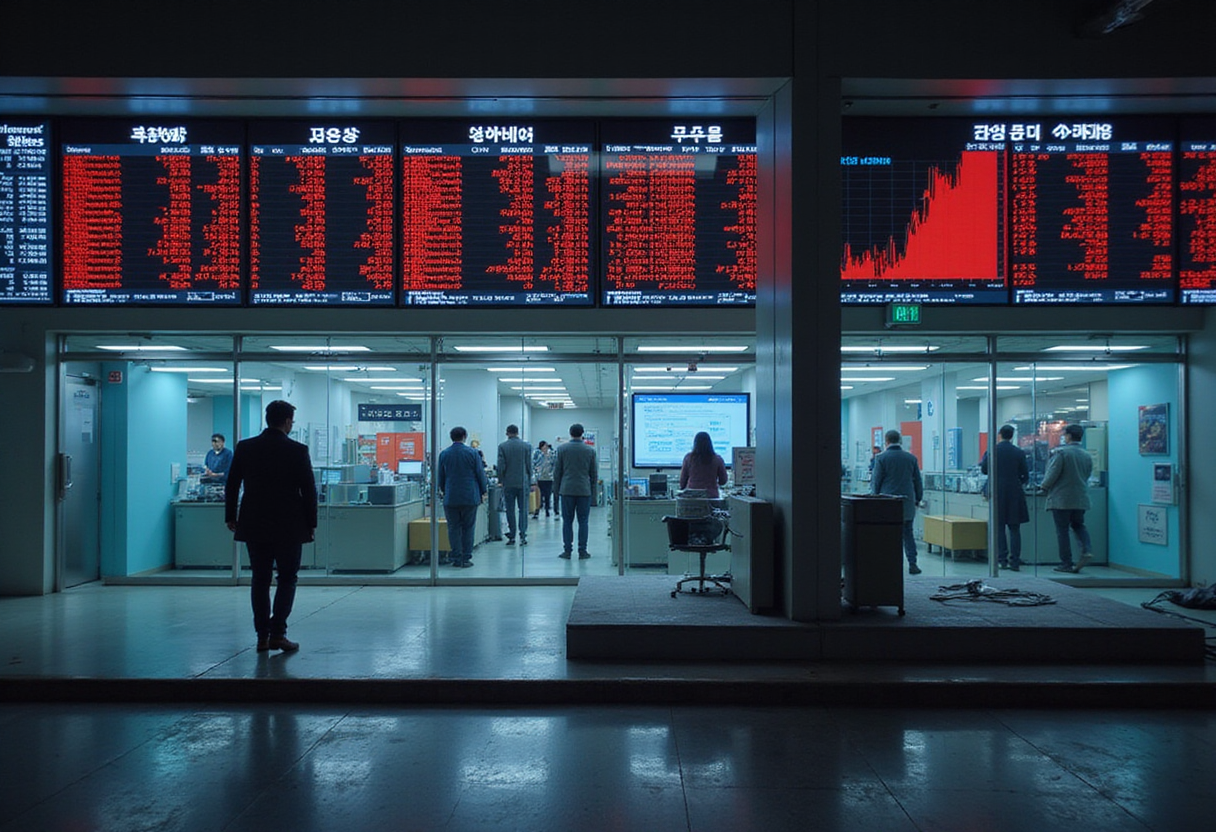
Kospi Falls More Than 7% as AI Fears Trigger Chip Sell-Off
South Korea's Kospi sank more than 7 percent as investors dumped semiconductor shares, questioning whether the AI boom can sustain the sector's lofty valuations.
- By
- Nathan Brooks
- Filed
- Channel
- Semiconductors
- Read
- 3 min read
South Korea's Kospi index dropped more than 7 percent in a single session, dragged down by a broad sell-off of semiconductor shares as investors reassessed the durability of the AI boom. The decline ranks among the steepest one-day falls for the benchmark in recent memory, and chips were at the center of it.
The trigger was sentiment, not a factory fire. Investors who spent two years pricing semiconductor makers as the undisputed winners of artificial intelligence began to question whether demand for AI-related hardware justifies the valuations. When that question is asked at scale, Seoul answers quickly. Chip stocks carry heavy weight in the Kospi, so a wave of selling in the sector moves the entire index with it.
Why did semiconductors drag the whole index?
The arithmetic is simple. Semiconductor companies occupy outsized positions in South Korea's benchmark index, and the country's largest chipmakers are among the most AI-exposed names in Asia. A sell-off that begins with doubts about AI infrastructure spending spreads through the sector within hours.
The selling reflected worries that the AI boom — the demand wave that has lifted memory prices, foundry utilization and equipment orders — may cool faster than markets expected. No earnings revision or guidance cut was reported as the immediate catalyst. This was a repricing of expectations, and repricings of expectations do not require an announcement.
What does this say about AI trade concentration?
The episode illustrates a structural feature of the current market: the AI trade is crowded. Semiconductor shares across the region have risen on the assumption that spending on AI compute continues upward without pause. When confidence in that assumption wobbles, the same concentration that drove gains drives losses. Seoul's more-than-7-percent session is the cleanest demonstration of the mechanism so far.
For South Korea specifically, the stakes run beyond stock tickers. Semiconductors anchor the country's export economy, and the sector's health feeds directly into national accounts, capital investment and government revenue planning. A market rout does not shut a fab line. It does, however, tighten the financing climate for the capacity expansions that Korean chipmakers have been pursuing.
Is this a correction or a turning point?
That question has no answer yet, and honest coverage should say so. A single-session decline of this magnitude tells us what investors fear, not what order books show. If AI demand data over the coming quarters remains firm, the sell-off will read in hindsight as a valuation reset. If end-demand for AI hardware softens, Monday's sellers will look prescient.
Watch three signals in the near term. First, whether the selling spreads to other AI-exposed markets and persists across sessions, which would indicate a broader de-risking rather than a local spasm. Second, whether memory and logic chipmakers revise guidance or hold their outlooks, a direct read on real demand. Third, whether Korean authorities or institutions respond publicly, which historically signals concern about systemic pressure.
For now, the facts are these: the Kospi fell more than 7 percent, semiconductor shares led the decline, and the stated cause was worry that the AI boom may not sustain the valuations built upon it. Everything else is interpretation. The market has begun pricing a slower AI ramp; whether the order books agree will decide whether this session was noise or a warning.
Source: Google News: semiconductors
More from Nathan Brooks
Show full bio
Senior reporter covering people, launches and day-to-day practice in Semiconductors, chip manufacturing, hardware, AI compute at Chip Dispatch.
417 articles
Related articles
kospi-falls-more-than-7-as-chip-stocks-lead-broad-sell-off-6236f879
Kospi Falls More Than 7% as Chip Stocks Lead Broad Sell-Off
kospi-falls-more-than-7-as-ai-fears-trigger-chip-stock-sell-off-c304c1a1
Kospi Falls More Than 7% as AI Fears Trigger Chip Stock Sell-Off
kospi-plunges-more-than-7-as-ai-fears-trigger-chip-share-sell-off-0c677af3
Kospi Plunges More Than 7% as AI Fears Trigger Chip Share Sell-Off
kospi-plunges-over-7-as-ai-fears-trigger-chip-stock-sell-off-2c3f968b
Kospi Plunges Over 7% as AI Fears Trigger Chip Stock Sell-Off