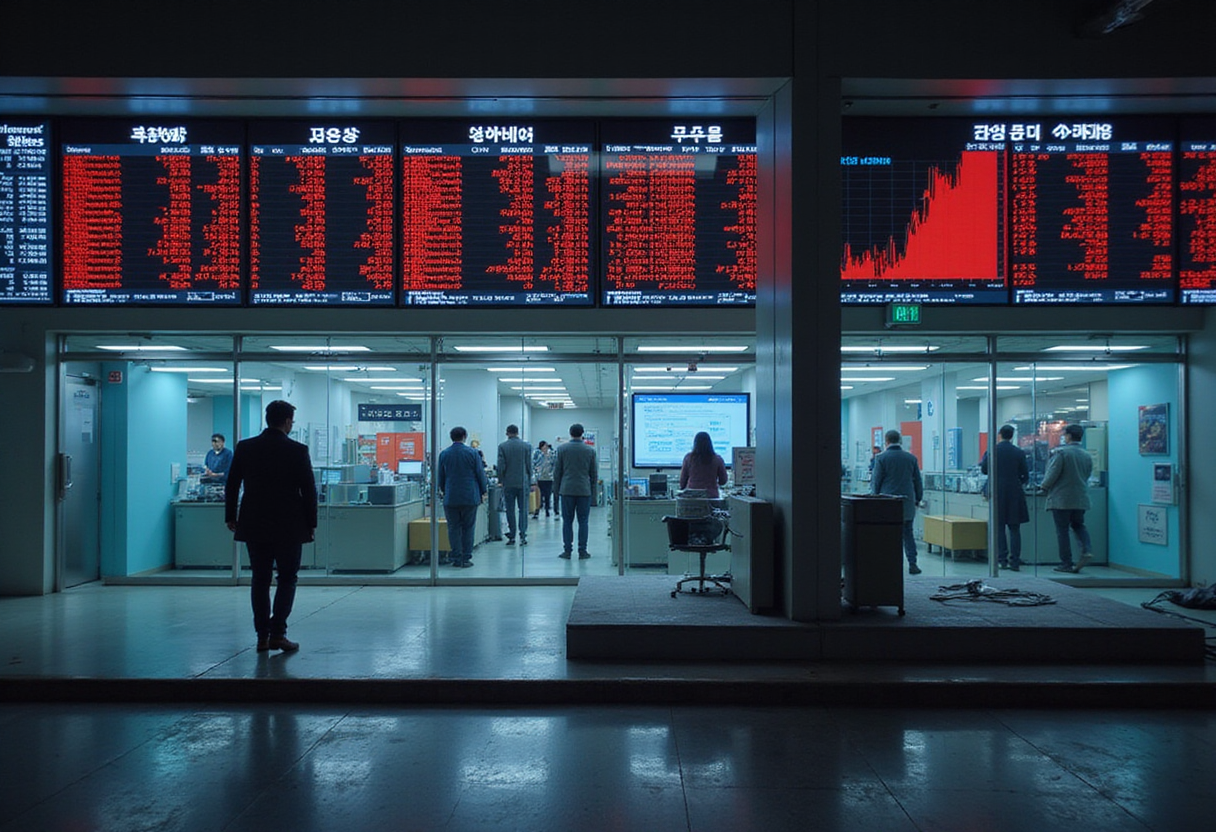
Kospi Falls Over 7% as Chip Stocks Lead Sharp Sell-Off
South Korea's Kospi sank more than 7% in one session as semiconductor shares led a broad sell-off, with investors repricing the AI boom that drove the index's chip-heavy rally.
- By
- Rebecca Stone
- Filed
- Channel
- Semiconductors
- Read
- 3 min read
South Korea's Kospi index sank more than 7% in a single session, with semiconductor shares leading the decline as investors dumped chip stocks on fresh worries about the AI boom, Click2Houston reported.
The number is the story. A 7% single-day drop in the Kospi is rare territory for one of Asia's major benchmarks, and the report pins the rout squarely on the sector that has powered the index's recent run: semiconductors. Samsung Electronics and SK Hynix sit at the heart of the Kospi's weighting, and any shift in sentiment around memory chips and AI demand moves the whole index with them.
Why did semiconductor shares fall so hard?
The sell-off, according to the report, stems from worries about the AI boom. That phrase covers a fear that has circulated across global markets in recent sessions: that expectations for artificial-intelligence-driven chip demand may have outrun what companies can actually deliver in revenue and orders. When that doubt takes hold, the stocks that climbed highest on the AI thesis fall fastest.
Korea's market is an outsized expression of that dynamic. The country's two chip giants dominate the index, and their shares have tracked the global AI trade — HBM memory demand, datacenter buildouts, and the capital spending of hyperscale cloud customers. Any signal that this spending might slow, or that valuations have stretched too far, hits the Kospi harder than more diversified benchmarks.
The report does not specify which individual stocks fell furthest, nor does it give exact closing prices. What it does confirm is the direction and the magnitude: semiconductor names drove the index down more than 7%.
How big a move is 7% for the Kospi?
Indexes rarely fall that far in a day. Moves of this size typically rank among the worst sessions in a market's recent history, and they tend to arrive when a crowded trade unwinds at speed. Semiconductor shares have been exactly that kind of trade — the sector most tightly coupled to the AI investment cycle.
A decline of more than 7% in the Kospi therefore reads as more than routine volatility. It signals forced deleveraging, program selling, or a genuine repricing of the AI growth story — or some combination of all three. The report attributes the trigger to worries over the AI boom, placing this Seoul session within the broader global correction that has hit AI-linked equities.
What does this mean for the chip trade?
For months, the bull case for memory and logic chipmakers rested on AI demand outrunning supply — high-bandwidth memory sold out, datacenter processors on multi-year order books, and wafer capacity tight through the forecast horizon. A sell-off of this magnitude tests that narrative. Investors are asking whether the revenue will arrive fast enough to justify the share prices.
Korea's exporters add another layer. Samsung and SK Hynix compete directly in the memory tiers that AI servers consume most, and their results serve as a proxy for global datacenter appetite. When the market reprices that appetite downward, the Kospi absorbs the shock first among major Asian indexes, because no other benchmark concentrates so much chip exposure at the top.
The report frames the decline as sentiment-driven rather than tied to a specific earnings miss or production announcement. That distinction matters. Sentiment-driven routs can reverse quickly if demand data holds up. They can also deepen if the next quarterly reports from chipmakers disappoint.
What comes next?
Traders will now watch whether the more-than-7% drop marks a single-session capitulation or the start of a sustained repricing of AI-linked chip shares. The answer depends, by the report's own logic, on whether evidence of AI demand — orders, pricing, and revenue from Korea's semiconductor leaders — keeps pace with the expectations investors had priced in before the fall.
Source: Google News: semiconductors
More from Rebecca Stone
Show full bio
Correspondent covering technology and product news in Semiconductors, chip manufacturing, hardware, AI compute at Chip Dispatch.
409 articles
Related articles
kospi-falls-more-than-7-as-ai-doubts-trigger-chip-sell-off-f518eb70
Kospi Falls More Than 7% as AI Doubts Trigger Chip Sell-Off
kospi-falls-more-than-7-as-ai-doubts-trigger-chip-stock-sell-off-029052fb
Kospi Falls More Than 7% as AI Doubts Trigger Chip Stock Sell-Off
kospi-falls-more-than-7-as-chip-stocks-lead-broad-sell-off-6236f879
Kospi Falls More Than 7% as Chip Stocks Lead Broad Sell-Off
kospi-falls-more-than-7-as-chip-shares-lead-broad-sell-off-87cbef19
Kospi Falls More Than 7% as Chip Shares Lead Broad Sell-Off