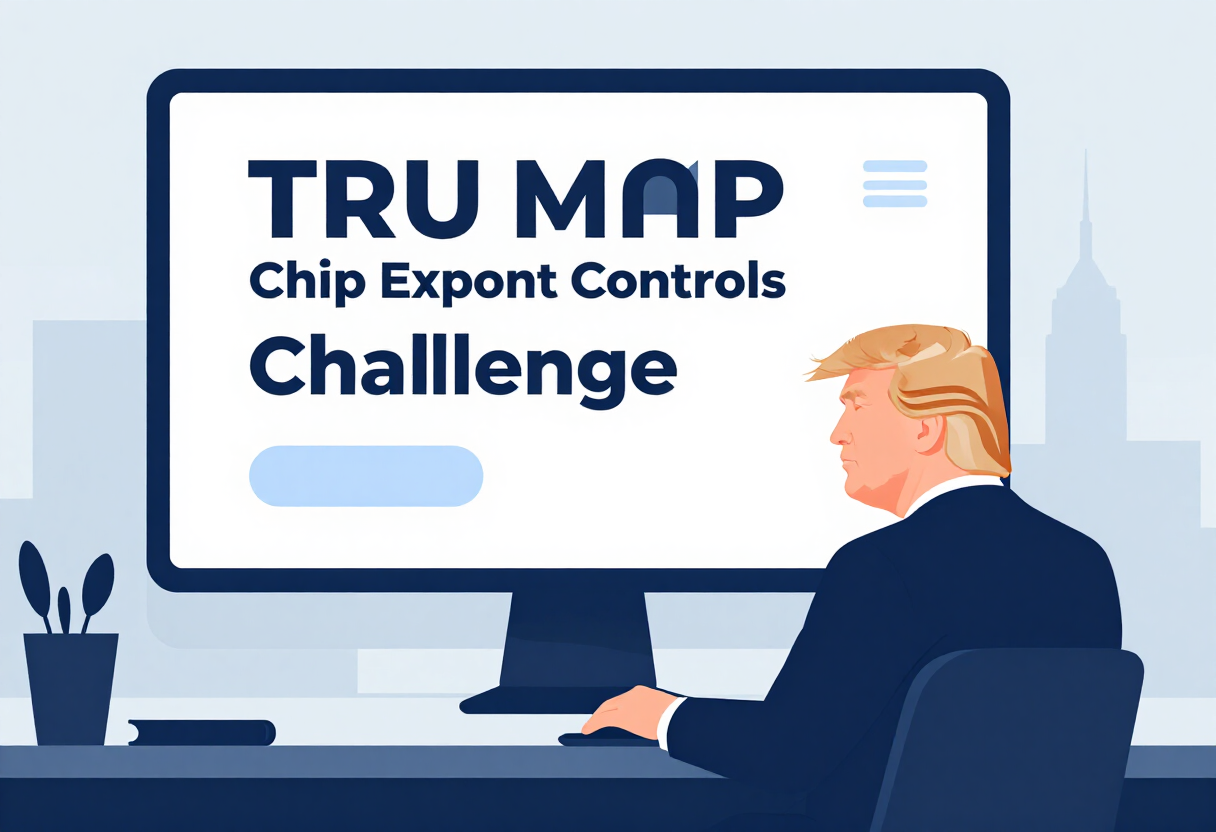
Lawfare Analysis Argues Trump's AI Chip Export Controls Break the Law
A Lawfare analysis argues the Trump administration's AI chip export controls exceed statutory authority, and maps which companies or governments could sue to overturn them.
- By
- Tom Whitfield
- Filed
- Channel
- Chips & Policy
- Read
- 2 min read
A new Lawfare analysis argues that the Trump administration's export controls on AI chips rest on legally shaky ground — and identifies the parties positioned to challenge them in court.
The piece, titled "Trump's Illegal AI Chip Export Controls, and Who Can Challenge Them," centers on the U.S. government's restrictions governing the sale of advanced accelerators — the Nvidia- and AMD-designed GPUs and associated silicon that power AI training and inference in data centers worldwide. These controls determine which countries, companies, and cloud operators can buy top-end AI hardware, and in what volumes, making them one of the most consequential levers in the global semiconductor trade.
The Lawfare authors contend that the current control regime exceeds the statutory authority Congress granted the executive branch. Export controls on goods and technology derive from specific legal frameworks, and the argument advanced in the piece is that the AI chip rules stretch those frameworks beyond what the enabling statutes permit. If the controls are, as the authors assert, illegal, the question becomes who has standing to bring a challenge and through what procedural route.
That question matters commercially. U.S. chip designers ship the majority of the world's advanced AI accelerators, and each restriction tier reshapes billions of dollars in potential revenue. Export licensing decisions determine whether hyperscalers in restricted markets can procure flagship data-center GPUs, whether third countries can host AI compute for customers elsewhere, and how much high-bandwidth-memory-equipped hardware reaches the market in a given quarter. A court ruling that invalidates part of the control framework would force a renegotiation of those commercial boundaries.
The stakes run in both directions. Chipmakers have argued that overly broad controls push foreign customers toward competing silicon ecosystems and erode the U.S. industry's revenue base, which funds the next generation of process and product development. Policy hawks counter that tight controls slow rival AI programs. The Lawfare analysis adds a third axis to that debate: whether the executive branch properly followed the law at all, independent of the policy merits.
For semiconductor industry observers, the piece is worth reading less for its policy preferences than for its mapping of the litigation landscape — which companies, industry groups, or foreign governments could plausibly sue, on what grounds, and how quickly a challenge might move through the courts. Legal risk now sits alongside licensing risk as a variable in any multi-year AI chip supply agreement.
No challenge has yet succeeded against the AI chip control regime, and the controls remain in force while the underlying legal arguments are contested. But if a credible plaintiff emerges, the trajectory of U.S. AI chip export policy — and the global distribution of advanced accelerators — could be decided by judges rather than regulators.
Source: Google News: chip export controls
More from Tom Whitfield
Show full bio
Staff writer covering consumer brands and retail at Chip Dispatch.
72 articles
Related articles
senate-democrats-unveil-three-bills-to-cut-china-off-from-ai-chips-eab9e654
Senate Democrats Unveil Three Bills to Cut China Off From AI Chips
brookings-argues-case-for-loosening-us-chip-export-controls-3903a33c
Brookings Argues Case for Loosening US Chip Export Controls
us-ai-chip-export-curbs-face-cloud-loophole-forbes-reports-d0328673
US AI Chip Export Curbs Face Cloud Loophole, Forbes Reports
nvidia-smuggling-allegations-resurface-export-control-questions-330e87f7
Nvidia Smuggling Allegations Resurface Export Control Questions