Musk Plans $16.8 Billion Megafactory Five Times World's Largest Building
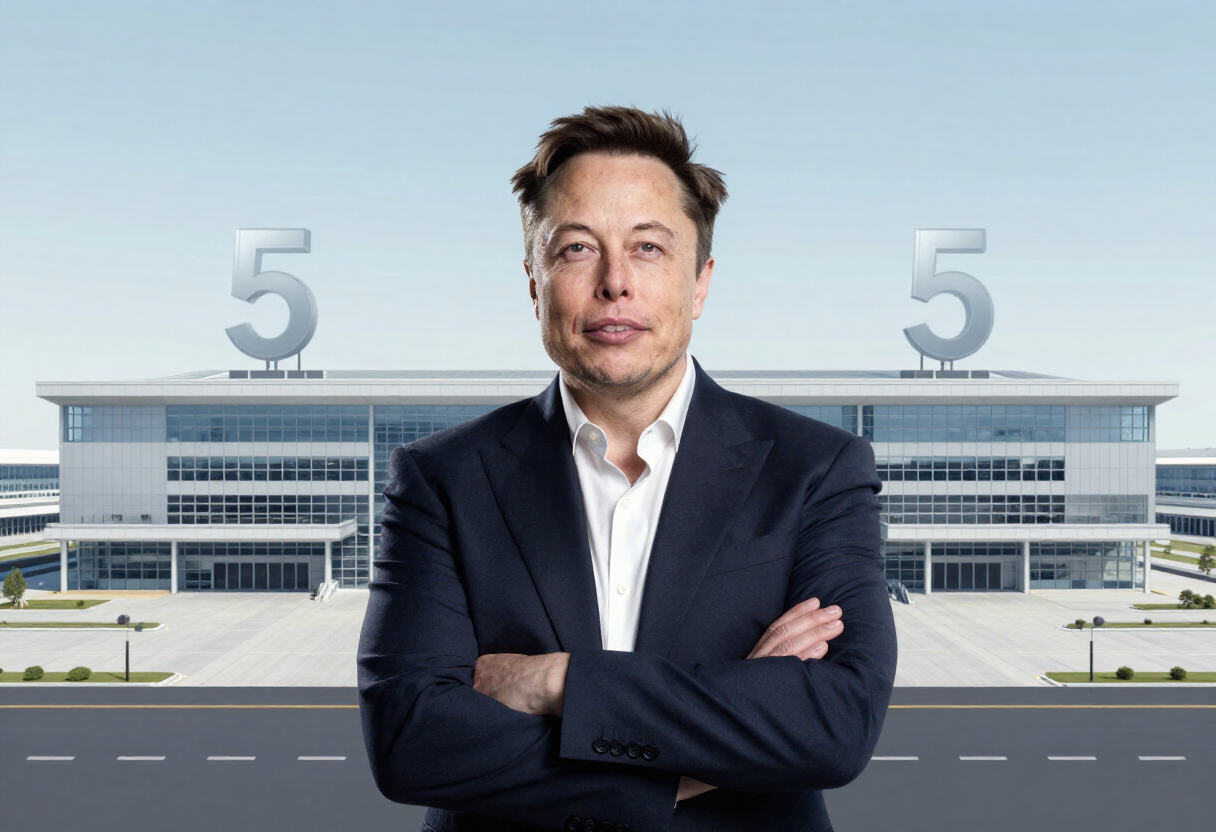
Elon Musk is planning a $16.8 billion factory five times larger than the world's biggest building, a footprint that would reset global benchmarks for single-site manufacturing capacity.
- By
- Tom Whitfield
- Filed
- Channel
- Tech Business
- Read
- 4 min read
Elon Musk is planning a factory that would carry a price tag of $16.8 billion and cover a footprint roughly five times larger than the world's current largest building, Fortune reports. If built to that specification, the facility would not merely set a record for Tesla. It would reset the benchmark for industrial construction worldwide.
The scale deserves a hard look. The world's largest building today is widely recognized as the Boeing Everett Factory in Washington State, which measures about 4.3 million square feet of floor space under a single roof and has served as the reference point for megastructures since 1968. A facility five times that size implies something on the order of 20 million square feet or more — a single enclosed manufacturing campus comparable in footprint to a mid-sized airport. The reported $16.8 billion investment figure places the project in the same financial tier as leading-edge semiconductor fabs, several of which now cost $20 billion to $30 billion per site.
That comparison is instructive. Chip fabs at the leading edge — TSMC's Arizona sites, Samsung's Taylor, Texas facility, Intel's Ohio campus — carry comparable or larger capital budgets, but they spend that money on cleanrooms, lithography tools and process equipment rather than sheer enclosed volume. Musk's plan inverts the equation: the money buys floor area and throughput capacity for mass manufacturing at a pace no single building has attempted.
What the money buys
The $16.8 billion figure, as reported by Fortune, would make the plant one of the largest single-building capital investments in modern industrial history. For context, Tesla's Gigafactory Nevada was originally pitched at a $5 billion total investment, and Gigafactory Shanghai — the company's highest-throughput vehicle plant — was built for roughly $2 billion. The planned facility would exceed those commitments several times over on a single site.
Five times the volume of the world's current largest building is not an incremental expansion. It is a category change. Buildings of that class typically take a decade or more to phase in, with output ramping line by line. Whether the full $16.8 billion lands as one commitment or stretches across phased construction will determine how quickly the capacity becomes economically real rather than architecturally impressive.
Why super-sized plants matter now
Manufacturing strategy across several industries has been trending toward consolidation of production into fewer, larger sites. The logic is straightforward: bigger buildings concentrate suppliers, shorten logistics chains and let firms scale output without duplicating tooling, engineering teams and administrative overhead across regions. Tesla has pushed this model harder than most automakers, using single massive campuses to produce vehicles, battery cells and energy products in proximity.
The bet carries obvious risk. A single-site concentration of that magnitude creates a single point of failure — for supply disruption, labor action, weather or grid constraints. It also demands that demand materialize fast enough to fill the floor. Idle capacity at Gigafactory scale burns capital at a rate few balance sheets can absorb, and Tesla has already navigated one demand-airpocket cycle at its Austin, Texas plant.
There is also a geopolitical dimension to constructing industrial capacity of this size on US soil. Federal policy over the past several years — from the CHIPS and Science Act to incentives for battery and vehicle manufacturing — has tilted capital expenditure toward domestic mega-sites. A $16.8 billion building fits squarely within that policy current, and the scale of the project suggests Musk expects favorable treatment, available power and a deep local labor pool wherever it lands.
The execution question
Skepticism is warranted on timeline. Musk's projects have a consistent pattern: announced ambitions run ahead of delivered capacity, and construction phases routinely outlast original schedules. Gigafactory Nevada took years longer than projected to reach target cell output. The Austin site announced in 2021 is still filling out its planned footprint. A building five times larger than anything previously attempted would test every assumption — concrete supply, crane availability, utility interconnection and permitting — at unprecedented scale.
The counterargument is equally consistent: Musk's companies have repeatedly delivered structures that industry observers called impossible, and vertical integration of construction under one roof has historically compressed Tesla's ramp timelines versus competitors relying on dispersed supplier networks.
What to watch
The concrete indicators to track are the groundbreaking date, the confirmed capital commitment in Tesla's filings versus the announced $16.8 billion, and the first named production line assigned to the building. Until equipment orders and permits appear, the project exists as an ambition with a price tag attached — a very large one, but an ambition nonetheless.
If Musk's company breaks ground and holds the projected footprint, the plant would become the largest enclosed manufacturing facility on Earth by a factor of five, and competitors across automotive, battery and heavy manufacturing would face a new physical benchmark for what a single factory can hold.
Source: Google News: chip factory investment
More from Tom Whitfield
Show full bio
Staff writer covering consumer brands and retail at Chip Dispatch.
33 articles
Related articles
16-8-billion-chip-plant-confirmed-for-grimes-county-texas-1cdfde6f
$16.8 Billion Chip Plant Confirmed for Grimes County, Texas
tower-semiconductor-commits-3-billion-to-japan-with-state-backing-3d4e1d02
Tower Semiconductor Commits $3 Billion to Japan With State Backing
apple-s-u-s-chip-strategy-builds-on-20b-tsmc-commitment-51140594
Apple's U.S. Chip Strategy Builds on $20B TSMC Commitment
tsmc-poised-to-expand-its-165-billion-u-s-investment-db43b042
TSMC Poised to Expand Its $165 Billion U.S. Investment