NVIDIA Puts $1 Billion Behind US Scientific Innovation Push
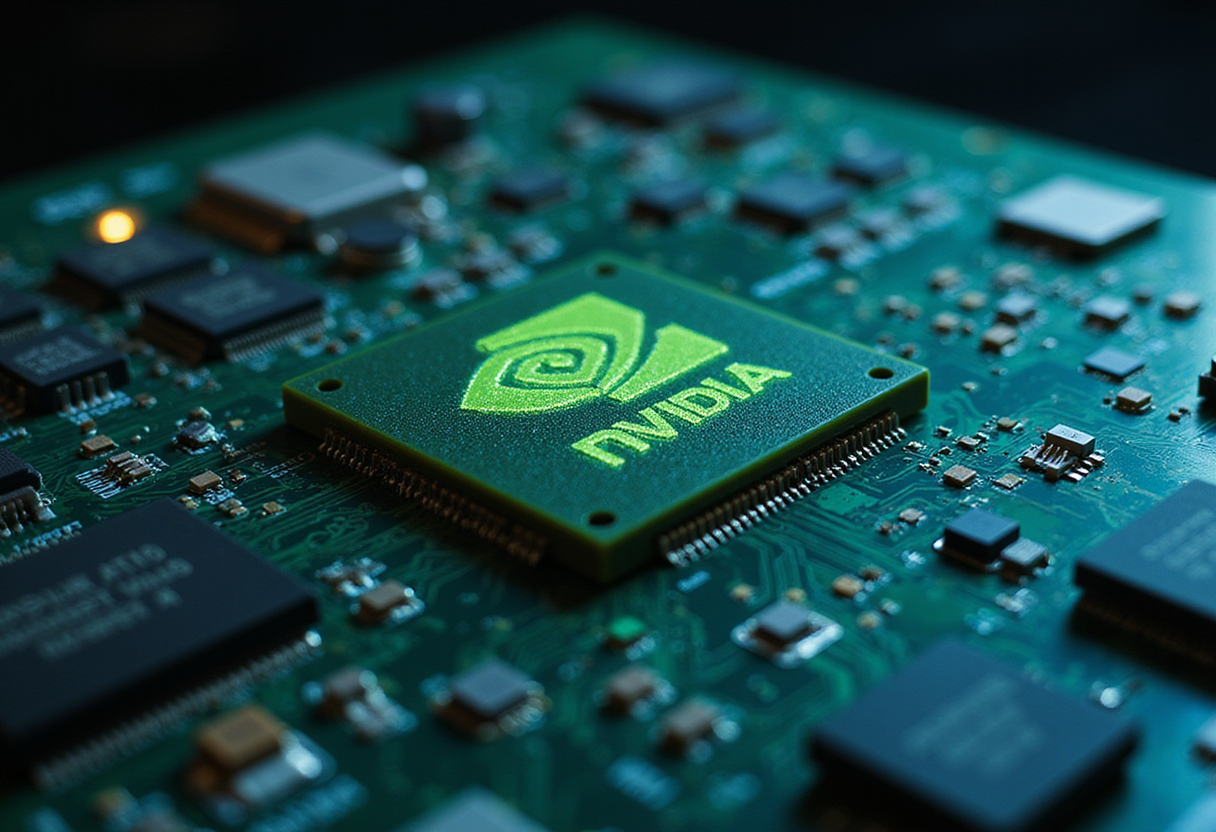
NVIDIA has committed roughly $1 billion toward U.S. scientific innovation, a figure that buys tens of thousands of H100-class GPUs at list price and signals how strategically the AI accelerator vendor views academic and lab demand.
- By
- Tom Whitfield
- Filed
- Channel
- AI & Compute
- Read
- 3 min read
NVIDIA has earmarked roughly $1 billion for U.S. scientific innovation, a figure that places the AI accelerator supplier alongside federal and philanthropic backers funding the compute backbone behind American research.
The size of the commitment is the headline. A nine-figure pledge from a single AI chip vendor aimed at U.S. science is unusual in scale, and it lands as U.S. universities and national labs scramble to acquire the GPU capacity that frontier AI training and scientific workloads demand.
Where the money is going
The source — a Simply Wall St. brief filed under its "AI Chips Update" series — confirms the $1 billion figure and the "U.S. scientific innovation" framing, but does not break out recipient institutions, program timelines, or whether the funds flow as cash grants, hardware donations, or cloud-credit commitments. NVIDIA has historically used all three vehicles in academic and lab partnerships.
The lack of detail matters. In this segment, the distinction between a hardware gift (DGX systems, H100 or Blackwell GPUs) and a cloud-credit commitment (AWS, Azure, OCI access) reshapes the commercial picture for the recipient and for competing accelerator vendors.
What $1 billion buys in AI silicon
Order-of-magnitude check: $1 billion at NVIDIA's flagship H100 list price of roughly $25,000–$30,000 per unit, before volume discounts, would fund a fleet on the order of 33,000–40,000 GPUs. If the package skews toward the newer Blackwell B200 or GB200 NVL systems, which carry higher unit pricing, the unit count compresses. None of those numbers have been confirmed by NVIDIA for this specific program.
For comparison, the U.S. Department of Energy's Frontier supercomputer at Oak Ridge National Laboratory operates at exascale class and required multi-billion-dollar procurement. A $1 billion vendor-side contribution is meaningful, but not sufficient to replace federal capital budgets — it complements them.
Supply chain and competitive context
The pledge arrives as NVIDIA's data-center revenue runs at an annual rate exceeding $40 billion, driven primarily by Hopper-class shipments and an early ramp of Blackwell parts to hyperscalers. Channel checks have suggested demand for H100, H200, and B200 systems continues to outrun supply, with allocation slots booked multiple quarters out. A $1 billion commitment to scientific users pulls some of those limited units — or the cloud-equivalent capacity — into research workloads rather than commercial model-training builds.
Competitively, AMD's MI300X and Intel's Gaudi 3 have argued they can absorb spillover demand. A federally- and vendor-funded scientific compute expansion tends to favor whichever vendor delivers the tightest software stack and the most reliable supply, factors that have favored NVIDIA in recent awards.
What remains unanswered
- Which universities, national labs, or research consortia will receive allocations
- Whether the $1 billion is split between hardware gifts and cloud credits
- The timetable for deployment
- Whether access includes Blackwell-generation parts or is capped at Hopper
- The level of co-funding from federal agencies or private foundations
NVIDIA has not published a detailed breakdown at the time of this report.
What to watch next
The commercial signal is straightforward: a $1 billion scientific-innovation pledge confirms that U.S. research institutions remain a strategic customer segment for AI accelerator vendors, and that NVIDIA is willing to invest ahead of rivals in seeding that demand. Watch for the first recipient announcements — they will reveal whether the package is heavy in hardware, cloud credit, or research funding — and for any matching commitments from AMD or Intel as they bid to keep U.S. scientific workloads running on competitive silicon.
Source: Google News: AI chips
More from Tom Whitfield
Show full bio
Staff writer covering consumer brands and retail at Chip Dispatch.
295 articles
Related articles
amazon-seeks-to-offload-8-billion-of-nvidia-chips-to-investors-9b2c2012
Amazon Seeks to Offload $8 Billion of Nvidia Chips to Investors
amazon-weighs-8-billion-sale-of-nvidia-ai-chips-to-investors-c67a9a71
Amazon Weighs $8 Billion Sale of Nvidia AI Chips to Investors
amazon-seeks-investors-to-take-8-billion-of-nvidia-chips-off-its-books-18459bf5
Amazon Seeks Investors to Take $8 Billion of Nvidia Chips Off Its Books
amazon-seeks-to-move-8b-of-nvidia-ai-chips-off-its-books-227e78d5
Amazon Seeks to Move $8B of Nvidia AI Chips Off Its Books