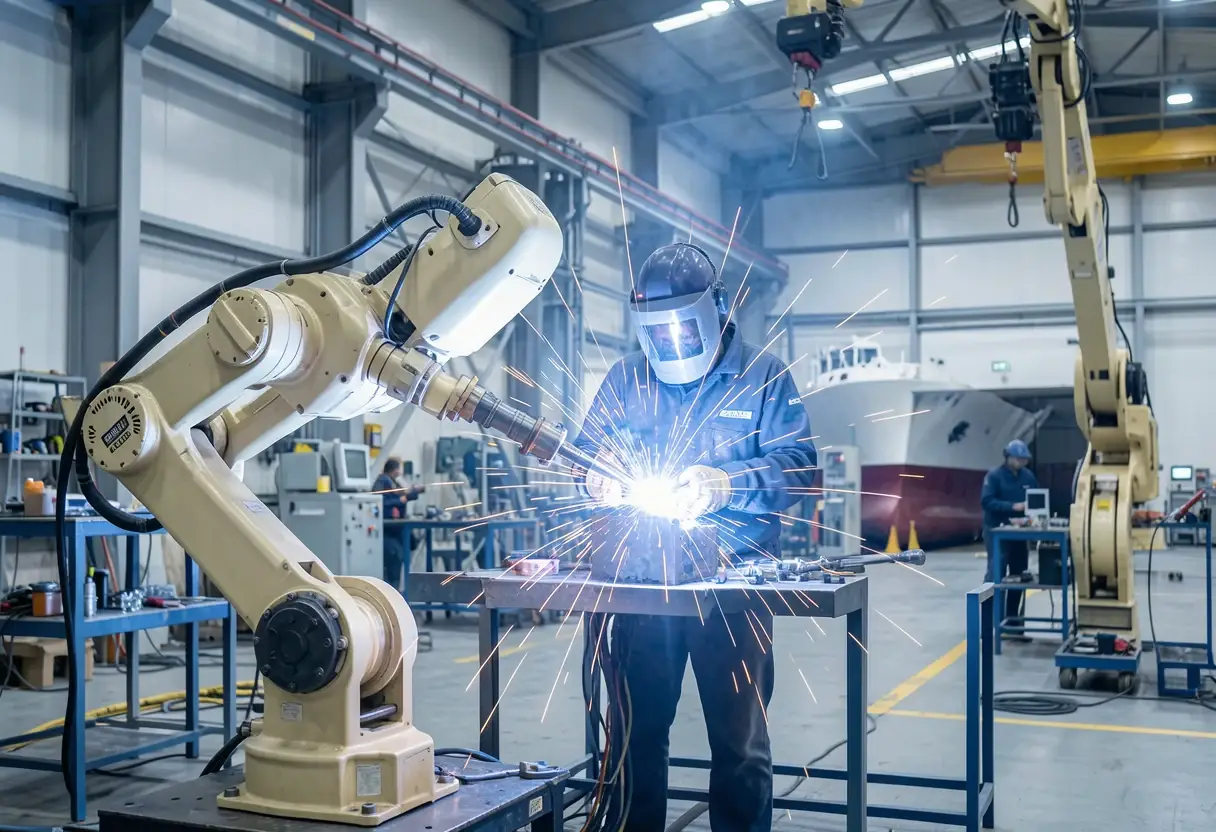
Path Robotics raises $300 million at $2.45 billion valuation
Path Robotics raised $300 million at a $2.45 billion valuation. Obsidian now moves beyond fixed cells as Rove draws 50 preorders and HII signs a $600 million performance-based agreement.
- By
- Nathan Brooks
- Filed
- Channel
- Startups & Funding
- Read
- 3 min read
By Nathan Brooks
Path Robotics, a Columbus, Ohio, company that builds AI-guided welding robots, raised $300 million in a Series E funding round at a $2.45 billion post-money valuation on Nov. 10. Georgian, an AI-focused growth equity firm, led the round; its partner Emily Walsh will join Path’s board. D. E. Shaw Ventures and Naver Ventures joined as new investors.
Existing backers Addition, Drive Capital, IronArc Ventures, Tiger Global and Yamaha Motor Ventures also participated. Bloomberg reported that the round nearly quadrupled Path’s previous valuation and lifted total funding since the company’s 2018 founding to about $610 million. That lifetime total is roughly twice the size of the latest round.
Path did not disclose revenue. It said annual recurring revenue (ARR) grew 17-fold over the past 18 months, while headcount rose 97% year over year. The company targets 400 employees by the end of 2026; without a disclosed ARR base, the growth rate cannot be sized in dollars.
What does Obsidian do on the factory floor?
Obsidian, Path’s physical AI model, learns from real-world welding data. It identifies weld joints, plans and executes each weld, then adjusts when conditions change.
Four lasers on the torch illuminate the part, while two cameras read the reflected light. Obsidian tracks how the metal deforms during welding and corrects for variation between parts.
A separate “weld world model” generates simulated welding jobs for training. Path first deployed Obsidian in fixed robotic welding cells, where the robot remained in one defined production position.
How does Rove change the deployment?
This year, Path put Obsidian on Rove, a welding quadruped that carries the welder to work in shipyards and industrial sites. Rove extends the system from stationary robotic cells to mobile deployment.
Bloomberg reported 50 preorders for Rove, with deployments scheduled to start next year. Those orders indicate customer interest, but the source provides no shipment schedule, unit price or revenue forecast.
Who is buying the systems?
Named customers include HII, Lockheed Martin and maritime drone maker Saronic. The roster also includes mid-sized shops EK Machine, Millerbernd Manufacturing, TransAmerican Power Products and Tycrop.
In August, Path signed a $600 million performance-based production agreement with HII to bring its systems into U.S. Navy shipbuilding. The $600 million figure belongs to a performance-based agreement, not a disclosed revenue total.
Why begin with welding?
“We started with welding because it is one of the hardest jobs on the factory floor to automate,” said co-founder and CEO Andy Lonsberry. The technical argument rests on part-to-part variation and changing metal behavior, which Obsidian’s cameras and models are designed to track.
Where will the capital go?
Path will use the money to scale its welding business with customers. It will also fund data collection, compute and model training, then extend Obsidian into tasks before and after welding and onto additional robot form factors.
Defense, shipbuilding, heavy equipment and energy infrastructure form the target sector list. The source identifies these as expansion plans; apart from the performance-based HII agreement, it gives no contract values or capacity commitments for them.
Chris Moran, vice president and general manager of Lockheed Martin Ventures, said the work with Path “can help expand capacity.” The comment supports the industrial logic of automating welding, but it does not quantify output.
What comes next?
The next checkpoint comes with Rove deployments next year: whether 50 preorders become installations, whether the HII agreement produces shipyard capacity, and whether Obsidian earns revenue beyond welding. If deployments convert those preorders into installed systems, Path must show that operating scale can catch up with a $2.45 billion valuation.
Source: mlq.ai
More from Nathan Brooks
Show full bio
Senior reporter covering people, launches and day-to-day practice in Semiconductors, chip manufacturing, hardware, AI compute at Chip Dispatch.
829 articles
Related articles
sima-ai-raises-150m-series-c-at-1-45b-valuation-for-edge-ai-chips-e98baddb
SiMa.ai Raises $150M Series C at $1.45B Valuation for Edge AI Chips
ai-agent-watchdog-bay-exits-stealth-with-50-million
AI Agent Watchdog Bay Exits Stealth With $50 Million
google-org-puts-2-3-mn-into-froncort-ai-for-disease-surveillance
Google.org Puts $2.3 Mn Into Froncort.AI for Disease Surveillance
anthropic-targets-88-5-billion-in-record-ipo-linked-fundraise
Anthropic Targets $88.5 Billion in Record IPO-Linked Fundraise