Resideo Cuts $1.1 Billion of Debt After ADI Global Spinoff
Resideo repaid $1.1 billion of gross debt with a $900 million dividend from ADI and $200 million of cash, leaving $2.1 billion outstanding as revenue rose 3% to $727 million.
- By
- Tom Whitfield
- Filed
- Channel
- Tech Business
- Read
- 4 min read
Resideo Technologies repaid $1.1 billion of gross debt in the quarter ended Oct. 3, its first full reporting period after spinning off ADI Global Distribution on Aug. 3. The company funded the repayment with a $900 million cash dividend from ADI plus $200 million of its own cash, leaving $2.1 billion of gross debt and $229 million of cash at quarter-end.
That transaction matters more than the income statement this quarter, because the money came from the separated entity rather than from Resideo's own operations.
How did the spinoff pay down the debt?
The mechanism was a cash transfer, not an earnings event. ADI Global Distribution, separated on Aug. 3, paid Resideo a $900 million dividend. Resideo applied $900 million of that dividend plus $200 million of its own cash to retire $1.1 billion of gross debt. Gross debt ended the period at $2.1 billion against $229 million of cash, so the company still holds more debt than cash after the move.
In plain terms, the spinoff dividend, not the thermostat and alarm business, funded the repayment.
What did the remaining business actually sell?
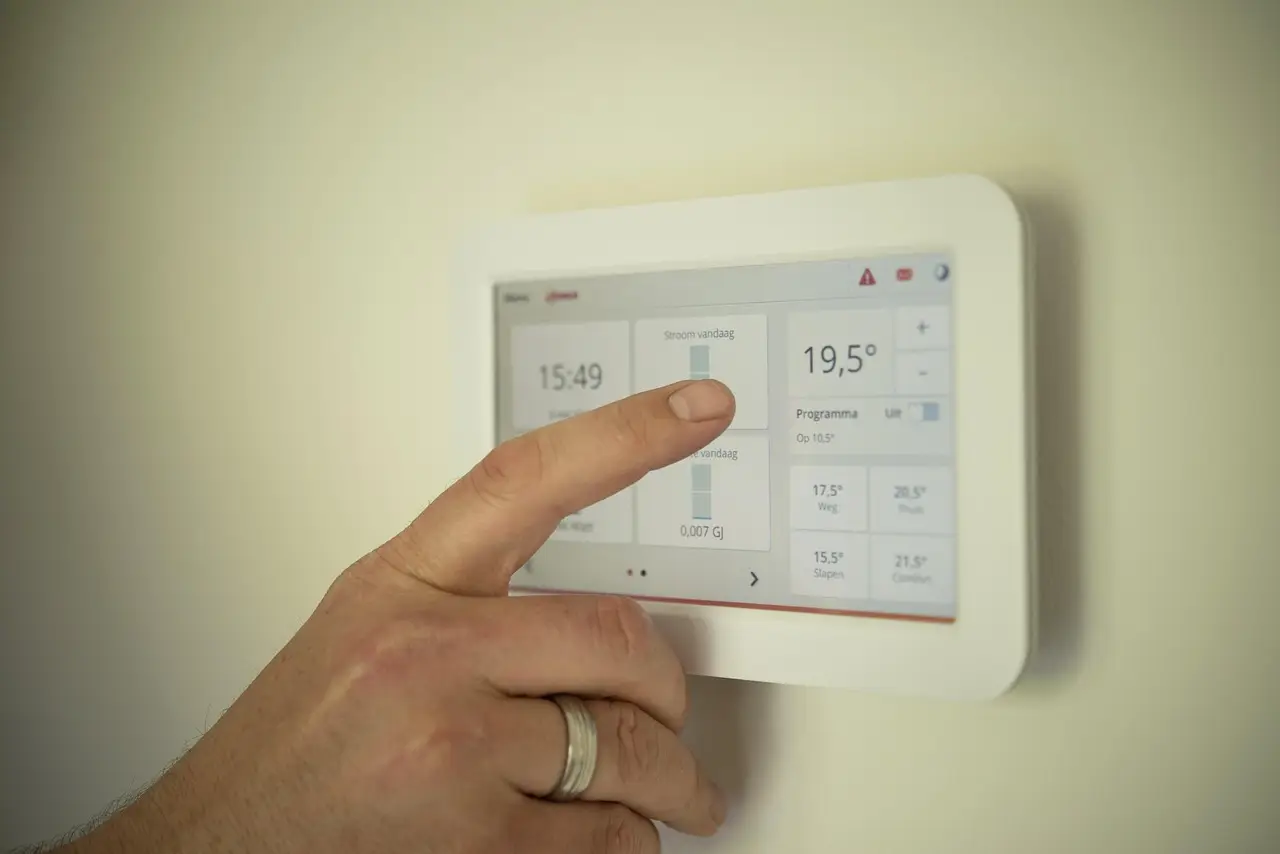
Revenue from the continuing business rose 3% to $727 million, near the top of the company's own $705 million to $730 million forecast. That portfolio spans Honeywell Home thermostats, First Alert and BRK smoke and carbon monoxide alarms, and heating, security and water controls.
Strip out OEM Security, which fell 34% to $33 million on lower volumes from a large customer, and revenue grew 6%. The gap between 3% and 6% shows how much of the growth comes from consumer-facing lines and how far the OEM order book has contracted. Gross margin reached 40.4%, the fourteenth straight year-on-year gain, which the company credits to price increases and tariff refunds. Sequentially, that margin slipped from 41.1% in the prior quarter.
Core consumer revenue did the work, and a single large customer's lower volumes remain the drag.
Why did GAAP profit fall 66% while adjusted EBITDA rose?
Income from continuing operations fell 66% to $31 million, or 14 cents a diluted share, after $30 million of one-time separation expenses and $20 million of restructuring, impairment and debt extinguishment costs. Operating income dropped to $72 million from $108 million in the prior quarter and $106 million a year earlier.
On the company's standalone presentation, which shows ADI as if it had been separate in every period, adjusted EBITDA rose 5% to $154 million and standalone adjusted earnings reached 52 cents a share, up from 48 cents.
The recast quarterly record:
- Q3 2026 (quarter ended Oct. 3): revenue $727 million; gross margin 40.4%; operating income $72 million; net income $31 million; standalone adjusted EBITDA $154 million
- Q2 2026: revenue $738 million; gross margin 41.1%; operating income $108 million; net income $96 million; standalone adjusted EBITDA $157 million
- Q3 2025: revenue $703 million; gross margin 40.4%; operating income $106 million; net income $90 million; standalone adjusted EBITDA $146 million
Prior periods recast by the company.
The distance between a 66% drop in GAAP profit and a 5% rise in adjusted EBITDA is separation and financing charges, not a collapse in trading.
What does the narrowed 2026 outlook say?
Full-year guidance now calls for revenue of $2.927 billion to $2.947 billion and standalone adjusted EBITDA of $614 million to $624 million, tightened from the $2.90 billion to $2.95 billion and $605 million to $625 million issued in August. For the fourth quarter, Resideo forecasts revenue of $710 million to $730 million and adjusted earnings of 42 to 48 cents a share, and expects at least $165 million of operating cash flow for the year.
Chief Executive Tom Surran said: "We are executing on our strategic priorities with discipline and consistency, creating positive momentum in a soft housing market and a dynamic macro environment."
His reference to a soft housing market frames the guidance. Resideo sells into new construction and replacement demand, and the outlook assumes no recovery in that end market. Tariff refunds helped margin this quarter, and the narrowed ranges leave the company with little cushion between its own low and high ends.
Narrower ranges and a revenue midpoint near $2.94 billion push execution risk into the fourth quarter.
The next test is whether Resideo can hold $710 million to $730 million of revenue and 42 to 48 cents of adjusted earnings while gross debt sits at $2.1 billion, operating cash flow reaches at least $165 million for the year, and the large OEM Security customer keeps ordering at its reduced level.
Source: mlq.ai
More from Tom Whitfield
Show full bio
Staff writer covering companies, deals and strategy in Semiconductors, chip manufacturing, hardware, AI compute at Chip Dispatch.
802 articles
Related articles
mara-posts-632m-net-income-on-885m-bitcoin-gain-despite-revenue-slump
MARA Posts $632M Net Income on $885M Bitcoin Gain Despite Revenue Slump
energy-vault-backlog-hits-2-3b-revenue-guide-is-600m-700m
Energy Vault backlog hits $2.3B; 2027 revenue guide is $600M-$700M
hyliion-lifts-guidance-as-navy-delivery-schedule-slips
Hyliion lifts 2026 guidance as Navy delivery schedule slips
amprius-lifts-outlook-to-145-million-after-83-sales-jump
Amprius Lifts 2026 Outlook to $145 Million After 83% Sales Jump