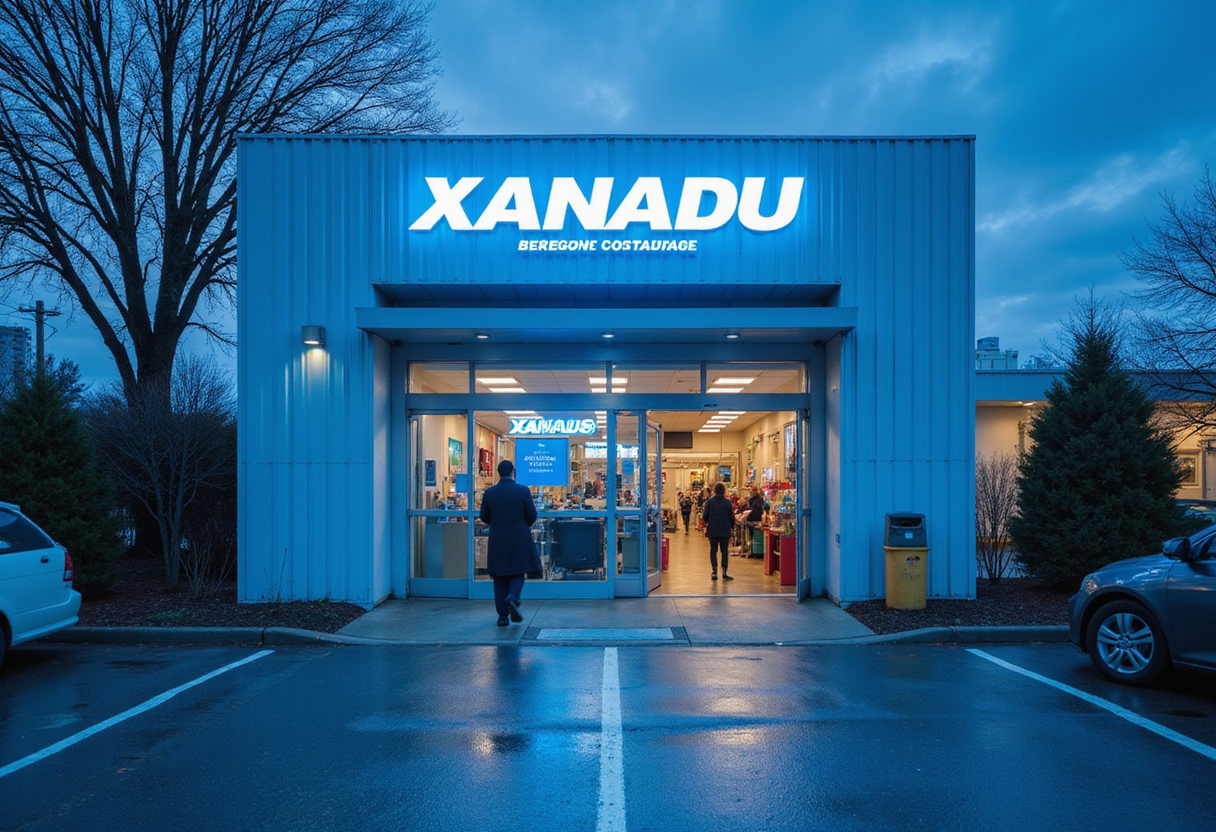
Xanadu and Bluefors Bet on Compact Cryogenics for Quantum Data Centres
Xanadu and Bluefors are spending millions on a compact cryogenic prototype they say eliminates industrial cryoplants from utility-scale quantum data centres.
- By
- Rebecca Stone
- Filed
- Channel
- AI & Compute
- Read
- 3 min read
Xanadu Quantum Technologies and Bluefors have signed a multi-million dollar partnership to build a compact, high-performance cryogenic prototype for utility-scale quantum computing (USQC), with the explicit goal of eliminating the massive cryoplants the industry long assumed such systems would need.
The Toronto-based photonic quantum computing firm, founded in 2016 and listed on Nasdaq and the TSX under the ticker XNDU, announced the deal on September 29, 2026. Helsinki-headquartered Bluefors brings more than EUR 210 million in revenue, over 700 employees, and a fleet of more than 1,800 delivered cryogenic systems now operating worldwide — installed base figures the companies position as evidence the collaboration can move from prototype to mass manufacturing.
The technical premise is straightforward but commercially significant. Until recently, the industry assumed USQC would require massive, industrial-scale cryoplants. "Our collaboration with Bluefors has yielded a concept that integrates their most advanced technology into a compact module," said Dr. Christian Weedbrook, Founder and Chief Executive Officer of Xanadu. "This approach is expected to remove the need for traditional cryoplants, greatly improving the scalability and economics of future quantum data centres."
That economics argument is the crux. Cryogenic cooling is one of the dominant capital and operating cost drivers for superconducting and photonic quantum architectures alike. If cooling can be modularized into compact, replicable units rather than centralized plants, the marginal cost of scaling a quantum data centre shifts from civil-engineering-scale construction toward a manufacturing problem — a transition the semiconductor industry itself made decades ago as fabs standardized on modular tool platforms.
Bluefors CEO Kim Povsen framed the product logic in similar terms. "We are delivering a high-powered, modular and cryo-tested solution that combines cooling and quantum infrastructure designed to grow alongside our customers' technology roadmaps," Povlsen said. "By meeting the cooling demands that infrastructure investments need to scale, we help customers optimize time-to-value and build a strong foundation to accelerate the next generation of fault-tolerant quantum computers."
The prototype phase will produce what the partners call a foundational blueprint — not only for Xanadu's planned USQC data centre but for future USQC data centres generally. After validating the prototype, Xanadu and Bluefors plan to engineer a mass-manufacturable cryogenic module tailored specifically for single-photon detectors and USQC in a data centre environment.
The detector focus matters. Xanadu builds fault-tolerant quantum computers using light, with systems designed to compute at room temperature — but single-photon detection, the readout path for photonic qubits, still demands millikelvin-range cooling. Squeezing that cooling into a standardized, mass-manufacturable module directly addresses the scaling bottleneck between Xanadu's photonic processing and the cryogenic periphery it depends on.
For Xanadu, the partnership de-risks the infrastructure layer of its roadmap toward fault tolerance. For Bluefors, it extends the company's position from supplying dilution refrigerators to individual labs toward supplying standardized infrastructure for quantum data centres — a market the company says it is helping to accelerate "across the widest range of modalities."
Both companies describe the effort as a shared vision of scalable, modular cryogenic infrastructure for USQC. No timeline, capacity targets, or financial terms beyond "multi-million dollar" were disclosed, and the data centre plans remain roadmaps rather than committed builds.
If the compact-module concept validates, the partners expect it to set the template for how future quantum data centres are provisioned — replacing bespoke cryoplant construction with manufacturable cooling modules, and in doing so reshaping the cost structure of utility-scale quantum computing.
Original: xanadu.ai
More from Rebecca Stone
Related articles
qualcomm-poised-to-supply-custom-ai-chips-to-amazon-bloomberg-reports-81a13f6f
Qualcomm Poised to Supply Custom AI Chips to Amazon, Bloomberg Reports
qualcomm-lands-deal-to-supply-amazon-with-custom-ai-silicon-8aad8dfa
Qualcomm Lands Deal to Supply Amazon With Custom AI Silicon
equal1-closes-51m-round-to-scale-silicon-based-quantum-computing-e028023b
Equal1 Closes €51M Round to Scale Silicon-Based Quantum Computing
tsmc-poised-to-expand-its-165-billion-u-s-investment-db43b042
TSMC Poised to Expand Its $165 Billion U.S. Investment