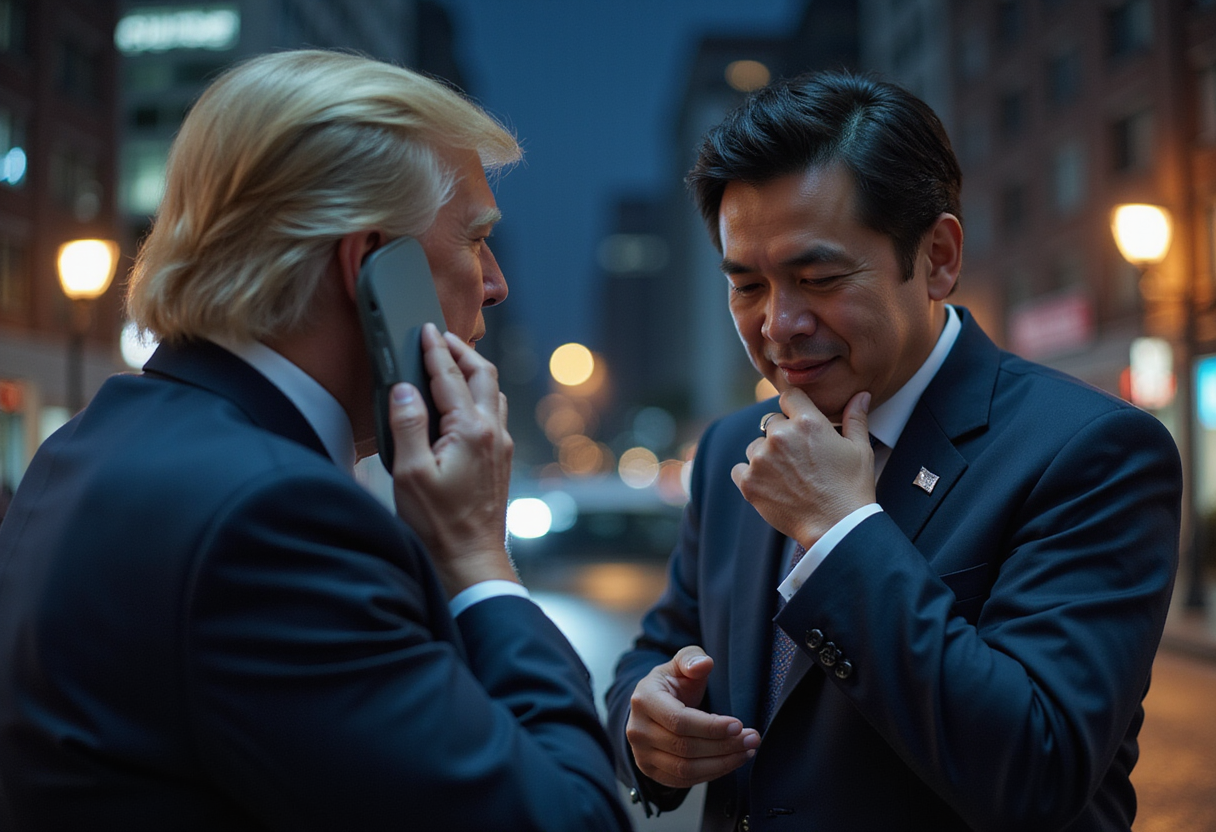
ABC News Australia Frames Jensen Huang Profile Around Trump's Late-Night Calls
The Australian Broadcasting Corporation publishes a profile of NVIDIA chief executive Jensen Huang, framed by his reported direct phone relationship with US President Donald Trump outside working hours.
- By
- Tom Whitfield
- Filed
- Channel
- Chips & Policy
- Read
- 4 min read
Jensen Huang, the chief executive of NVIDIA, is the subject of an international profile distributed by ABC News Australia under the headline "Who is Jensen Huang, the AI boss Trump calls at night?"
The headline reached global readers through Google News from the Australian Broadcasting Corporation's news service. The text names Huang through two roles. The first is his position at the head of the company most identified with AI accelerator processors. The second is a direct phone relationship with US President Donald Trump that runs outside White House working hours.
The text available to Chip Dispatch contains only the headline and the source attribution. The full article body has not arrived through the feed being monitored.
What does the "calls at night" framing change for the semiconductor industry?
The operational detail in the headline is not the identity of the executive. It is the timing. Federal policy levers under the current US administration — export licensing rules for advanced AI processors, allocations under the CHIPS and Science Act, and tariff measures on imported silicon — can shift customer access and unit pricing inside a single quarter.
A chip industry chief who picks up the phone after hours sits closer to those decisions than one who waits for formal meetings. The ABC headline, by attaching the phrase to Huang specifically, places him in that closer position by name. For rivals in the accelerator market, the framing sets Huang apart as the industry figure who carries documented White House access.
Why single out Huang from the broader AI executive cohort?
Huang has led NVIDIA since co-founding the company in 1993. He has served as its public voice through the transition from PC graphics chips to AI training silicon. The broadcaster's choice to lead with the phrase "AI boss," rather than a corporate title, treats him as the single executive through whom the AI chip story and the Trump White House story connect.
The headline does not name peers at other chip companies. The profile, on the strength of its title, treats Huang as the channel worth covering in his own right. That framing matters because the AI accelerator market has consolidated around a small number of suppliers, and the executive who picks up the president's calls shapes how policy plays out across all of them.
What does the Australian outlet choice signal?
ABC News sits outside the US press corps that covers Washington policy on a daily basis. Its decision to lead with a profile of an American chip chief executive, framed by a relationship with the US president, suggests the broadcaster views the Huang-Trump channel as a story with international rather than purely domestic resonance.
For semiconductor readers in Asia and Europe, the framing carries a supply-chain dimension. Export licensing decisions made in Washington affect which AI accelerators reach customers in Seoul, Shenzhen, and Munich, and through which volume and pricing terms. A profile that names Huang as the executive the US president contacts directly tells those readers where the policy signal most likely originates.
What does the headline not yet settle?
The headline poses a question. The text available to Chip Dispatch does not supply the answer. The reported episodes, named sources, and direct quotations inside the full ABC profile remain outside the feed being monitored.
Until the full article is reviewed, semiconductor industry readers will need to consult the original publication to learn which specific incidents the broadcaster has tied to the phrase "calls at night." The pieces worth looking for include any on-record statements from White House officials, any policy decisions the broadcaster attributes to Huang's input, and any direct quotes from the executive himself.
The takeaway for now
A profile that names any chip company executive through a direct line to the US president is, on its own, a signal that the relationship carries commercial weight in Washington. The ABC headline is the only piece of the profile that has reached international feeds through the channel Chip Dispatch is monitoring.
The reporting worth watching, when the full text arrives, is whether the broadcaster names specific Trump-era policy decisions that Huang weighed in on, and whether any White House officials are quoted on the record about the channel.
Source: Google News: AI chips
More from Tom Whitfield
Show full bio
Staff writer covering companies, deals and strategy in Semiconductors, chip manufacturing, hardware, AI compute at Chip Dispatch.
384 articles
Related articles
california-ceo-arrested-in-300m-ai-chip-smuggling-case-25b7d9ea
California CEO Arrested in $300M AI Chip Smuggling Case
california-tech-ceo-arrested-over-ai-chip-smuggling-to-china-7f033e26
California Tech CEO Arrested Over AI Chip Smuggling to China
china-s-ai-chip-push-builds-xi-s-case-you-can-t-choke-us-off-b18505da
China's AI Chip Push Builds Xi's Case: 'You Can't Choke Us Off'
us-federal-agents-arrest-california-executive-over-ai-chip-sales-to-china-18e71804
US Federal Agents Arrest California Executive Over AI Chip Sales to China