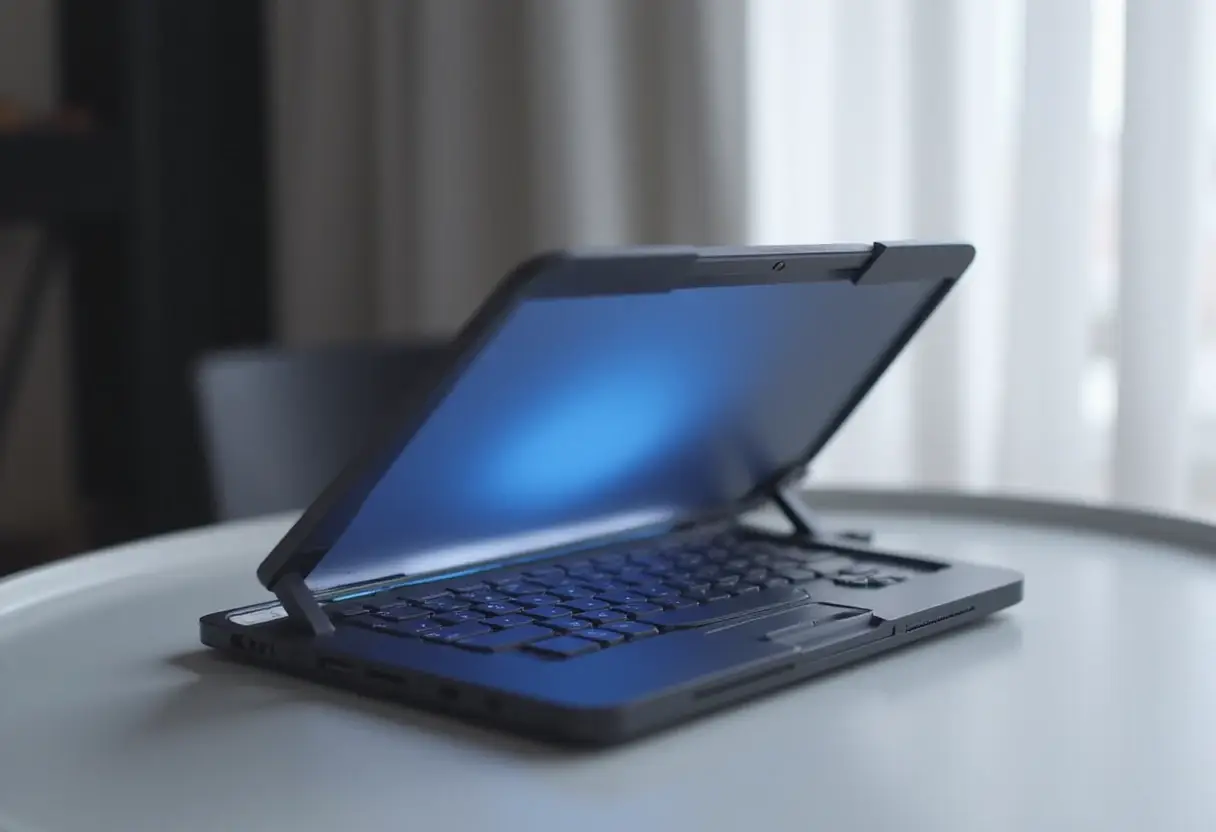
Acer's $2,774 Helios Neo 16S AI: RTX 5070 Ti Power, 240 Hz OLED, Weak Battery
Acer's $2,774 Helios Neo 16S AI pairs a 115W RTX 5070 Ti with a 240 Hz OLED in a 4.85-pound chassis, beating rivals in benchmarks but losing up to 2.5 hours of battery life.
- By
- Sophie Lindqvist
- Filed
- Channel
- Consumer Tech
- Read
- 3 min read
Acer's Predator Helios Neo 16S AI costs $2,774.99 as tested, and it beats its thin-and-light rivals in nearly every benchmark — except the one that defines its category. The laptop's battery life trails competitors by up to two and a half hours, an ironic failure for a machine marketed on portability.
The core configuration pairs Intel's Core Ultra 9 290HX Plus processor with an Nvidia GeForce RTX 5070 Ti running at 115 W maximum graphics power, 12GB of GDDR7 memory, and a 1,612 MHz boost clock. Acer fits 16GB of DDR5-6400 RAM, a 1TB PCIe 4.0 SSD, and a 92 WHr battery into a 4.85-pound (2.2 kg) chassis measuring 14.05 x 10.85 x 0.74 inches.
Tom's Hardware reviewer Charles Jefferies tested the machine against the Gigabyte Aero X16 ($1,499.99 as of writing, RTX 5070 at 85W) and the HyperX Omen 15 (about $3,159.99, RTX 5070 at 85W). The Acer won most contests. Its higher-wattage GPU, enabled by a rear thermal shelf that adds roughly an inch of depth, drew considerably more power than either competitor.
What do the benchmarks show?
- Shadow of the Tomb Raider (Highest): 76 FPS at native 2560 x 1600, versus Gigabyte's 60 FPS and HyperX's 64 FPS.
- Far Cry 6 (Ultra): 122 FPS at native resolution, ahead of Gigabyte (85 FPS) and HyperX (107 FPS).
- Cyberpunk 2077 (Ray Tracing Ultra): 21 FPS at native, beating Gigabyte (17 FPS) and HyperX (5 FPS).
- Red Dead Redemption 2 (Medium): 52 FPS at native, narrowly ahead of Gigabyte's 49 FPS.
- Forza Horizon 6 (Extreme): 60 FPS at native against HyperX's 51 FPS, despite losing at 1080p (72 versus 80 FPS).
In 007 First Light, Jefferies recorded 65 to 75 FPS in most scenes, with spikes above 100 FPS — though only with DLSS enabled at native resolution and High settings.
Sustained performance held up. Across 15 loops of the Metro: Exodus stress test, simulating half an hour of gaming, the Acer averaged 86.82 FPS with variance under one FPS between runs. The CPU averaged 2.94 GHz on P-cores at 73 degrees Celsius; the GPU averaged 1.622 GHz at 74 C.
Productivity results favored the Acer decisively. Geekbench scores of 3,349 single-core and 19,313 multi-core beat both rivals, and a 4K-to-1080p Handbrake transcode finished in 2 minutes 30 seconds — over a minute faster than the HyperX (3:39) and the Gigabyte (3:54). File transfers averaged 2,034.84 MBps.
Where does the machine fall short?
The display is a genuine strength: a 16-inch OLED panel at 2560 x 1600, 240 Hz with G-Sync, covering 82.7% of DCI-P3, reaching 372.4 nits in SDR and 608 nits in HDR testing. But the panel runs at a fixed 240 Hz with no variable refresh rate option, and Tom's Hardware assigns most of the blame for poor battery life to that decision.
The speakers are thin and quiet, with flat bass and muted vocals. Fan noise is audible while gaming, and surface temperatures peaked at 129 F on the bottom during the stress test. Wi-Fi 6E, not Wi-Fi 7, handles networking. Acer also preloads a long list of utilities plus bloatware including a McAfee trial and Forge of Empires.
Upgrade options are solid but awkward to reach. Ten Torx T6 screws and stubborn clips guard the interior, which holds two SODIMM slots, an M.2 2280 SSD slot, an M.2 2230 wireless slot, and a replaceable battery. Acer sells a 32GB version at $3,199.99 list, discounted to $2,459.99 during the review period — cheaper than the 16GB review unit at its $1,999.99 promotional low.
Is it worth buying?
Jefferies concluded that the laptop "delivers on most of its thin-and-light gaming promise" but that "below average battery life" undermines the portability pitch. Buyers who plan to stay near an outlet get strong performance and a standout OLED screen; buyers who need real unplugged runtime should look elsewhere.
Source: Tom's Hardware
More from Sophie Lindqvist
Show full bio
News editor covering money, funding and market shifts around Semiconductors, chip manufacturing, hardware, AI compute at Chip Dispatch.
834 articles
Related articles
acer-puts-amd-ryzen-ai-into-swift-air-14-starting-at-1-200-in-japan
Acer Puts AMD Ryzen AI Into Swift Air 14, Starting at $1,200 in Japan
apple-s-m6-macbook-pro-posts-18-multi-core-gain-on-2nm-silicon
Apple's M6 MacBook Pro Posts 18% Multi-Core Gain on 2nm Silicon
hp-targets-macbook-neo-with-699-99-wildcat-lake-laptop-oled-standard-144a8346
HP Targets MacBook Neo with $699.99 Wildcat Lake Laptop, OLED Standard
mediatek-s-3-nm-dimensity-cx-c10-max-takes-aim-at-899-googlebooks-d1320c21
MediaTek's 3 nm Dimensity CX C10 Max Takes Aim at $899 Googlebooks