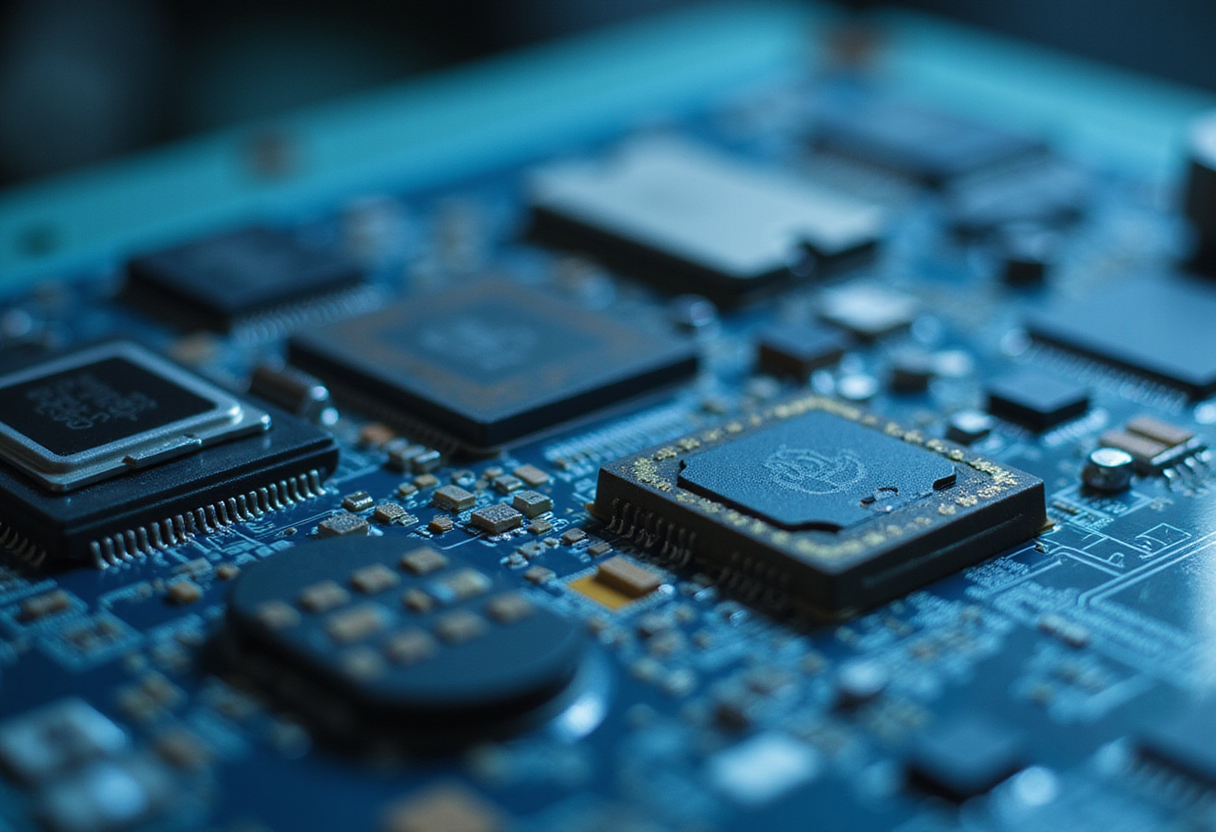
AI Demand Pushes Chip Giants to Pour Billions Into R&D Labs
IEEE Spectrum reports that AI chip demand is driving semiconductor giants to pour billions into R&D, reshaping budgets across the industry's labs.
- By
- Tom Whitfield
- Filed
- Channel
- AI & Compute
- Read
- 3 min read
The world's largest semiconductor companies are pouring billions of dollars into their research and development labs, and the driver behind that spending is unmistakable: demand for artificial-intelligence chips. That is the central finding reported by IEEE Spectrum, which describes a sector-wide shift in which R&D budgets, once spread across many product lines, now tilt heavily toward AI-related silicon.
The scale of the spending matters for the whole supply chain. Chip development is expensive at every stage. A single advanced design can consume years of engineering time, hundreds of millions of dollars in software and verification, and access to leading-edge manufacturing long before the first product ships. When the biggest companies raise that spending in unison, the effect reaches equipment vendors, chip designers, foundries and materials suppliers alike.
Why is AI demand reshaping R&D budgets?
The mechanism is straightforward. AI workloads reward chips that move enormous volumes of data quickly and consume as little energy as possible while doing it. Meeting those requirements pushes designers toward the most advanced process nodes, the largest package designs and the fastest on-chip and off-chip interconnects available.
Each of those steps raises the cost of a design. More advanced nodes mean more expensive mask sets and longer verification cycles. Larger packages combine multiple dies, which adds testing and assembly complexity. The result is a product family in which a single mistake costs far more than it did a generation ago, and in which the engineering effort per chip has climbed sharply.
In plain terms, the customers buying AI chips want performance that only the newest and most expensive engineering can deliver, and the chipmakers are paying for that engineering up front.
What does the spending shift mean for competition?
R&D spending has always separated the leaders from the rest of the industry, but the gap is now widening in a specific direction. Companies with the cash flow to fund multi-billion-dollar research programs can chase the AI opportunity directly. Smaller players must either specialise in a narrow part of the stack or partner with the giants that control the main platforms.
The shift also changes what the labs themselves work on. Priority now sits with processor cores tuned for AI arithmetic, high-bandwidth memory interfaces, advanced packaging that stacks chips close together, and the software tools needed to make all of it usable. Research areas without a clear AI connection compete for a shrinking share of the budget.
The takeaway: the companies that can sustain the highest R&D burn are positioning themselves to own the AI silicon market, while everyone else adjusts around them.
How does this fit the broader market picture?
The spending wave follows the demand curve rather than leading it. Data-center operators have placed large orders for AI accelerators, and those orders have translated into revenue that funds the next round of research. Chipmakers are, in effect, reinvesting the profits of the current AI cycle into the products they hope to sell in the next one.
That pattern carries a familiar risk. If AI demand growth slows, the industry will hold expensive research programs built for a market that no longer justifies them. If demand holds, the same programs become the barrier that keeps new entrants out. Every prior semiconductor cycle has turned on exactly this question, and this one is unlikely to differ.
IEEE Spectrum's reporting frames the current moment clearly: the billions flowing into R&D labs are a bet that AI chip demand is structural rather than temporary, and the industry's largest companies are placing that bet together.
Source: Google News: semiconductors
More from Tom Whitfield
Show full bio
Staff writer covering companies, deals and strategy in Semiconductors, chip manufacturing, hardware, AI compute at Chip Dispatch.
448 articles
Related articles
us-chip-tool-leader-sees-revenue-doubling-as-ai-reshapes-r-d-5271de56
US Chip Tool Leader Sees Revenue Doubling as AI Reshapes R&D
applied-materials-expects-ai-demand-to-double-its-revenue-a68456ab
Applied Materials Expects AI Demand to Double Its Revenue
applied-materials-bets-5-billion-on-next-gen-ai-chip-center-7af279be
Applied Materials Bets $5 Billion on Next-Gen AI Chip Center
tsmc-on-track-for-another-record-quarter-as-ai-demand-persists-cd477048
TSMC On Track for Another Record Quarter as AI Demand Persists