Asian Equity Funds Pull $11.53 Billion as Chip Stocks Rebound
Asian equity funds drew $11.53 billion, a near four-year high, as SK Hynix and China tech rebounded and KeyBanc forecast HBM prices rising 80–100% by Q1 2027.
- By
- Tom Whitfield
- Filed
- Channel
- Semiconductors
- Read
- 5 min read
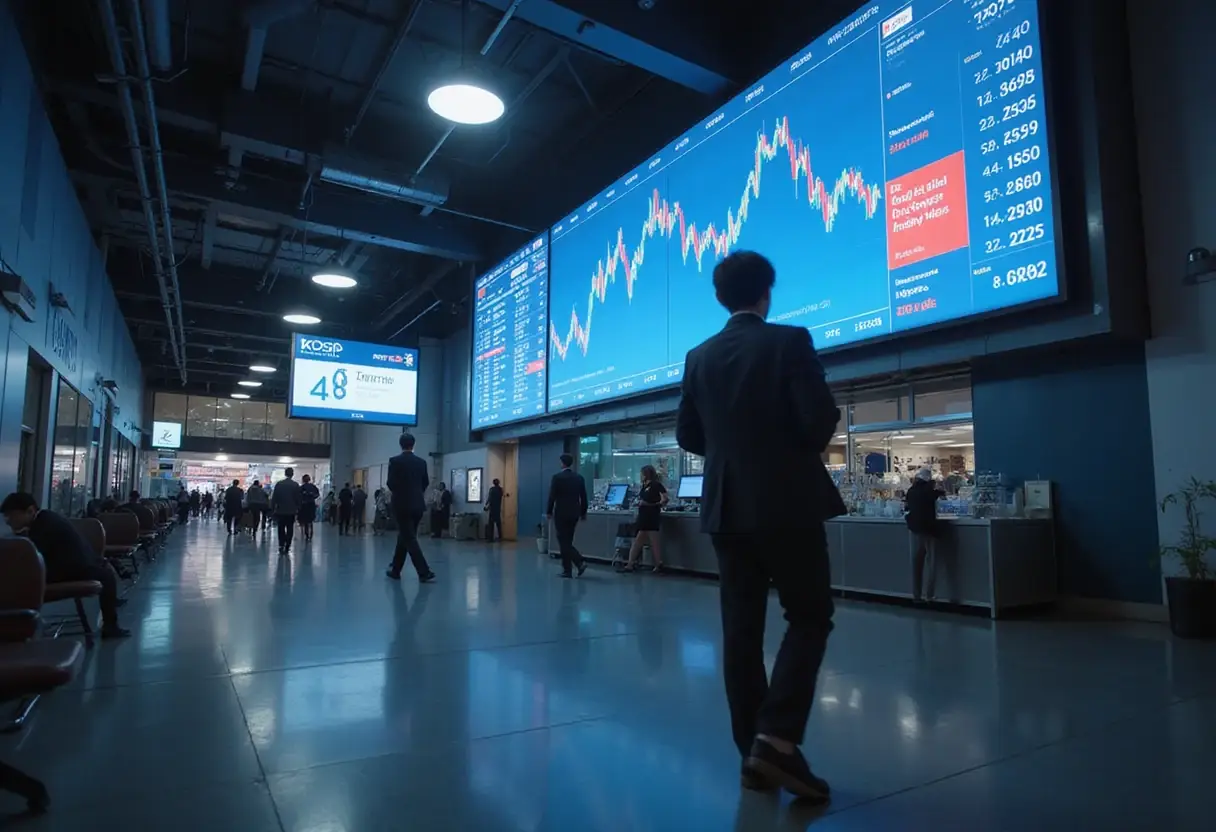
Asian equity funds absorbed $11.53 billion in net inflows for the week ending October 21, the highest level since at least December 2022, according to LSEG Lipper data. The money moved in just as Asian investors bought the dip in AI computing and semiconductor stocks after a sharp U.S. sell-off, turning memory chips and optical communications into the engine of a regional rebound.
The numbers behind the reversal were stark. On October 22 the Philadelphia Semiconductor Index fell 6.72%, the Nasdaq Composite dropped 2.60%, and Nvidia and Micron declined 4.40% and 6.26% respectively. The next day the Korea Composite Index reversed a midday fall of more than 4% to close up 0.30%, with SK Hynix up 4.42% and Samsung Electronics up 0.47%. China's Growth Enterprise Market Index swung from a 3%-plus intraday loss to close up 4.16%, on total turnover of roughly RMB 1.97 trillion across the Shanghai, Shenzhen and Beijing markets.
Why did Chinese and Korean tech shares bounce?
Company-specific news supplied the spark. SK Hynix suspended the valuation of Solidigm's IPO, easing investor concerns about duplicate listings and valuation discounts. Xinyisheng, a Chinese optical-components maker, announced share buybacks of RMB 800 million to RMB 1 billion, and several optical-communication companies issued operational updates that strengthened confidence in order backlogs and product upgrades.
A seasoned analyst cited in the report argued that after two weeks of concentrated selling in Chinese and South Korean tech stocks, some investors had already booked profits on short positions, while bargain-hunting capital entered the market. As fresh selling pressure eased and both short-covering and dip-buying demand emerged, the sharp Friday rebound followed. In short, oversold conditions plus positive corporate news drove the recovery.
How strong is the global capital return?
Global equity funds recorded net inflows of $28.16 billion for the week ending October 21, up from $19.88 billion the prior week — the fifth consecutive week of accumulation. European equity funds drew $9.14 billion, and U.S. equity funds drew $5.07 billion. U.S. inflows fell roughly 62% from the prior week's $13.37 billion, showing investors favored lagging Asian markets over record-high U.S. stocks.
Global technology-sector funds swung to net inflows of $5.05 billion, reversing the prior week's $4.77 billion in outflows. Healthcare funds attracted $1.83 billion; non-essential consumer goods funds bled $1.29 billion. In the U.S., large-cap funds drew $8.63 billion and mid-caps $1.92 billion, while small-caps saw outflows of $4.24 billion — evidence, the report notes, that capital is raising its bar on size, liquidity and financing capacity.
Two drivers underpin the bullish stance. The U.S. 10-year Treasury yield has retreated nearly 38 basis points from its 24-and-a-half-year high of 5.3645% in early October, falling below 5%. Earnings are also delivering: about 82% of the roughly 24% of S&P 500 companies that have reported beat profit expectations, and roughly 73% of the approximately 18% of MSCI All Country World Index constituents that disclosed results exceeded estimates.
What do the memory-price forecasts say?
KeyBanc's recent Asia-focused research indicates AI data centers continue to absorb substantial supplies of storage and other AI-computing resources, keeping price increases extending into 2027. The firm forecasts HBM composite prices could surge 80% to 100% in the first quarter of 2027. For DRAM, it projects a quarter-over-quarter rise of 15% to 20% in the fourth quarter of 2026, followed by an additional 10% to 15% in the first quarter of 2027. NAND prices are seen climbing roughly 20% quarter-over-quarter in Q4 2026, then another 10% to 15% in Q1 2027.
JPMorgan estimates this year's tech-sector cash flow at approximately $2.2 trillion against roughly $1.8 trillion in investments, leaving a financing surplus of about $400 billion. New cloud-provider financing is under pressure, which may shift who builds certain projects but is unlikely to end the AI capex cycle. The bank also notes semiconductors account for roughly 21% of global equity-portfolio risk against only about 13% of market-cap weight, so concentrated holdings can amplify short-term declines. UBS points to relative strength indices near 27 for the Hang Seng Tech Index and 23.9 for the CSI 300, plus elevated U.S. equity short positions, as conditions favoring an oversold bounce.
How does the compute build-out reach the supply chain?
Meta reported third-quarter revenue of $64.601 billion, up 26% year over year, with advertising revenue of $63.061 billion and Q4 guidance of $73.0–$76.0 billion. But capital expenditures hit $34.91 billion, free cash flow was negative $2.12 billion, and the full-year capex floor was raised from $130 billion to $135 billion, with roughly $825 billion in future spending commitments.
That spending cascades through the stack: Nvidia and AMD accelerators, Broadcom custom chips and interconnects, Micron and SK Hynix memory, Seagate and Western Digital storage, and TSMC and Amkor manufacturing and packaging. Nvidia also unveiled the DSX POD at GTC Berlin, which integrates computing, networking, power and liquid cooling at the factory, cutting on-site deployment to as little as 14 days, with delivery slated for early 2027.
Bank of America's bull case centers on HBM4 adoption plus SOCAMM and enterprise SSD demand tied to GPU and ASIC upgrades. With Nvidia at roughly $5.1 trillion in market capitalization, Wall Street targets remain far above the October 22 close of $212.21: Morgan Stanley at $300, Citi at $315, Bank of America at $350 — implied upside of 41.4% to 64.9%. Whether orders convert into cash flow will decide how far the rebound runs.
Source: Google News: semiconductors
More from Tom Whitfield
Show full bio
Staff writer covering companies, deals and strategy in Semiconductors, chip manufacturing, hardware, AI compute at Chip Dispatch.
726 articles
Related articles
kospi-falls-more-than-7-as-ai-doubts-trigger-chip-stock-sell-off-029052fb
Kospi Falls More Than 7% as AI Doubts Trigger Chip Stock Sell-Off
kospi-plunges-over-7-as-ai-fears-trigger-chip-stock-sell-off-2c3f968b
Kospi Plunges Over 7% as AI Fears Trigger Chip Stock Sell-Off
kospi-falls-over-7-as-chip-stocks-lead-sharp-sell-off-5648a897
Kospi Falls Over 7% as Chip Stocks Lead Sharp Sell-Off
kospi-falls-over-7-as-semiconductor-shares-lead-sell-off-5318ce6a
Kospi Falls Over 7% as Semiconductor Shares Lead Sell-Off