Envision's Galaxy AI campus delivered 120 MW, targets 800 MW
SemiAnalysis says Envision delivered 120 MW at Galaxy in under a year and one-fifth of U.S. cost. The Ulanqab campus targets 800 MW by end-2027 with dedicated wind power.
- By
- Grace Kim
- Filed
- Read
- 3 min read
By Grace Kim
SemiAnalysis reports that Chinese wind-turbine maker Envision delivered the first 120 MW of planned IT capacity at its Galaxy AI data center in Ulanqab, Inner Mongolia, in August 2026. The delivery came less than a year after work started.
The research firm visited the campus in September and published its findings on Nov. 7. Its report, titled "We Visited China's Stargate in Inner Mongolia," compared Galaxy with the roughly 820 MW of critical IT capacity at the Crusoe-built Stargate site in Abilene, Texas.
How large will Galaxy become?
Envision plans four phases, with up to 800 MW of IT capacity by the end of 2027. All four phases are built to suit two internet companies that SemiAnalysis did not name.
At the August commissioning, Envision said the campus could scale to 2 GW and accommodate up to one million accelerators, a longer-term ambition rather than the four-phase capacity schedule. The 2 GW claim exceeds the 800 MW plan by 1.2 GW.
The announcement did not identify accelerator suppliers or product families. The figure therefore describes potential accelerator capacity, not a disclosed shipment commitment.
What did the first phase cost?
SemiAnalysis said the first 120 MW was built "at a fifth of US costs." The research firm did not publish the detailed per-megawatt cost breakdown outside its paywalled report.
Public materials do not state Galaxy's dollar cost per MW. SemiAnalysis's market estimate cannot substitute for a campus-specific budget.
Separately, SemiAnalysis estimated that Chinese data-center capital expenditure fell about 25% over five years to below $3 million per MW, a market-wide measure distinct from the initial 120 MW delivery.
How does Galaxy obtain power?
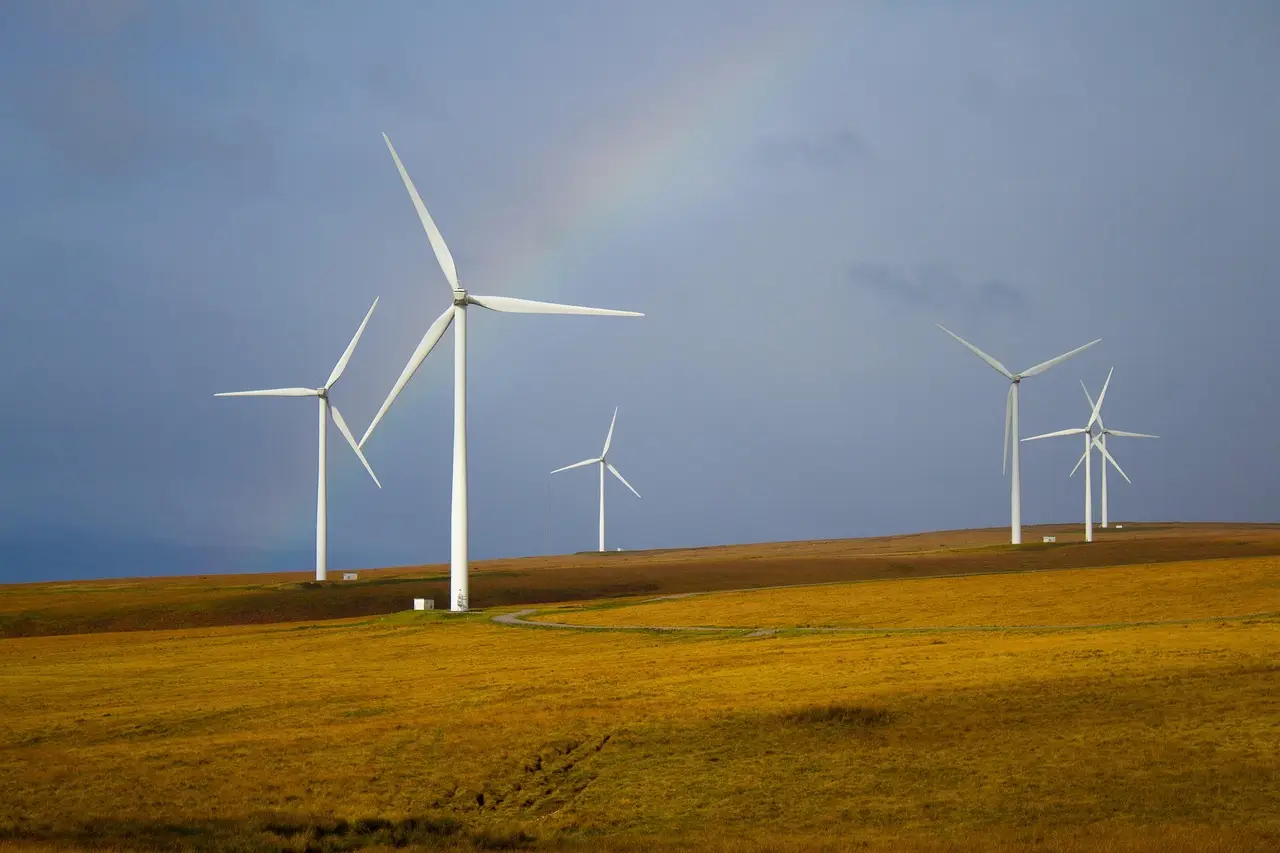
Galaxy operates under China's "source-grid-load-storage" model on a dedicated line rather than the public grid, while Envision's two wind farms sit about 80 kilometers apart and provide 420 MW of combined capacity.
The first two phases carry an expected load of 240 MW. Envision wants the wind farms to supply more than 60% of their electricity.
The wind fleet's 420 MW installed capacity exceeds that initial load by 180 MW. A roughly 35% to 40% Ulanqab wind capacity factor means installed capacity does not equal steady output.
Envision therefore added four-hour battery storage supplied by affiliate AESC. The more-than-60% target links the phase load to the wind-and-storage buildout.
The cooling design links liquid- and air-cooled servers through one water loop. The campus has no central chiller plant.
What does 800V DC change?
In one 5 MW hall, solid-state transformers convert 10 kV AC from the grid directly into 800V DC for the racks, removing low-voltage transformers, uninterruptible power supply units and rectifiers from the power chain.
SemiAnalysis did not report a measured efficiency gain from that arrangement. Envision said on Nov. 2 that the 800V DC system was running live AI workloads.
The company's Nov. 2 statement establishes live operation, but not measured savings. Envision plans a larger deployment in later phases.
The rollout will test whether the electrical architecture scales as Galaxy moves beyond its first 120 MW. On the stated figures, the 800 MW phase plan would sit 20 MW below Abilene's roughly 820 MW critical IT capacity.
Could the site exceed 800 MW?
SemiAnalysis said Galaxy could reach about 1 GW if a wind-turbine factory next to the campus were converted, making that larger estimate conditional rather than part of the announced end-2027 schedule.
The next commercial test is whether Envision can preserve the reported cost advantage as capacity expands. Completion of the remaining phases, wider 800V DC deployment and any factory conversion will show whether the initial economics endure at larger scale.
Source: mlq.ai
More from Grace Kim
Show full bio
Market editor covering people, launches and day-to-day practice in Semiconductors, chip manufacturing, hardware, AI compute at Chip Dispatch.
763 articles
Related articles
envision-builds-120-mw-toward-800-mw-galaxy-ai-data-center
Envision builds 120 MW toward 800 MW Galaxy AI data center
spacexs-10-gw-data-center-build-faces-a-power-test
SpaceX’s 10-GW data-center build faces a power test
samsung-electro-mechanics-commits-6-8-trillion-to-ai-chip-substrates-308af5a7
Samsung Electro-Mechanics Commits ₩6.8 Trillion to AI Chip Substrates
datacenters-will-eat-3-3-of-world-power-gartner-says-06f3688c
Datacenters Will Eat 3.3% of World Power by 2030, Gartner Says