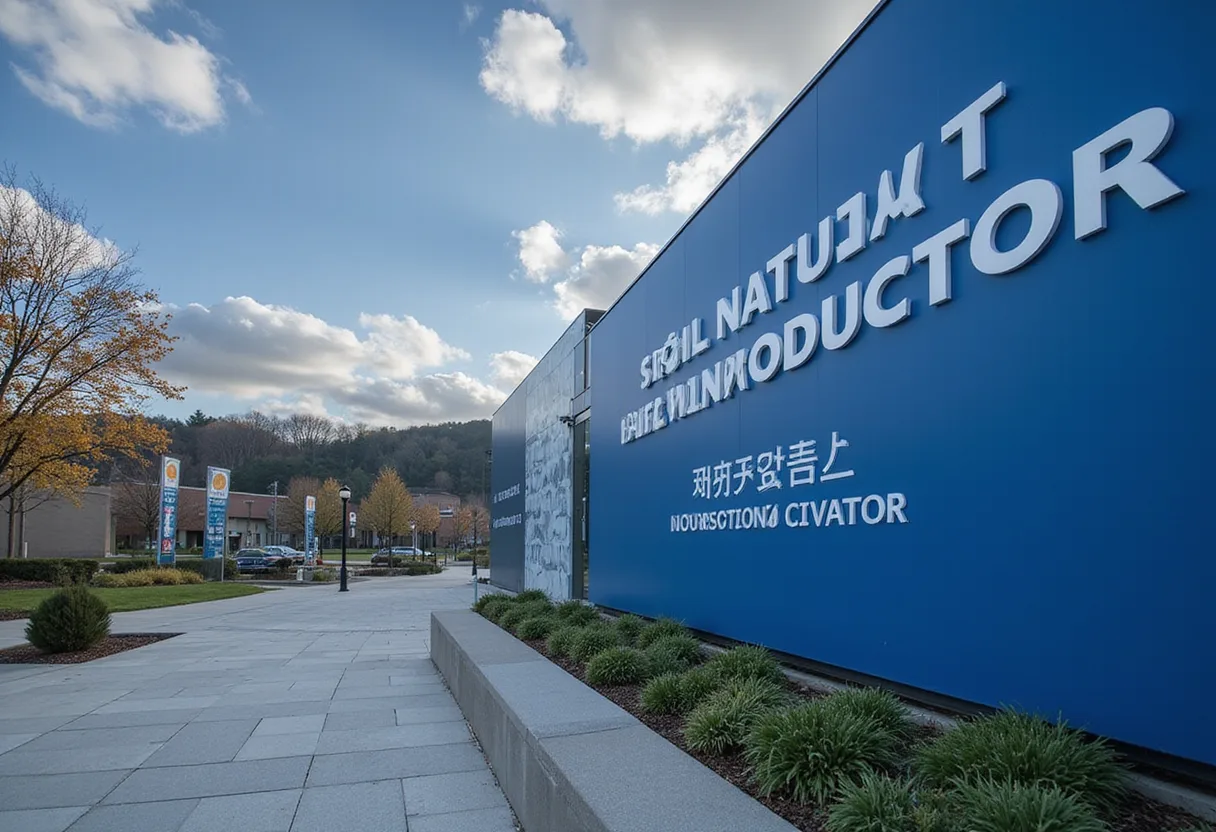
Gangneung Puts Homegrown AI Chips on the Road, Eyes Exports
Gangneung is road-testing Korean-developed AI chips and exploring export channels, giving domestic fabless designers deployment references and a possible route to overseas revenue.
- By
- Tom Whitfield
- Filed
- Channel
- Chips & Policy
- Read
- 3 min read
The South Korean city of Gangneung has begun road-testing domestically developed AI chips and is exploring export opportunities for them, according to a report by Financial News (파이낸셜뉴스). The move puts locally designed artificial intelligence silicon through real-world conditions while the city simultaneously investigates whether the chips can reach buyers abroad.
The story is modest in scale but pointed in direction. A municipal government, rather than a chipmaker's own validation lab, is hosting the deployment. That detail matters because it signals how Korean regional authorities are trying to build demand-side evidence for domestic semiconductor design — evidence that smaller AI chip firms often struggle to generate on their own.
What is actually happening in Gangneung?
The city is testing AI processors developed by Korean companies in live operating environments, the report states. The Financial News headline frames the effort in two parts: the chips are "hitting the road," and the city is "exploring export opportunities."
Read carefully, those are two different claims with two different levels of certainty. The testing is underway. The export path is exploratory — a search for opportunities rather than a signed channel or a shipment figure. No contract values, wafer volumes, or process nodes appear in the source material, so none should be assumed here.
The takeaway: domestic AI silicon is moving from design houses into field deployment, with a city government acting as both testbed and matchmaker.
Why does a city government matter in chip commercialization?
Semiconductor startups usually face a cold-start problem. A chip that works on a bench means little to a customer until it runs in a real setting — a data center, a traffic system, a public facility. By hosting trials, Gangneung gives local designers something they cannot easily buy: operational references.
The export angle follows the same logic. Before a foreign buyer will sample an unproven AI accelerator, the seller needs proof of deployment somewhere credible. A public-sector pilot in an advanced manufacturing economy supplies exactly that. The city's role, in plain terms, is to convert a test into a credential.
One-sentence takeaway: Gangneung is manufacturing the missing middle between chip design and chip sales.
How does this fit Korea's broader AI chip push?
South Korea's semiconductor industry is dominated by memory — Samsung Electronics and SK hynix together control most of the world's DRAM and a large share of high-bandwidth memory used in AI accelerators. The design side of AI logic silicon has historically been thinner, with domestic fabless firms competing against entrenched players in the neural processing unit market.
Regional pilots of the kind reported in Gangneung are one mechanism policymakers use to thicken that part of the stack. Rather than subsidizing fabrication directly, the approach creates early customers for local chip designers and, if exports follow, a route to revenue that does not depend on winning against global incumbents on day one.
The source does not name the specific chip companies involved, the volumes deployed, or the target export markets, so the commercial picture beyond the pilot itself remains open.
Takeaway: this is a demand-side bet — grow domestic AI chip firms by giving them somewhere to run.
What comes next?
The Financial News report frames the export effort as an exploration, not a launch. The natural next milestones, on the pattern such pilots usually follow, would be an expanded deployment scope and a first overseas agreement. Whether Gangneung's homegrown AI chips convert from road test to export order will show whether city-level demand building can meaningfully accelerate Korea's fabless AI segment.
Source: Google News: AI chips
More from Tom Whitfield
Show full bio
Staff writer covering companies, deals and strategy in Semiconductors, chip manufacturing, hardware, AI compute at Chip Dispatch.
665 articles
Related articles
seoul-sends-minister-to-audit-800-trillion-honam-chip-buildout-186b3def
Seoul Sends Minister to Audit ₩800 Trillion Honam Chip Buildout
seoul-national-university-opens-ai-semiconductor-research-center-a560392a
Seoul National University Opens AI Semiconductor Research Center
seoul-targets-southwest-korea-for-semiconductor-and-ai-shipbuilding-push-7ae56c95
Seoul Targets Southwest Korea for Semiconductor and AI Shipbuilding Push
ai-chip-market-headed-for-krw-1-200-trillion-report-warns-ed8c70cc
AI Chip Market Headed for KRW 1,200 Trillion, Report Warns