Google's AI Chips Reach Orbit as MVP Satellite Launches
Four Alphabet AI chips launched aboard a SpaceX Falcon 9 today, testing orbital computing as terrestrial data center opposition blocks $130B in Q1 projects alone.
- By
- Tom Whitfield
- Filed
- Channel
- AI & Compute
- Read
- 4 min read
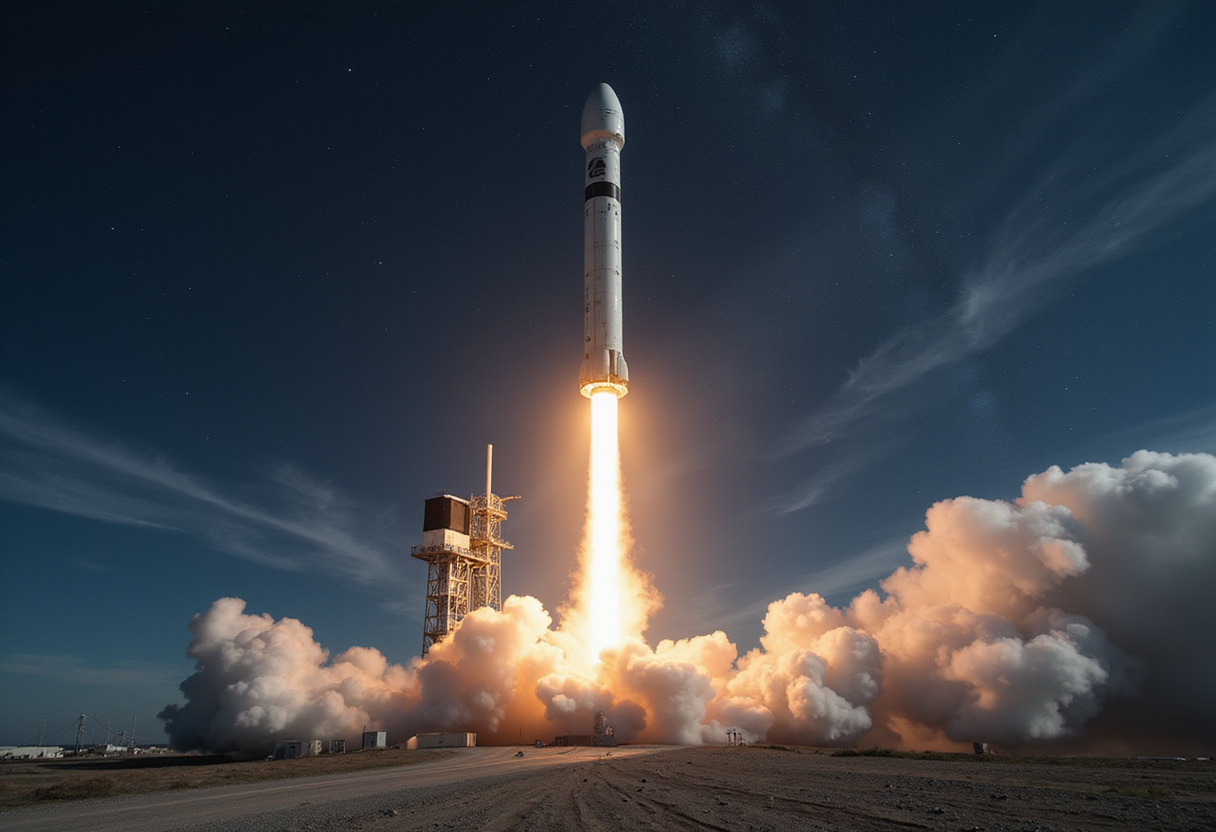
At 2:32 p.m. ET, a SpaceX Falcon 9 lifted off from Vandenberg Space Force Base in California carrying a satellite called MVP — and inside it, four of Alphabet's AI chips, the same silicon family that powers Google's Gemini chatbot. The launch marks the first orbital test of hardware in a project aimed at eventually moving AI compute off Earth.
The mission is deliberately modest. MVP carries roughly the computing power of a single server and draws about as much electricity as a hair dryer. It is not a data center in space; it is a qualification flight. Last month, technicians in a San Francisco lab bolted the satellite to a shaker table and vibrated it violently to simulate launch loads, according to The New York Times, which had an inside look at the project. Nothing came loose.
The commercial logic behind the experiment is straightforward: Earth is becoming a difficult place to build AI infrastructure. AI chips demand enormous electricity and run hot enough to require cooling systems that consume millions of gallons of water. In the right orbit, solar panels can collect up to eight times more energy than ground-based installations, according to Google's own figures, while chips can radiate heat into the cold vacuum of space.
Local opposition adds another constraint. According to Data Center Watch, at least 75 data center projects worth roughly $130 billion were blocked or delayed in the first quarter of this year alone — approximately matching the total for all of 2025. Another 45 projects worth $68 billion followed in the second quarter. There are no zoning hearings 400 miles up.
Elon Musk has pushed the orbital-compute thesis hard. In August he wrote on X: "Orbital compute will be the only way to scale AI probably sometime in 2029 due to power availability & permitting problems on land." Last week, responding to Google's launch announcement, he went further: "The amount of compute in space will obviously round up to 100% of all compute."
Google's own research is more conservative. The company estimates space-based AI will not make economic sense until around 2035, and only if launch costs fall to roughly $200 per kilogram — a fraction of current prices.
SpaceX is not waiting. The company has filed with the Federal Communications Commission for a constellation of up to 1 million computing satellites and targets its first orbital AI deployments for late 2027. Musk has also framed today's Google launch as a milestone in that race, though MVP represents experimental hardware, not a commercial deployment.
The launch also lands amid a turbulent session for semiconductor investors. Micron crushed estimates with data-center revenue jumping elevenfold year over year, yet investors initially sold the stock on concerns that a planned spike in capital spending — driven heavily by new fab and cleanroom construction — signals coming memory overcapacity. A 10-year Treasury yield that touched 5.34%, its highest level since 2002, added pressure before equities recovered.
For SpaceX itself, the orbital-compute push builds on an existing compute business. After merging with xAI earlier this year, SpaceX took over the Colossus data centers in Memphis, packed with hundreds of thousands of Nvidia chips. SpaceX owns the buildings and rents out the capacity — tenants include Anthropic and Google itself. In its first quarterly report as a public company, SpaceX posted revenue of $7.8 billion, up 92% year over year, with its net loss narrowing from $1 billion to $541 million.
The stock trades around $152, up roughly 10% from July even after a 22% drawdown, lifted partly by index mechanics. At the September Nasdaq-100 rebalance, SpaceX's weighting more than doubled from 1.28% to 2.82%, triggering an estimated $15.5 billion to $22 billion in forced index-fund buying. More lockup expirations are due October 9 and October 24, with the full lockup ending December 8 — supply that cuts both ways against a valuation near 106 times sales, compared with roughly 3.7 for the S&P 500.
For now, MVP's four chips represent the moment orbital computing moved from investor-deck renderings to actual silicon circling the planet. Whether it becomes a business will depend on launch costs falling an order of magnitude — and on whether Earth-based data centers can keep clearing zoning boards faster than constellations can be filed.
Original: investorplace.com
More from Tom Whitfield
Show full bio
Staff writer covering consumer brands and retail at Chip Dispatch.
167 articles
Related articles
spacex-and-google-send-ai-chips-into-orbit-to-test-space-data-centers-4dc76cb9
SpaceX and Google Send AI Chips Into Orbit to Test Space Data Centers
google-to-launch-ai-chips-into-space-for-orbital-data-centers-d257cc02
Google to Launch AI Chips Into Space for Orbital Data Centers
google-launches-first-tpu-test-satellite-for-orbital-data-centers-92903fa9
Google Launches First TPU Test Satellite for Orbital Data Centers
spacex-to-launch-google-ai-chips-into-orbit-f680c03f
SpaceX to Launch Google AI Chips Into Orbit