Google Launches First TPU Test Satellite for Orbital Data Centers
Google's Project Suncatcher prototype launches Thursday on a Falcon 9, testing TPUs on 1 kW of power with 20-minute duty cycles ahead of two more satellites in 2027.
- By
- Tom Whitfield
- Filed
- Channel
- AI & Compute
- Read
- 4 min read
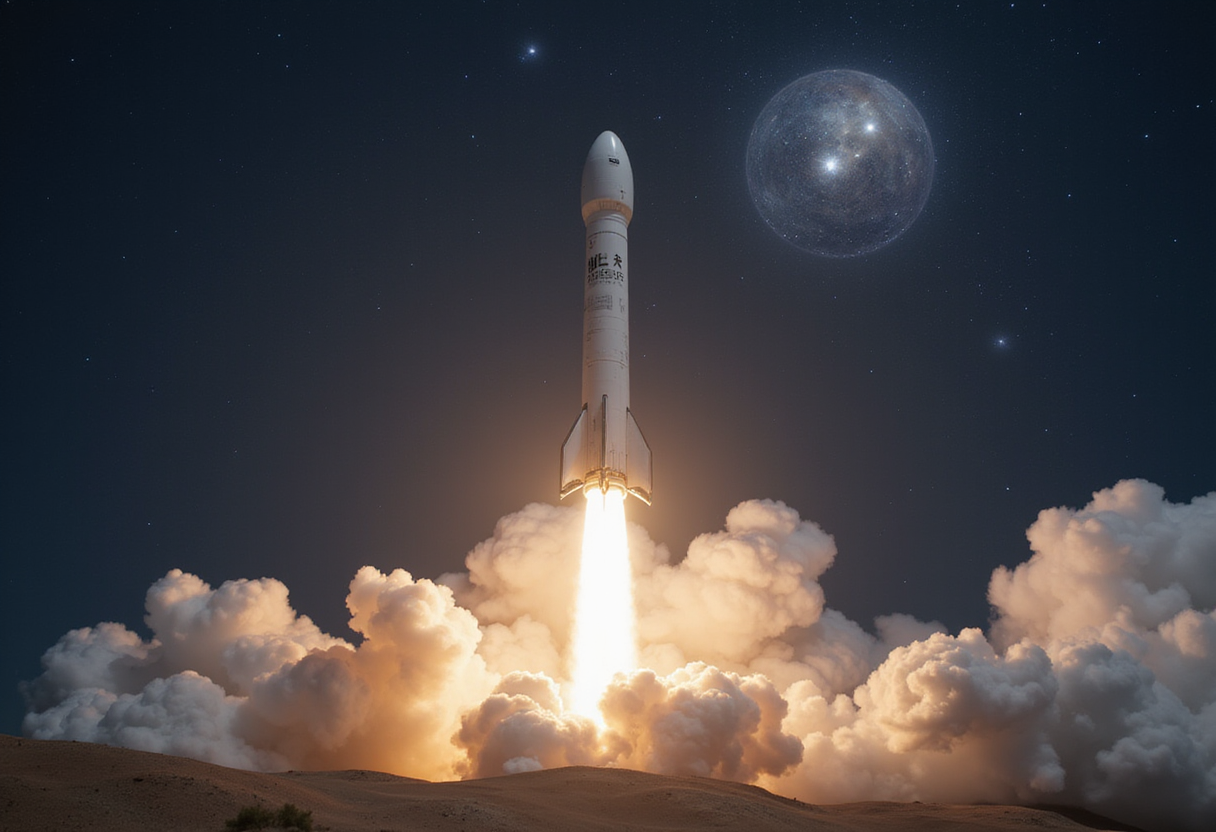
Google's first Project Suncatcher test satellite is scheduled to lift off Thursday at 2:18 p.m. ET aboard a SpaceX Falcon 9 rideshare mission, Transporter-18, from Vandenberg Space Force Base in California — the company's first orbital experiment to determine whether its tensor processing units can survive the journey to space and function in its radiation-riddled environment.
The prototype spacecraft will carry TPUs supplied with roughly 1 kilowatt of power, according to the New York Times — a fraction of the 10 to 20 kilowatts that operational telecommunications satellites generate today, and far below the 50 to 100 kilowatts per satellite that Google's own researchers say an operational AI-computing spacecraft may require. A Google spokesperson confirmed to CNN that the test vehicle will "have to power down every 20 minutes, because we don't want it to overheat," even though its chips will draw far less power than an operational system would.
"This first launch is about seeing what works, identifying points of failure, and applying those findings to future missions," said Travis Beals, Google's senior director of paradigms of intelligence, in a news release. Google plans to follow up in 2027 with two additional satellites that, according to the spokesperson, will operate continuously without overheating shutdowns and may test laser-based intersatellite data links — a capability so far demonstrated at scale only by SpaceX's Starlink constellation.
The initiative responds to a terrestrial constraint: communities from Maine to Texas are fighting to block AI data center construction, while machine learning workloads keep demanding more compute. A similar thesis helped fuel SpaceX's record-shattering IPO earlier this year, and SpaceX has said it plans to deploy a constellation of up to 1 million AI-computing satellites. Google has not disclosed a target constellation size, but a 2025 paper (arXiv:2511.19468) suggested the company proposed operating the technology in clusters of 81 satellites; the spokesperson said the number of clusters needed for a fully operational system remains undetermined.
Radiation testing on the ground at the Crocker Nuclear Laboratory at the University of California, Davis, showed Google's TPU chips fared "remarkably well," the company said — "but some things can only be tested in space." High-energy particles can cause bit flips and shorten hardware lifespans, and orbital congestion raises collision risks that large constellations could worsen.
Cooling may prove the harder problem. Terrestrial data centers rely on convection and evaporating water in cooling towers; the vacuum of space offers no air molecules, so AI satellites will need massive radiators. Google says it will test radiators and heat pipes and "refine our designs as we learn more" — though the first prototype does little to prove the thermal solution, given its 20-minute duty cycle.
The economics remain unresolved. JLL Research noted in a June report that AI chips "advance every 1–2 years, while satellites last 5–7 years, making hardware obsolescence a persistent challenge." The report concluded orbital data centers only become attractive versus terrestrial facilities if launch prices fall dramatically. They are not falling. Launch costs are climbing and expected to keep rising — an advantage for SpaceX, which builds its own rockets and leads the industry in satellite production and orbital launch volume, and a structural headwind for everyone else.
A paper from Google's research team published Thursday in the peer-reviewed journal Joule confirms data center satellites may need to produce as much power as a typical Earth-based data rack — about 50 to 100 kW — a figure that dwarfs current spacecraft power systems. Caleb Henry, director of research at St. Petersburg, Florida-based advisory firm Quilty Space, noted that AI-computing spacecraft may require as much as 100 kilowatts, roughly five to ten times today's telecom satellites.
Google's partner, San Francisco-based satellite operator Planet Labs, shares the long-horizon view. "I do think it's a very viable project long-term," cofounder and CEO Will Marshall said on an earnings call. "This will take significant R&D dollars — and these companies are going to be willing to put dollars behind it."
Google frames Suncatcher as analogous to its early autonomous driving and quantum computing research: years of experimentation before practical systems. With launch costs rising, chip refresh cycles measured in 18 months, and a 100-kilowatt power requirement still unmet by any flying spacecraft, whether orbital data centers ever close the cost gap with terrestrial fabs of compute will hinge on what the 2027 satellites demonstrate about continuous operation and thermal management.
Original: cnn.com
More from Tom Whitfield
Show full bio
Staff writer covering consumer brands and retail at Chip Dispatch.
154 articles
Related articles
alphabet-sends-google-tpus-into-orbit-in-first-space-data-center-test-2d6b37f0
Alphabet Sends Google TPUs Into Orbit in First Space Data Center Test
google-to-fly-first-ai-chips-in-space-under-project-suncatcher-276fccc3
Google to Fly First AI Chips in Space Under Project Suncatcher
google-plans-to-test-ai-chips-in-space-83083084
Google Plans to Test AI Chips in Space
alphabet-to-send-ai-chips-into-orbit-for-first-space-data-center-test-e06a9e6f
Alphabet to Send AI Chips Into Orbit for First Space Data Center Test