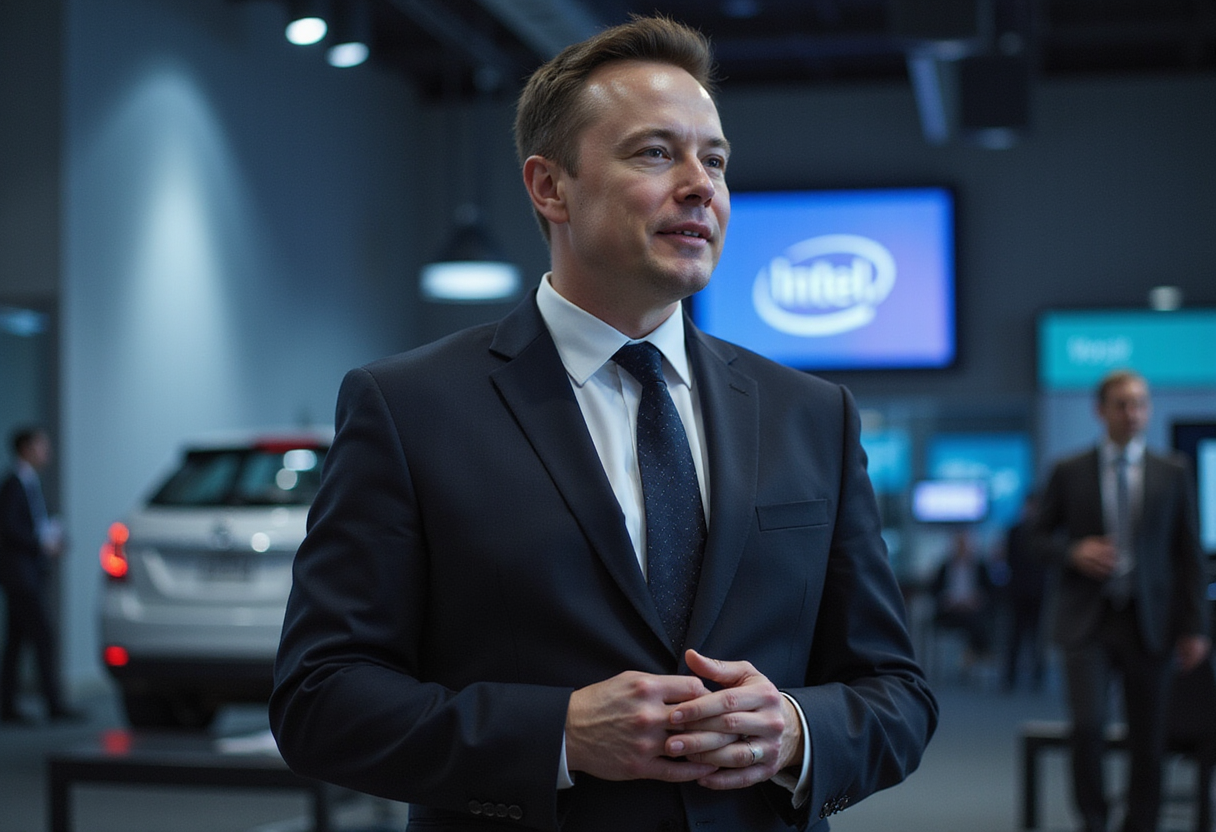
Intel Pulls Back as Musk Confirms TSMC Talks for Terafab
Intel shares pulled back after Elon Musk confirmed TSMC is in talks about his 'Terafab' venture, per FXLeaders. Process node, capacity and deal value remain undisclosed. INTC priced the rumor, not the contract.
- By
- Rebecca Stone
- Filed
- Channel
- Chip Manufacturing
- Read
- 3 min read
Intel shares pulled back after Elon Musk confirmed that TSMC is in talks about his planned "Terafab" semiconductor venture, per an FXLeaders report on the chipmaking discussions.
The report's headline reads: "Intel Pulls Back as Elon Musk Confirms TSMC Talks for Terafab Venture." That framing matters. INTC moved on the confirmation, not on a contract.
What actually moved the tape
Two facts, and only two. Musk confirmed talks with TSMC. Intel reacted. Anything else — process node, capacity figure, capital outlay, timeline — sits outside the public reporting and stayed unspoken.
That absence is itself the story. Foundry orders of the size Musk has publicly described for Terafab usually come with parameters attached: wafer starts per month, which node, what anchor customer, what financing structure. None of that surfaced in the reporting. Traders priced the rumor.
Why the reaction landed on Intel
Intel has staked its turn-around on Intel Foundry — a U.S.-anchored capacity build-out pitched at external customers chasing leading-edge nodes and domestic capacity. A Musk-anchored megafab that landed at TSMC removes one of the few potential anchor customers who could have given Intel's foundry unit a halo name, and a marquee reference logo for the 18A node.
Intel's foundry business has carried heavy operating losses. Its 18A node and Arizona and Ohio fab build-outs are the company's competitive pitch.
Why TSMC, specifically
TSMC sets the benchmark on leading-edge density and yield. Its N3 and N2 nodes remain the reference points for anyone chasing leading-edge silicon. A TSMC tie-up for Terafab would route production through Taiwan rather than betting on a U.S.-only build.
That calculation recurs across Musk's industrial footprint. Stamping out chips in Taiwan cuts years off a process-node ramp. It also carries the geopolitical risk any TSMC customer now runs.
TSMC also owns the advanced packaging allocation Musk's silicon plans would likely need. CoWoS capacity at the Taiwan giant remains the chokepoint for AI accelerator production across NVIDIA, AMD and the hyperscaler custom-silicon programs. A Musk entry into that queue adds another claimant.
What Terafab actually is
Musk has publicly described Terafab as an ambitious vertically integrated chip manufacturing complex, sized to feed Tesla, xAI and SpaceX with custom silicon for AI training, autonomous driving and space-grade systems.
The unit volumes he has floated publicly put Terafab well outside the conventional foundry envelope. A project of that scale would absorb significant wafer capacity and pull advanced packaging allocations — both scarce resources in the current market.
How the foundry order book splits
Three customer tiers steer foundry demand. Hyperscalers, AI labs and consumer chip designers cluster around TSMC's leading-edge density and yield. Industrial, automotive and defense customers increasingly prioritize U.S.-domestic capacity for supply-chain reasons. Musk's venture straddles both columns — Tesla and SpaceX ride Tesla's AI silicon road map, while SpaceX's launch cadence pulls on radiation-hardened parts.
A megafab order anchored at TSMC reinforces the existing market order. A megafab order that landed at Intel would have redrawn it.
What's next
Musk's next public comment on Terafab will move the tape. So will any disclosure of process node, capacity, or anchor-customer commitments. Until then, INTC traders are reacting to a confirmation — not to a contract. The next leg depends on whether Musk names a node, narrows the partner list, or walks the project back entirely.
Source: Google News: TSMC
More from Rebecca Stone
Show full bio
Correspondent covering technology and product news in Semiconductors, chip manufacturing, hardware, AI compute at Chip Dispatch.
394 articles
Related articles
intel-shares-climb-as-musk-rules-out-tsmc-for-terafab-2e193bf7
Intel Shares Climb as Musk Rules Out TSMC for Terafab
musk-confirms-tsmc-could-join-terafab-chilling-intel-s-foundry-story-3845982c
Musk Confirms TSMC Could Join Terafab, Chilling Intel's Foundry Story
intel-holds-line-on-musk-s-terafab-as-tsmc-enters-the-frame-db600c99
Intel Holds Line on Musk's 'Terafab' as TSMC Enters the Frame
intel-shares-fall-3-as-musk-hints-tsmc-may-join-terafab-project-0eee31f3
Intel Shares Fall 3% as Musk Hints TSMC May Join Terafab Project