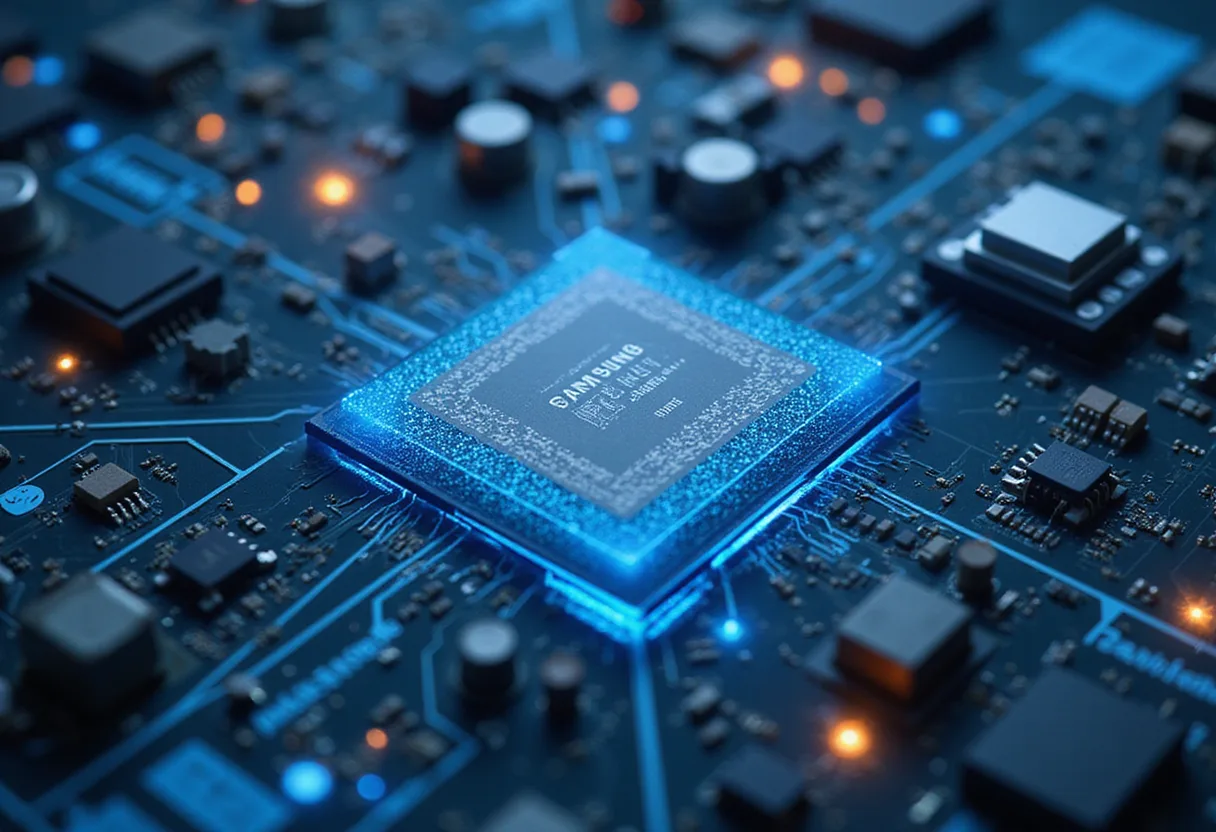
KAI Fits Korean AI Chip Into Next-Gen UAV; Gaonchips Taps Samsung 8nm
KAI will fly a Korean AI chip in its next-gen UAV, with Gaonchips designing into Samsung Foundry's 8nm node to support the defense program.
- By
- Grace Kim
- Filed
- Channel
- Semiconductors
- Read
- 2 min read
Korea Aerospace Industries will equip its next-generation unmanned aerial vehicle with a domestically developed AI chip, Chosunbiz reported, in one of the clearest signals yet that Korean fabless silicon is reaching defense platforms rather than remaining a data-center ambition.
The companion fact matters as much as the platform win. Gaonchips, the Korean design services house, has joined Samsung Electronics' 8-nanometer process program to support the effort, the report said. That pairing gives the program a concrete manufacturing anchor: Samsung Foundry's 8nm node, a mature FinFET process that balances power efficiency against cost for edge inference workloads.
What is confirmed here?
Two things. First, KAI — the country's sole fixed-wing military aircraft maker and the prime contractor behind the KF-21 Boramae fighter program — has selected a Korean AI processor for a next-generation UAV. Second, Gaonchips will design into Samsung's 8nm node as part of the effort.
What remains unspecified in the report is the identity of the AI chip itself, the UAV program concerned, the production timeline, and any volume or value figures. Chip Dispatch will treat those as open questions until KAI, Gaonchips, or the chip supplier confirm them.
Why does the foundry node matter?
The choice of 8nm tells an engineering story. Edge AI processors for airborne platforms must deliver inference throughput inside strict thermal and power envelopes. A mature node such as Samsung's 8nm offers predictable yields and lower wafer costs than the company's gate-all-around nodes, which matters for defense programs priced per unit rather than per cloud instance.
For Samsung Foundry, the engagement adds a domestic defense-adjacent customer at a node the company continues to run in volume. For Gaonchips, it deepens a role the firm has built as the bridge between Korean system companies and Samsung's process ecosystem.
How does this fit Korea's AI silicon push?
Seoul has spent several years pushing domestic AI chip adoption across government and industry, with state procurement programs and R&D funding aimed at reducing reliance on foreign accelerators. A defense UAV design win is a harder test than a server-room pilot project. Flight hardware demands long qualification cycles, environmental hardening, and supply guarantees measured in decades, not quarters.
A program that clears those bars would give the Korean AI chip industry a reference customer with export potential, given KAI's growing portfolio of international UAV and aircraft contracts.
What comes next?
Watch for three confirmations: the named chip supplier, the specific UAV program, and any production schedule tied to the Samsung 8nm line. Until then, the commercial picture rests on a single hard fact — a Korean AI processor has landed a next-generation UAV slot at KAI, with Gaonchips and Samsung Foundry's 8nm process behind it.
Source: Google News: semiconductors
More from Grace Kim
Show full bio
Market editor covering people, launches and day-to-day practice in Semiconductors, chip manufacturing, hardware, AI compute at Chip Dispatch.
621 articles
Related articles
anthropic-eyes-samsung-2nm-for-first-custom-ai-chip-b1e98c3f
Anthropic Eyes Samsung 2nm For First Custom AI Chip
south-korea-commits-576-billion-to-ai-chip-production-12d0fc8c
South Korea Commits $576 Billion to AI Chip Production
samsung-electro-mechanics-commits-6-8-trillion-to-ai-chip-substrates-308af5a7
Samsung Electro-Mechanics Commits ₩6.8 Trillion to AI Chip Substrates
samsung-commits-4b-class-vietnam-test-fab-for-dram-and-nand-6fc54876
Samsung Commits $4B-Class Vietnam Test Fab for DRAM and NAND