Los Alamos Powers Up First NVIDIA Vera CPU Node in Darwin Testbed
Los Alamos National Laboratory brought up the first production-grade NVIDIA Vera CPU node in its Darwin testbed in August, the first stop on the path to its 2027 Mission supercomputer.
- By
- Nathan Brooks
- Filed
- Channel
- AI & Compute
- Read
- 3 min read
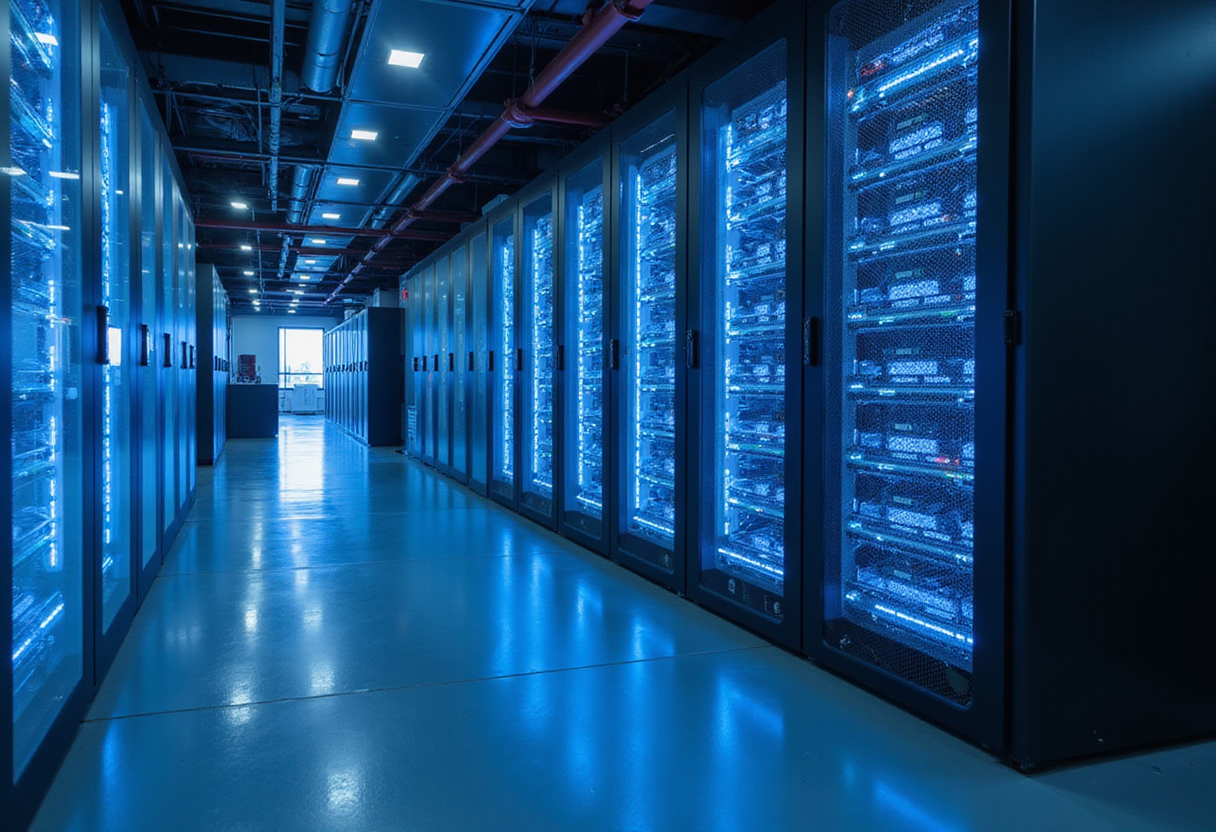
The first production-grade NVIDIA Vera CPU node came online at Los Alamos National Laboratory's Darwin testbed in August, marking a concrete step toward the lab's planned 2027 Mission supercomputer for the National Nuclear Security Administration (NNSA).
The air-cooled MGX Vera CPU node combines two Vera CPUs, each carrying 88 Olympus high-bandwidth cores, in a two-socket server linked by NVIDIA's NVLink Chip-to-Chip interconnect. LANL staff delivered the server in August and brought it up for benchmarking within weeks.
What does Vera replace at Los Alamos?
The deployment extends a more-than-decade-long hardware-software codesign collaboration between LANL, NVIDIA, ARM and HPE. Vera's immediate predecessor, the Grace CPU, currently powers the lab's Venado supercomputer, which HPE and NVIDIA built and delivered. The new Vera node is the first Vera-class CPU platform to reach the Darwin testbed ahead of three planned Vera-powered machines: Mission, Vision and Veritas.
Why does NNSA's Mission use three different accelerators?
Mission, the first NNSA Advanced Technology System built around diverse, purpose-built silicon, splits into three partitions:
- Ranger: Vera CPUs for the highest-complexity 3D multi-physics simulations
- Sandstone: NVIDIA Vera Rubin NVL-4 for GPU-accelerated workloads
- Starlight: NVIDIA Vera Rubin NVL-72 for the largest agentic AI and simulation jobs
Ranger delivers high-frequency, high-bandwidth cores with large aggregate and per-core memory, the configuration NNSA requires for stockpile-stewardship-class modeling.
"In its eventual deployment in Mission's Ranger partition, the Vera CPU will support the NNSA's highest complexity 3D multi-physics simulations and provide the technology foundation for Agentic AI powered workloads," said Galen Shipman, chief architect of advanced technology systems at Los Alamos. "Having collaborated with ARM, NVIDIA and HPE over many years on architectural specification and requirements definition, we are excited to have this Vera CPU in our testbed to further validate our codesign decisions."
When will Mission and Veritas arrive?
The full Ranger partition will install alongside Sandstone in Mission in 2027. The Starlight partition of Mission, along with the Transformer partition of Vision, could ship to Los Alamos as soon as late 2026. Veritas will also receive Vera CPU nodes, though the lab has not disclosed Veritas's delivery date.
The Darwin team, funded by NNSA's Advanced Simulation and Computing Program, runs application-readiness tests today. Venado remains in production.
How is NVIDIA positioning Vera in HPC?
"The next era of scientific discovery will be powered by supercomputers that bring AI and simulation together," said Ian Buck, vice president of hyperscale and HPC at NVIDIA. "Through our long partnership with Los Alamos, Vera CPUs and Rubin GPUs will power Mission, Vision and Veritas, creating a purpose-built foundation for the Laboratory's goal of accelerating the combination of agentic AI with their most complex modeling and simulation workloads."
For Los Alamos, the stakes extend beyond benchmarks. "At the Laboratory, we've concentrated on tailoring hardware technologies in Mission to address simulation characteristics that are not well represented in the broader cloud- and AI-driven market," said Ben Santos, HPC Platforms program director at Los Alamos. "This focus on the unique characteristics of Laboratory applications has allowed our technology partners to address these unique needs with the latest highly impactful enhancements to their base technology portfolio."
Gary Grider, senior director for computing technology at Los Alamos, framed the deployment as an early delivery: "Los Alamos National Laboratory will be one of the first institutions to receive the Vera CPU technology during an ongoing, rigorous collaboration between the Laboratory and NVIDIA."
What comes next for the Darwin testbed?
LANL will run application-readiness, performance and stability tests on the Vera node through the end of 2026, feeding results back into Vera and Rubin design decisions. With Ranger due in 2027 and Starlight possibly arriving before year-end, Los Alamos is positioning itself as one of the first Vera CPU production sites outside NVIDIA's own internal deployments — a sequencing decision that will shape the lab's codesign influence on the Rubin generation that follows.
Original: lanl.gov
More from Nathan Brooks
Show full bio
Senior reporter covering industry trends and analytics at Chip Dispatch.
263 articles
Related articles
coreweave-puts-nvidia-vera-rubin-nvl72-into-production-with-cognition-first-d77d4696
CoreWeave Puts NVIDIA Vera Rubin NVL72 Into Production, With Cognition First
trane-s-liquidstack-cdu-2-x-targets-3-750-lpm-for-next-gen-ai-cooling-29420bca
Trane's LiquidStack CDU 2.X Targets 3,750 lpm for Next-Gen AI Cooling
carla-2026-latin-america-squeezes-more-from-the-machines-it-has-da7be648
CARLA 2026: Latin America Squeezes More From the Machines It Has
nvidia-backed-upscale-ai-connects-chips-from-rival-suppliers-ab6ac47a
Nvidia-Backed Upscale AI Connects Chips From Rival Suppliers