Consumer Tech · 4 min read
MacBook Force Touch trackpad becomes a speaker via haptics
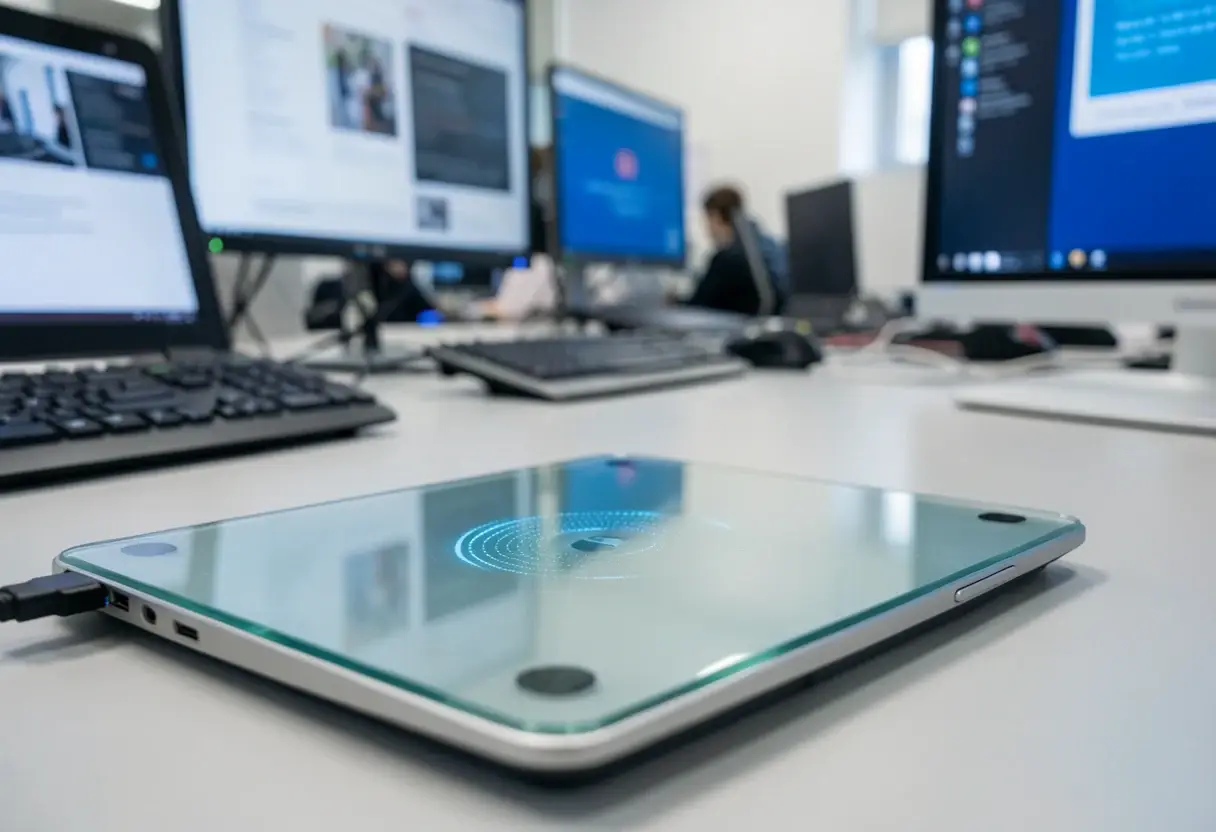
Cody Collier's No Speaker software drives a MacBook's Force Touch haptic motor up to 4,000 times per second, producing audible speech, tones and music through the glass trackpad.
Key takeaways
- No Speaker drives the haptic motor up to 4,000 times per second.
- The demo drum machine uses a 16-step grid.
- Testing covered a MacBook Pro Mac17,10 with M5 Max and macOS 27.2.1.
- Force Touch first appeared in MacBooks in 2015.
- Support requires macOS 12 or later on Apple silicon, or macOS 13 or later on Intel.
By Grace Kim
No Speaker can make a MacBook's Force Touch trackpad produce audible speech, tones and music by driving its haptic motor up to 4,000 times per second.
Cody Collier, who publishes on GitHub as os6, developed the software around the component Apple designed for tactile feedback. The trackpad contains no conventional speaker. No Speaker instead manipulates the haptic motor's vibration frequencies and turns its taps against the glass into audible output.
Force Touch has long been one of Apple's more valued laptop technologies. Its smooth, solid glass surface gives users consistent and accurate tactile feedback through haptics. Collier sees the experiment mainly as a last-resort option for a Mac whose normal audio outputs have all failed. He calls that scenario remote, not a likely reason to replace working speakers.
The limitation keeps the project in hobby territory. The source presents no pricing, commercial product or release timetable. Nothing in the project indicates that Apple has planned a native trackpad-audio feature.
How does a trackpad produce audible sound?
Collier explained: "There's no speaker in a MacBook trackpad, just a small haptic motor that taps the glass so you feel a click."
He added: "No Speaker drives that motor up to 4,000 times a second, fast enough to make sound you can hear, and turns it into a voice."
Collier also says the system can talk, sing, rap and act as an instrument under a user's finger. The normal click remains a tactile input. At faster settings, repeated taps cross into the human hearing range. The same actuator then provides both feedback and sound.
What can the software play?
A demo video mixes speech, test tones and music playback through a MacBook trackpad. Collier plays a melody through the surface. He also programs kick, snare and high-hat sounds into a 16-step grid. That sequence turns the trackpad into a simple drum machine.
No Speaker's audio quality is poor. The closest quality comparison is an ancient Speak & Spell with a severely damaged speaker. The demonstration therefore establishes a novelty rather than a practical replacement for normal laptop audio.
The software treats the trackpad as a playable output surface. Its audible range comes from the haptic motor's repeated contact with the glass, while the available commands determine what text, voice or tone reaches that motor.
How does the nospeaker command work?
The GitHub project page links to Mac software and command-line examples for testing the trackpad. Users pass parameters to the installed nospeaker command.
The command supports:
- Speaking supplied text strings.
- Adjusting the selected No Speaker voice.
- Playing test tones.
- Switching between several user-interface modes.
The demo video lets users evaluate the rough output before installing the software. That route provides a quick way to assess the technique on compatible hardware.
Which Macs meet the requirements?
Collier tested No Speaker on a MacBook Pro identified as Mac17,10, with an M5 Max processor. The test machine ran macOS 27.2.1.
He notes that Force Touch first appeared in MacBooks in 2015. The software may therefore work on MacBooks released from that point onward.
The requirements differ by processor architecture. No Speaker needs macOS 12 or later on Apple silicon, or macOS 13 or later on Intel.
The app detects a missing Force Touch trackpad. It alerts the user if they attempt to run it on a Mac without the required hardware.
Only one machine configuration appears as a confirmed test. The broader 2015-onward compatibility claim remains unverified in the source.
Why does this MacBook hack matter?
No. Earlier tinkerers played music through floppy-drive motors and used hard-drive actuators as speakers. Another MacBook experiment used the hidden LidAngleSensor API to make the lid sound like a creaky door being adjusted.
Those examples show a recurring hobbyist approach to Mac hardware. No Speaker extends that pattern by turning the standard click feedback into audible speech, music and percussion.
The project is presented as independent software rather than an announced Apple feature. Its immediate use is limited, but its software and command-line examples make the technique easy to inspect and test on eligible hardware.
If Collier's compatibility claim holds across MacBooks from 2015 onward, the project could expand the pool of Macs on which No Speaker might work, even without an Apple release or commercial timetable.
Tom's Hardware (Source)
More from Grace Kim
Show full bio
Market editor covering people, launches and day-to-day practice in Semiconductors, chip manufacturing, hardware, AI compute at Chip Dispatch.
1,233 articles