Apple’s Touchscreen MacBook Pro Is More Normal Than Expected
Apple’s touchscreen MacBook Pro uses an OLED PROLED XDR display with deeper blacks than Mini LED and first laptop support for CMF 2026; the key verdict is that it feels normal.
- By
- Rebecca Stone
- Filed
- Channel
- Consumer Tech
- Read
- 4 min read
By Rebecca Stone
Apple’s new MacBook Pro with PROLED XDR Display is the first laptop display to support Apple CMF 2026, bringing an OLED panel and a touchscreen to the MacBook Pro line.
The long-awaited machine is finally here, and the reviewer has tried it. In a hands-on image accompanying the review, a designer uses the touchscreen on a MacBook Pro to manipulate a 3D render, showing a concrete creative task without presenting the notebook as an unfamiliar category of machine.
The reviewer’s central verdict is deliberately understated: “The most surprising thing is how normal it is.” Touch feels ordinary. That is the achievement. The judgment matters because Apple’s last two CEOs, Steve Jobs and Tim Cook, had argued that touchscreen laptops should not exist. The finished product now challenges their earlier position.
What does touch change?
For users, normality sets a demanding commercial test. Touch must earn its place by completing a useful task, not by requiring a separate operating routine. The 3D-render demonstration provides one visible use case, while the reviewer’s verdict suggests that touch does not dominate the MacBook Pro experience.
That conclusion should not be stretched into a full software assessment. The review gives no detail about app support, gesture behavior, palm rejection, stylus input, display latency, hinge placement, keyboard or trackpad changes. Without those specifications, usefulness beyond the demonstrated workflow remains unmeasured.
The contrast with Jobs and Cook also deserves precision. The source establishes earlier skepticism and a current hands-on product, but it does not quote either former CEO responding to this machine or document a formal reversal in Apple’s product policy. A shorthand about Apple changing its mind would therefore compress a more complicated record.
How does OLED compare with Mini LED?
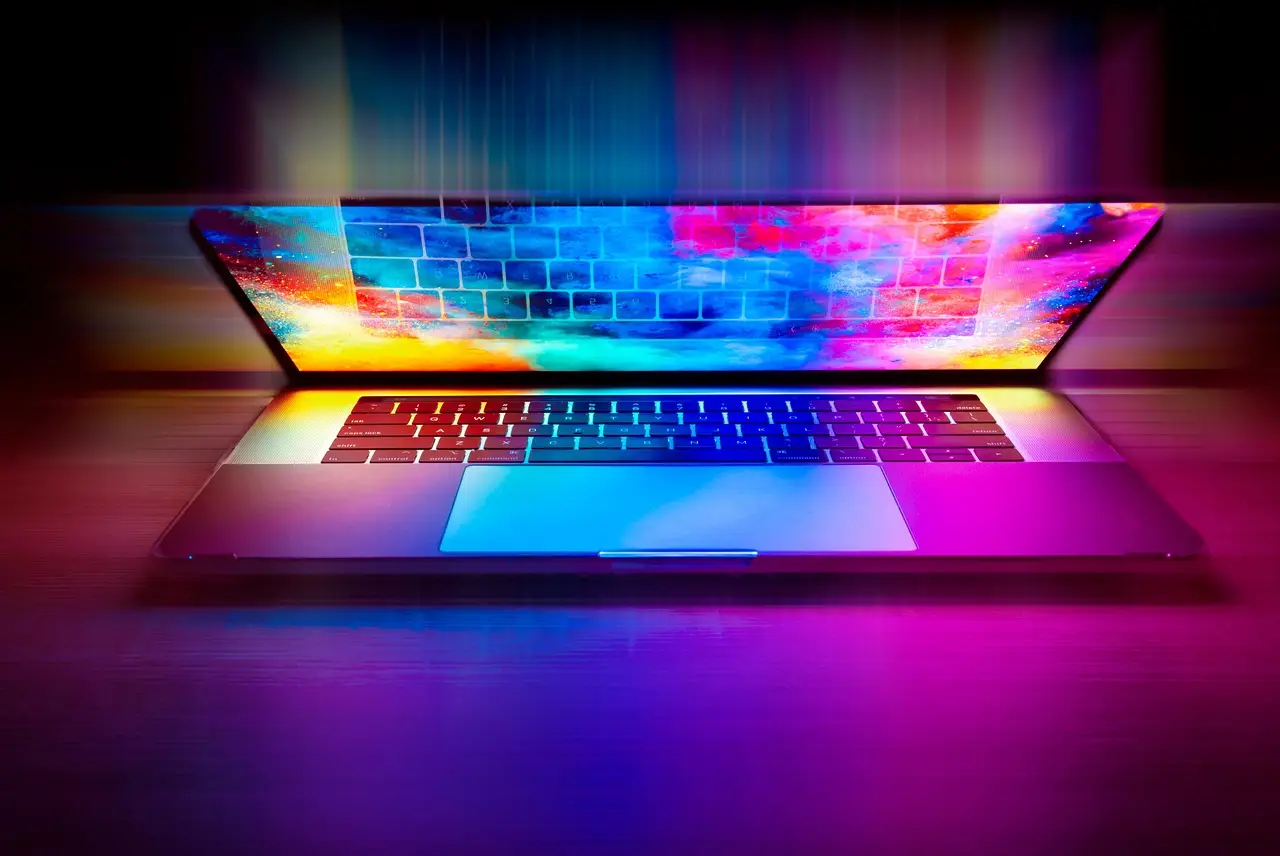
The display comparison is specific but qualitative. The reviewer calls the PROLED XDR Display one of the nicest screens they have seen on a laptop, and calls the current Mini LED MacBook Pros great. The specific improvement cited is the OLED panel’s even inkier blacks. Apple is therefore not replacing an obviously weak predecessor; it is raising the visual standard inside a line that already has capable displays.
The new panel also gets a strong brightness assessment, along with praise for rich colors and infinite contrast. Those are the reviewer’s descriptions, not measured results: the source provides no peak luminance, contrast ratio, color-gamut coverage, refresh rate or test conditions.
Apple calls the panel a “reference-caliber display,” a carefully chosen marketing phrase for a professional display claim. The reviewer says it walks the walk, then adds a more concrete distinction: this is the first laptop display with support for Apple CMF 2026.
That CMF distinction gives the panel a more concrete claim than the marketing label alone. It could matter in the design workflow shown in the hands-on image, but the source does not define which applications or operating-system features depend on CMF 2026, so the commercial reach of the advantage remains open.
The product name raises a separate question the source leaves unresolved. It combines PROLED and XDR while identifying the underlying panel as OLED, but it does not explain whether PROLED denotes a technology tier, a product family or simply Apple’s branding for this display.
What does the source establish commercially?
The available details do not support a supply-chain forecast. They include no display-panel supplier, manufacturing site, process generation, wafer size, capacity figure, panel yield, shipment number, price, release date or revenue estimate. The OLED panel and touchscreen are confirmed product features, not a quantified production or market forecast.
Nor does the review say whether touch functionality extends to other MacBook models or how Apple implements it. It also does not quantify battery impact, repairability or upgrade paths. Those omissions do not overturn the display impressions, but they leave commercial comparisons between this model and the Mini LED line unresolved.
For an audience tracking displays and chips, the absence of panel and device economics is important. The display impressions establish product appeal, yet they cannot show whether panel supply is constrained or whether Apple has priced the new configuration for broad volume.
The most credible competitive conclusion is narrower. The product uses an OLED PROLED XDR panel and CMF 2026 support; the reviewer finds touch normal. Together, those details strengthen an established MacBook Pro proposition rather than create a visibly separate computing category.
For Apple, the next commercial test is whether deeper blacks, the reported brightness and CMF 2026 support can make this touch-equipped OLED model compelling against the company’s own Mini LED MacBook Pros without disturbing the familiar professional workflow. The reviewer’s finding of normality supports the execution; without pricing or shipment evidence, however, the source cannot establish whether the model will gain share or merely shift mix within the MacBook Pro line.
Original: abcnews.com
More from Rebecca Stone
Show full bio
Correspondent covering technology and product news in Semiconductors, chip manufacturing, hardware, AI compute at Chip Dispatch.
726 articles
Related articles
apples-october-event-could-bring-touch-oled-and-m6-macs
Apple’s October event could bring touch, OLED and M6 Macs
apple-ships-a-touchscreen-macbook-pro-after-15-years-of-saying-no
Apple Ships a Touchscreen MacBook Pro After 15 Years of Saying No
apple-ships-touchscreen-macbook-pro-with-oled-and-a-5-799-problem
Apple Ships Touchscreen MacBook Pro With OLED, and a $5,799 Problem
apple-s-first-touchscreen-macbook-pro-starts-at-2-899
Apple's First Touchscreen MacBook Pro Starts at $2,899