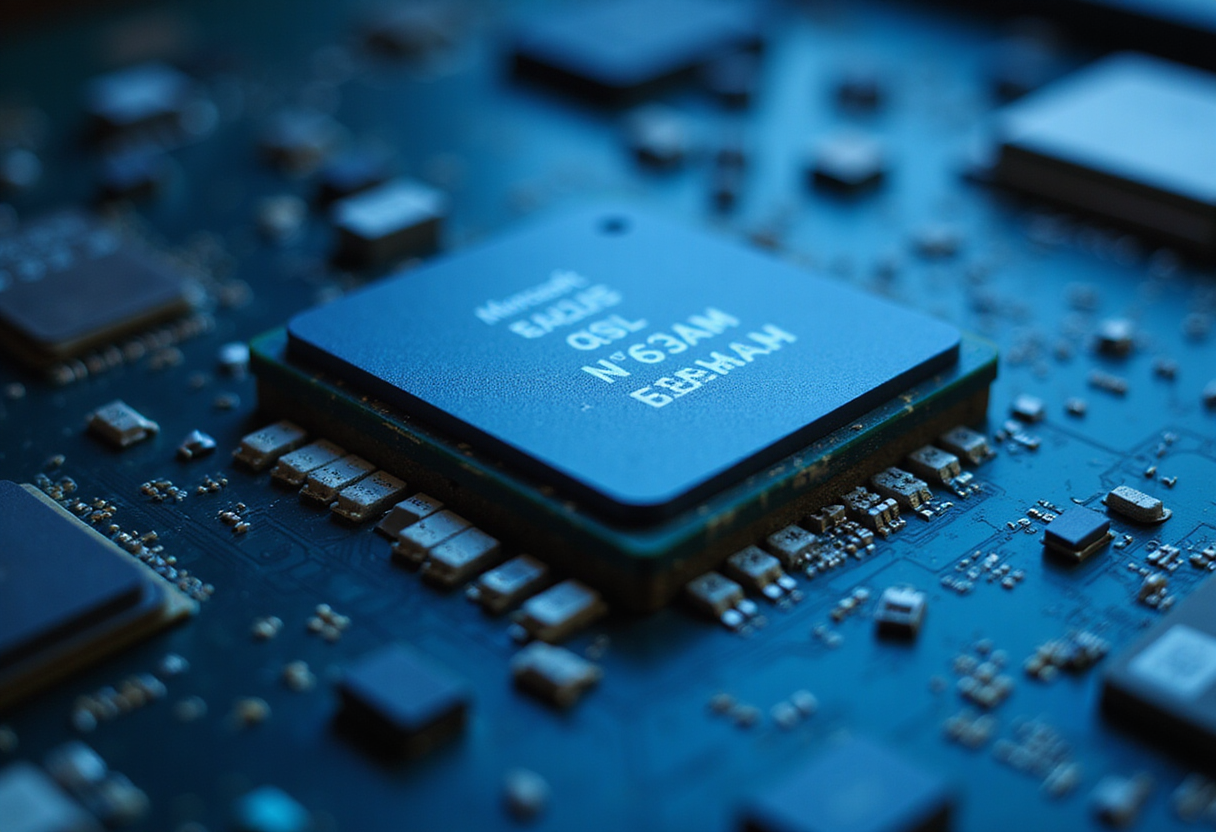
Microsoft Pushes Custom AI Silicon with Azure Maia 300
Microsoft is advancing its second-generation custom AI accelerator, the Azure Maia 300, for Azure data center workloads, per Data Center Knowledge. The chip targets inference and training at hyperscale.
- By
- Tom Whitfield
- Filed
- Channel
- AI & Compute
- Read
- 4 min read
Microsoft is moving forward with its second-generation in-house AI accelerator, branded Azure Maia 300, according to a headline published by Data Center Knowledge. The chip is positioned to handle generative AI inference and training inside Microsoft's Azure data centers, continuing a custom-silicon effort that began with the Azure Maia 100 announcement in November 2023.
Why does Microsoft need its own AI silicon?
The cloud operator has spent the past two years building an internal chip organization under Rani Borkar, the corporate vice president who leads Microsoft's hardware engineering for Azure. The strategic logic is straightforward. Hyperscale AI demand has stressed supply of third-party accelerators, and the cost of inference at scale has become a line item that Microsoft can no longer absorb passively.
By designing its own accelerator, Microsoft gains three levers that an off-the-shelf GPU cannot provide. It can tune the silicon for the specific transformer models that dominate its Azure OpenAI service. It can co-design the host CPU, memory subsystem, and rack-level networking around the accelerator. And it can amortize engineering cost across the largest AI workload base in commercial cloud.
The Maia family is the practical expression of that strategy.
Where does the Maia 300 sit in the lineup?
Microsoft has not publicly released detailed specifications for the Maia 300. The naming convention, however, places the part as a successor to the Maia 100, which Microsoft disclosed alongside the Cobalt 100 server CPU at its Ignite conference in late 2023. The Maia 100 was fabricated on TSMC's N5 process and integrated into Microsoft-designed server boards and rack chassis.
Key facts that can be stated without speculation:
- The Maia 300 is a Microsoft-designed AI accelerator intended for Azure data center deployment.
- It is the reported successor to the Azure Maia 100, Microsoft's first-generation AI chip.
- Microsoft's custom silicon program is led by Rani Borkar's Azure hardware organization.
- The custom chip work runs in parallel with Microsoft's continued large-scale purchases of Nvidia H100 and H200 GPUs for Azure.
What changes for Nvidia and AMD?
The commercial impact depends on volume. Nvidia reported data center revenue of $47.5 billion in fiscal 2025, a figure that includes purchases by Microsoft, Google, Meta, and the major hyperscalers. Microsoft's own design work does not displace that pipeline in the short term. The H100 and the Blackwell-generation B200 remain the default training silicon for frontier model builders.
Where Microsoft can move the needle is on inference. Inference workloads are steady-state, latency-sensitive, and run continuously. They reward silicon that is tuned for a specific model family rather than raw training throughput. A purpose-built inference accelerator with a competitive cost-per-token figure can displace a portion of Nvidia's volume inside a single hyperscaler's fleet without affecting the broader market.
Microsoft's posture is consistent with that calculus. The company has publicly described its custom silicon as complementary to Nvidia, not competitive with it at the high end of training.
How does this fit the broader custom-chip trend?
Microsoft joins Google, Amazon, and Meta in operating an in-house AI accelerator program. Google's TPU has been in production since 2018 and now spans multiple generations, with the Trillium generation shipping in 2024. Amazon's Trainium and Inferentia lines target training and inference inside AWS. Meta's MTIA family focuses on recommendation and ranking workloads.
The four largest hyperscalers are now also the four largest merchant buyers of third-party AI accelerators. That overlap is the central tension in the segment. Custom silicon reduces cost and improves workload fit. Off-the-shelf silicon offers supply elasticity and a mature software stack.
What to watch next
The operative question for the second half of 2026 is deployment volume. Microsoft has not disclosed how many Maia 300 units it intends to ship, nor which foundry node the part targets. Until those figures are published, the chip's commercial weight inside Azure remains a roadmap rather than a confirmed capacity figure. Pricing-per-token for inference on Maia 300 versus Nvidia B200 will be the metric that determines whether Microsoft's second custom accelerator scales beyond pilot racks and into the broader Azure fleet.
Source: Google News: AI chips
More from Tom Whitfield
Show full bio
Staff writer covering companies, deals and strategy in Semiconductors, chip manufacturing, hardware, AI compute at Chip Dispatch.
456 articles
Related articles
microsoft-makes-maia-its-primary-ai-architecture-cnbc-416eb19f
Microsoft Makes Maia Its Primary AI Architecture: CNBC
microsoft-readies-maia-300-for-wider-rollout-next-year-dd4e3650
Microsoft Readies Maia 300 for Wider Rollout Next Year
microsoft-targets-nvidia-dependence-with-maia-300-ai-chip-bf806ff4
Microsoft Targets Nvidia Dependence With Maia 300 AI Chip
microsoft-speeds-up-azure-maia-rollout-to-reduce-nvidia-dependence-90f1f079
Microsoft Speeds Up Azure Maia Rollout to Reduce Nvidia Dependence