AI & Compute · 4 min read
NVIDIA's Own Rack Now Rebuts the 'GPU for Everything' Myth
Groq's 3 LPU joins NVIDIA's Vera Rubin rack, TrendForce sees ASIC servers at 27.8% of 2026 shipments, and Rizzatti argues agentic workloads demand new silicon: control-flow acceleration and hardware-managed memory.
Key takeaways
- Groq 3 LPU carries 500 MB of on-chip SRAM at 150 TB/s with no HBM and sits in NVIDIA's Vera Rubin platform.
- TrendForce forecasts ASIC-based AI servers at 27.8% of shipments in 2026, near 40% by 2030.
- NVIDIA lost roughly $590 billion in market value in one day after DeepSeek's January 2025 release.
- Rubin CPX pairs 128 GB of GDDR7 with 30 PFLOPS of NVFP4 for prefill in disaggregated serving.
- NVIDIA announced a BlueField-4-based KV-cache storage tier in January 2026.
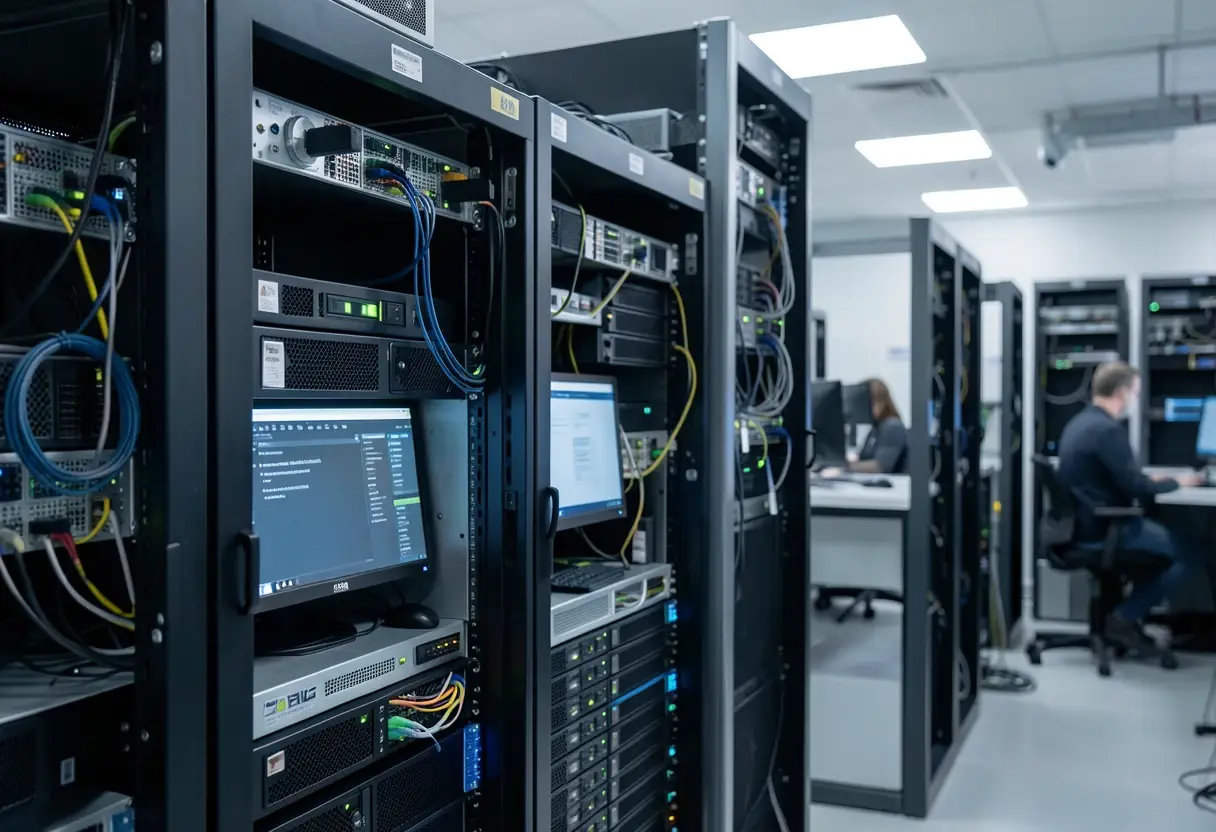
Groq's 3 LPU, with 500 MB of on-chip SRAM, 150 TB/s of bandwidth and no HBM at all, now sits inside NVIDIA's Vera Rubin platform alongside Rubin GPUs and the GDDR7-based Rubin CPX. That pairing is the strongest evidence in Lauro Rizzatti's updated survey of AI architecture myths: the GPU is no longer the only answer, even inside the GPU leader's own rack.
Rizzatti, business development executive at VSORA and a longtime chip verification consultant, has published the 2026 edition of his myth-debunking analysis, previously issued in 2023 and 2025. The context has shifted, he writes: the industry has moved into autonomous AI agents, test-time compute, sovereign deployment and extreme energy constraints.
What has changed since 2025?
Heterogeneity is now the architecture, not the exception. TrendForce forecasts that ASIC-based AI servers will account for 27.8% of AI server shipments in 2026, rising to nearly 40% by 2030, as hyperscalers expand in-house accelerators.
Inference itself has split in two, Rizzatti argues. Prefill is compute-bound and highly parallel. Decode generates tokens one at a time and is memory-bandwidth-bound at low arithmetic intensity. One chip serving both phases is over-provisioned for one and starved for the other. Disaggregated serving places prefill on compute-dense parts — the Rubin CPX with 128 GB of GDDR7 and 30 PFLOPS of NVFP4 — and decode on bandwidth-rich parts such as the Groq 3 LPU, with the KV cache shipped between them.
Do agents change the silicon?
Yes, fundamentally. Agentic workloads introduce unpredictable control branching, dynamic sequence lengths, fast switching between retrieval and tool calling, and persistent KV-cache management across multi-turn interactions. Rizzatti writes that running multi-agent orchestration on hardware designed for static LLM generation leads to severe pipeline stalls, memory fragmentation and cache latency bottlenecks. Next-generation AI processors, he concludes, require dedicated control-flow acceleration, hardware-managed dynamic memory allocation, and ultra-fast context switching.
Can more HBM stacks fix the memory wall?
No. Rizzatti cites three walls: thermal, physical and financial. Stacking 8 to 12 HBM layers adjacent to high-power compute dies drives up cooling overhead — often requiring direct-to-chip liquid cooling — and drives die yields down. Memory capacity and bandwidth scale linearly, while agentic context windows grow exponentially. Real relief, he writes, requires near-memory computing, processing-in-memory, fine-grained SRAM caching and hardware-accelerated context compression.
The memory constraint shows up in pricing. AI demand has diverted enough DRAM capacity to push conventional memory prices sharply higher through 2026, and HBM supply gates every leading accelerator. In January 2026, NVIDIA announced a BlueField-4-based storage tier dedicated solely to holding KV cache outside the GPU. When a vendor builds a storage product for one data structure, Rizzatti notes, the bottleneck is not compute. He cites Stanford professor Mark Horowitz's data that DRAM access costs roughly a thousand times the energy of an integer add; million-token contexts push KV cache from gigabytes to terabytes per rack.
Does efficiency shrink hardware demand?
The DeepSeek episode answered that. When the company released low-cost models in January 2025, NVIDIA shed roughly $590 billion of market value in a single day. The opposite happened: usage expanded with longer contexts, reasoning by default and agents calling models dozens of times per task. Rizzatti invokes Jevons' paradox, first observed with coal in the 1860s, and advises hardware planners to treat efficiency as a demand accelerant.
Mixture-of-experts models follow the same logic. MoE activates often under 10% of parameters per token, which is why most frontier models use it. But every expert must reside in fast memory, and each layer triggers an all-to-all exchange across accelerators. MoE is a reason to build bigger scale-up domains, not smaller systems.
What about precision, chiplets and design automation?
FP4 is now practical: NVIDIA's Blackwell supports NVFP4, and its 2026 material describes training and inference applications. Rizzatti cautions that scaling, outliers, accumulation and sensitive operations still require attention, and a small change in an average benchmark score may conceal a larger loss on a particular workload. The older assumption that training requires FP32 throughout is also wrong.
Chiplet integration via 2.5D/3D packaging is a physical enabler, not a substitute for hardware/software co-design. Batching improves decode only up to the roofline ridge, where it turns from memory-bound to compute-bound; beyond it, latency grows with little throughput gain.
At DAC 2026, Synopsys, Cadence and Siemens launched agentic AI workflows, some billed as fully autonomous, with claims including up to 50X faster time to validated RTL — largely unaudited by named customers. A tapeout remains an irreversible, multi-million-dollar commitment. AI raises the productivity of skilled engineers, Rizzatti concludes; it does not replace the engineer accountable for the silicon. With ASIC share climbing toward 40% by 2030 and memory pricing still tight, the competitive question for vendors is which inference phase they serve, at what context length, under what latency target.
Electronic Design (Source)
More from Grace Kim
Show full bio
Market editor covering people, launches and day-to-day practice in Semiconductors, chip manufacturing, hardware, AI compute at Chip Dispatch.
1,314 articles