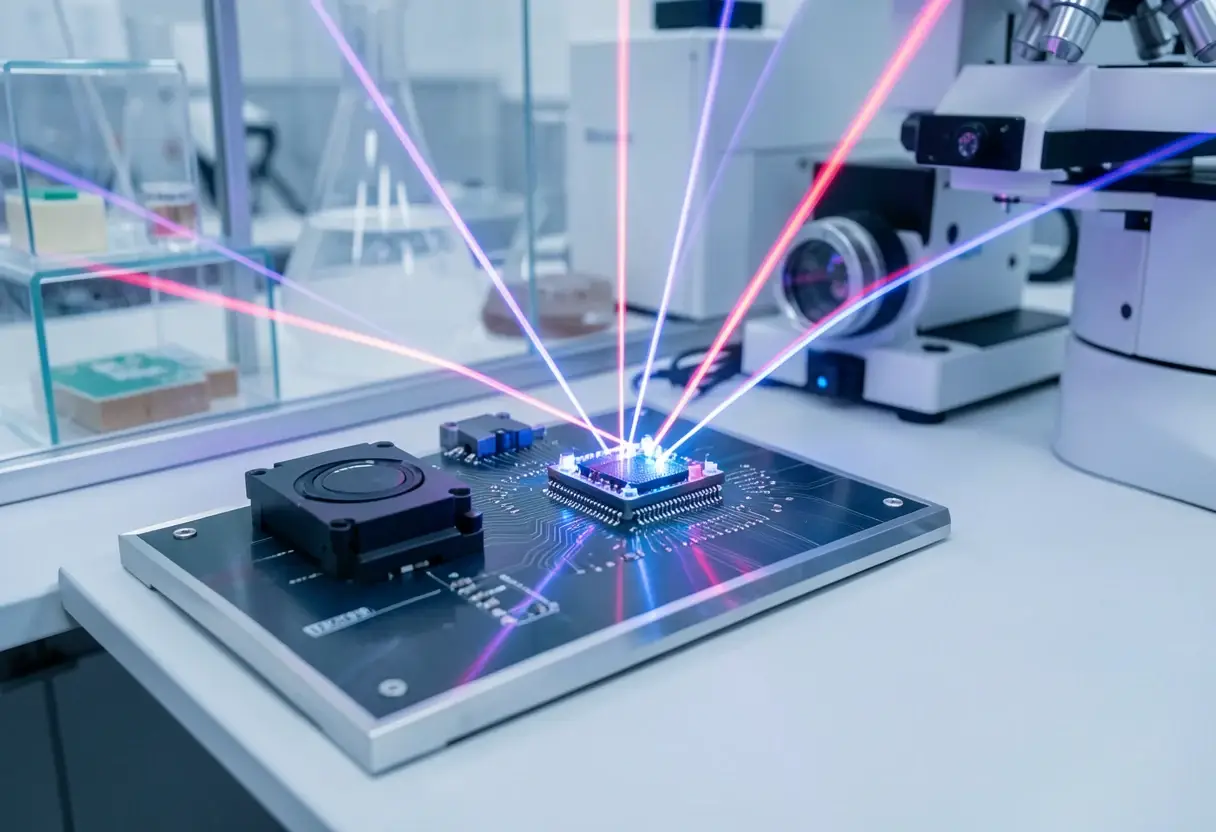
Photonics Takes Another Run at AI Inference as Power Bills Bite
Optical-computing firms now command $2.22 billion, up from $0.4 billion in 2022, as AI inference hits power limits and startups promise 10- to 80-fold energy gains over GPUs.
- By
- Rebecca Stone
- Filed
- Channel
- AI & Compute
- Read
- 4 min read
The optical-computing sector's market valuation has jumped from $0.4 billion in 2022 to $2.22 billion today, and the reason is one word: AI inference. Data centers built to answer user queries have hit hard power limits, and a wave of startups in the United States, China, Germany, Israel and England now argues that light, not silicon, can do the multiplication at the heart of that workload for a fraction of the energy.
"Most of the interest in [photonics] is driven by the fact that AI inference has literally become limited by power, and in a rather striking manner," says Peter McMahon, associate professor of applied and engineering physics at Cornell University, who has researched optical computing for over a decade.
Why optics could win on energy
The core of inference is matrix-vector multiplication, and optical computing's founding blueprint dates to 1978, when Stanford pioneer Joseph W. Goodman proposed doing it with LEDs, lenses and a pixelated attenuator. In electronics, multiplying an N-by-N matrix costs energy proportional to N². In optics, the attenuator does the multiplication passively; only encoding the vector and reading out the result cost energy, scaling as N.
The physics has matured. In 2022, a Cornell team led by McMahon demonstrated an optical neural network consuming less than one photon — roughly 2.5 x 10⁻¹⁹ joules — per multiplication, versus 10⁻¹² to 10⁻¹⁴ joules on a standard computer. That suggests a possible 100,000x energy reduction.
McMahon urges caution. Encoding data into light costs energy too, and the crossover point matters. "The very rough answer is somewhere between N equals 1,000 and N equals 10,000," he says of the vector size needed before optics starts winning. Amdahl's law also applies: matrix multiplication is only part of the workload, with nonlinear operations left to electronics. Companies today realistically target a 10- to 80-fold energy-efficiency gain over GPUs — if they scale before CMOS catches up.
Who is building what
- Lumai (Oxford, England) uses free-space optics with a spatial light modulator. "A full vector-matrix multiply completes in a single optical cycle," says head of product Phillip Burr. Its Iris Nova evaluation server shipped April 2026; the next-gen Iris Aura targets prefill at roughly one-tenth of GPU energy.
- Neurophos (Austin, Texas) builds metamaterial modulators several micrometers per side, fitting a 1,000 x 1,000 array on a 5-mm-square chip — switching over 10,000 times faster than liquid-crystal modulators. CEO Patrick Bowen targets "50 times Blackwell B200's speed and 35 times its energy efficiency," with a roadmap to 250x speed and ~90x efficiency. The CMOS-compatible chips are due in customer racks in 2028; a fab site is being chosen now.
- Q.ANT (Stuttgart, Germany) and Lightelligence (Shanghai) integrate photonics on silicon. Q.ANT's Native Processing Server already runs at the Leibniz Supercomputing Centre in Munich and Jülich Supercomputing Centre, with a commercial sale to cloud provider Ionos. Lightelligence's PACE2 processor multiplies 128 x 128 matrices; a 2025 Nature paper described 1-GHz operation at 3-nanosecond latency, claiming two orders of magnitude lower latency than GPUs.
- LightSolver (Israel) puts a spatial light modulator inside a laser-like cavity with a gain medium. Emulation shows its laser processing unit solving differential equations 40 to 80,000 times faster than a GPU depending on workflow; energy benchmarks are pending. CEO Ruti Ben-Shlomi says its own image-generation algorithm could deliver "dramatic energy-consumption decrease and speedup."
- Optalysys (Leeds, England) inserts passive on-chip Fourier transforms into the network path, where data already travels as light. "We're effectively adding processing to where there is none right now," says founder Nick New, targeting memory-bound decode workloads, compression and format conversion.
Can photonics actually displace GPUs?
Not soon, says Yale's Logan Wright. "The direction of algorithm development... is most likely to go in the opposite direction, because [AI developers] want it to work better on GPUs." But he sees a door opening through Nvidia's and TSMC's real investment in co-packaged silicon photonics for switching and interconnects.
Q.ANT's Michael Förtsch frames the endpoint: "We see the data center of the future as heterogeneous: CPUs, GPUs and photonic NPUs each take on the tasks they are best suited for." With Iris Nova in evaluation, Neurophos racks promised for 2028, and analog-to-digital conversion still the unsolved energy bottleneck, the next three years will show whether optics can deliver its promised 10- to 80-fold gains at volume before silicon closes the gap.
Source: spectrum.ieee.org
More from Rebecca Stone
Show full bio
Correspondent covering technology and product news in Semiconductors, chip manufacturing, hardware, AI compute at Chip Dispatch.
1,052 articles
Related articles
cscale-raises-145-million-for-optical-networking-for-ai-c2a9d0a5
CScale Raises $145 Million for Optical Networking for AI
volantis-raises-88-million-to-attack-ai-s-memory-wall-with-photonics-055f6c14
Volantis Raises $88 Million to Attack AI's Memory Wall With Photonics
volantis-banks-88m-to-build-a-photonic-memory-layer-for-ai-inference-9caa83f8
Volantis Banks $88M to Build a Photonic Memory Layer for AI Inference
sima-ai-banks-150-million-to-scale-physical-ai-chips-c5a094d3
SiMa.ai Banks $150 Million to Scale Physical AI Chips