PUE Blind Spot: Why AI Rack Power Demands a New Efficiency Metric
AI racks now draw 15 to 100 kW, yet PUE stops at the server door and cannot see conversion losses inside. Lotus Microsystems' CEO argues for a stage-by-stage power delivery metric.
- By
- Grace Kim
- Filed
- Channel
- AI & Compute
- Read
- 5 min read
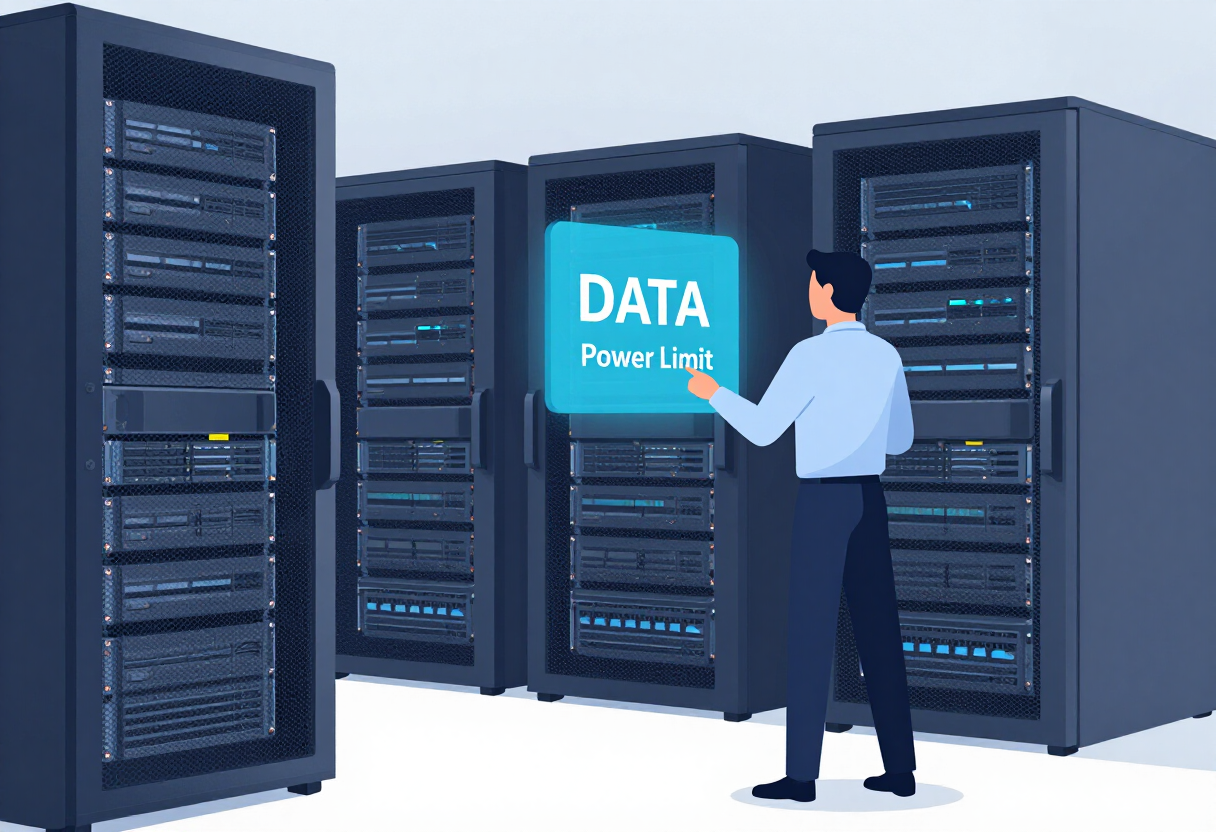
AI facilities are now being designed with power-per-rack specifications of 15 to 50 kW, with GPU-dense configurations exceeding 100 kW — roughly an order of magnitude above the 5 to 8 kW per rack typical just five years ago. Yet the industry's default efficiency yardstick, power usage effectiveness (PUE), cannot see any of the power lost inside the servers themselves.
That is the argument advanced by Hans Hasselby-Andersen, CEO of Lotus Microsystems, in a recent analysis of AI data center efficiency. His point is structural, not rhetorical: PUE measures everything that happens to power before it reaches the server — cooling, lighting, power distribution — and stops the moment power crosses the server's threshold. What happens after that, as electricity moves through the server and down to the AI processor, sits entirely outside the metric.
A facility can therefore report an industry-leading PUE while losing a meaningful share of its power invisibly inside its own servers.
What PUE Measures, and Where It Stops
PUE compares a facility's total energy draw to the energy that reaches IT equipment. The ratio captures facility-level overhead, and operators compete to push it toward the theoretical ideal of 1.0. Regulators cite it. Sustainability reports lead with it.
Hasselby-Andersen, whose two-decade semiconductor career includes Texas Instruments, Infineon and the founding of Merus Audio (acquired by Infineon in 2018), argues the metric was designed for a different era — one of modest, relatively uniform server power draw. It gave operators a clean, comparable number for facility-level waste, and it has worked well for years.
What PUE was never designed to do is look inside the server. It has no visibility into how efficiently power is converted once it arrives: from the AC feed, through the server's power supply, down through intermediate voltage converter (IBC) stages, to the specific voltage a processor requires. That entire path is treated as a black box.
The Conversion Chain Inside the Server
Delivering power from the wall to an AI processor is not a single step. Power typically enters as AC and converts to a high-voltage DC bus. It then steps down through one or more DC-DC conversion stages. Finally, a point-of-load (POL) converter regulates power at the last stage before the processor, where voltage must be delivered precisely and hold steady under load.
Every stage in that chain has its own efficiency curve, and every stage leaks power as heat rather than delivering it to compute. None of that shows up in a facility-level metric. The losses appear as heat that must be cooled, as power draw that corresponds to no useful work, and as the energy spent spinning cooling fans or pumping liquid coolant. An operator monitoring PUE alone has no way to see any of it.
Why AI Changes the Stakes
The physics of conversion losses does not change with scale, but the stakes do. AI accelerators draw far more current, at far more aggressive and less predictable load transients, than the CPU-dominated racks PUE was developed around. Power electronics must respond faster and hold tighter tolerances, at power levels that would have been unusual only a few years ago.
A conversion inefficiency that was a rounding error at 5 to 8 kW per rack becomes real, measurable waste once multiplied across AI-era power levels and multiplied again across a fleet of racks. The same percentage loss now means significantly more wasted energy, more heat to remove, and higher electricity bills simply because the baseline draw is so much higher. PUE does not move to reflect any of this, because it never measured this part of the path in the first place.
Extending the Metric Past the Server Door
Hasselby-Andersen is careful to frame this not as an argument against PUE, which still does what it was built to do, but as a case for a more complete measure — one that extends past the server door and accounts for each conversion stage inside it, including the point-of-load regulation closest to the processor, where a large share of remaining losses tend to concentrate.
That does not necessarily mean replacing PUE. It could mean pairing it with a conversion-stage efficiency measure, or asking equipment vendors to report power delivery efficiency the way they already report other performance specs. What matters, he writes, is that the industry starts treating server-internal power delivery as something to be measured and compared, rather than an assumed constant.
What It Means for Operators
For operators, the commercial consequence is direct. An operator relying on PUE alone sees part of the cost and emissions picture, not the whole one. Energy lost inside the server still appears on the power bill, still generates heat that needs cooling, and still carries an emissions footprint — it is simply not attributed to anything, because no metric currently exists to catch it.
Operators and architects need not wait for an industry-standard metric to start asking better questions. Ask vendors how power delivery efficiency is measured stage by stage, not just at the server's rated input. Examine point-of-load conversion specifically, since that is where AI-era current density concentrates the remaining losses.
As AI infrastructure scales and the grid demand that scale creates continues to build, the pressure to account for server-internal power losses will grow — and vendors able to demonstrate higher conversion-stage efficiency, particularly at the point of load, stand to gain a measurable commercial edge.
Original: datacenterdynamics.com
More from Grace Kim
Show full bio
Market editor covering industry trends and analytics at Chip Dispatch.
164 articles
Related articles
ubs-power-supply-will-just-cover-ai-chip-boom-if-everything-gets-built-01689683
UBS: Power Supply Will Just Cover AI Chip Boom — If Everything Gets Built
power-not-accelerators-now-caps-data-center-ai-scaling-6bd78ff3
Power, Not Accelerators, Now Caps Data Center AI Scaling
taiwan-s-nchc-cloud-compute-center-earns-silver-green-building-rating-7248b115
Taiwan's NCHC Cloud Compute Center Earns Silver Green Building Rating
on-semiconductor-positioned-as-sleeper-ai-infrastructure-play-fb6f3fd0
ON Semiconductor Positioned as Sleeper AI Infrastructure Play