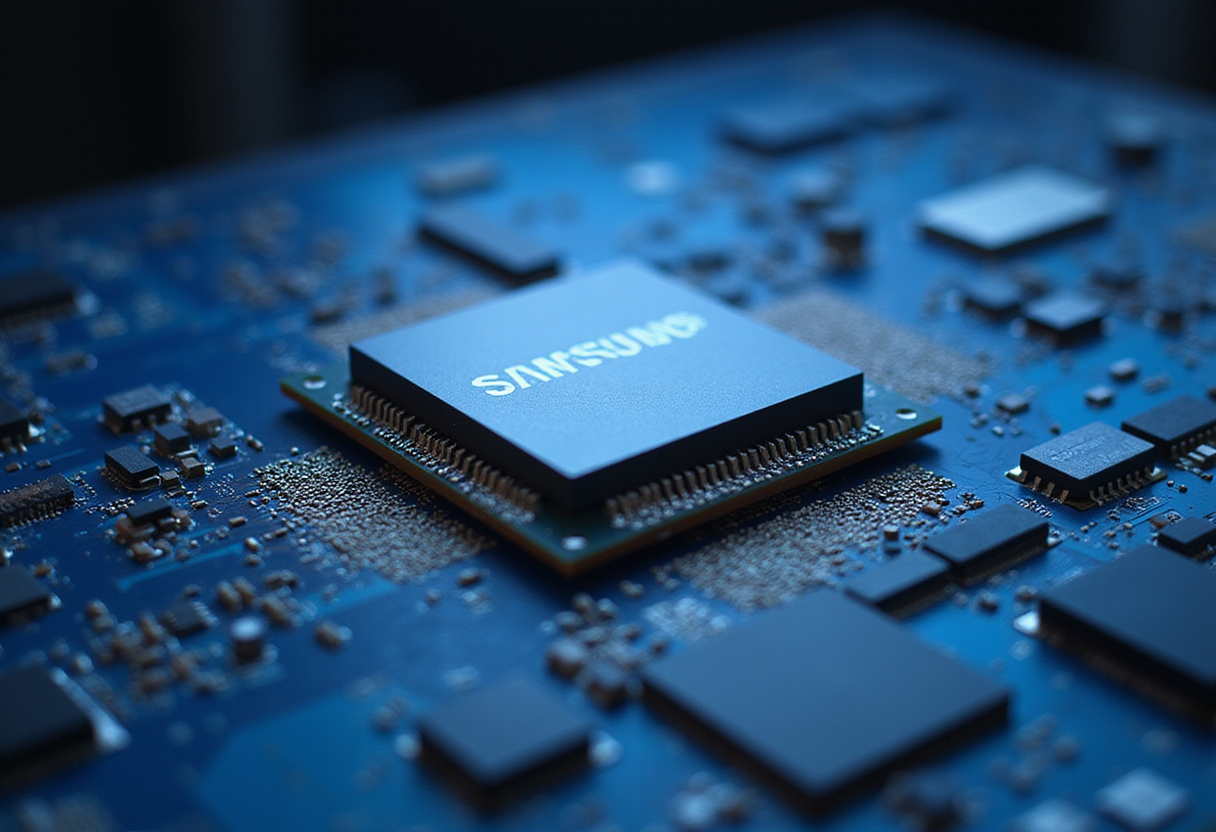
Samsung Puts 400+ Layer V-NAND at Center of Its Agentic AI Pitch
Samsung used GMIF2026 to showcase V-NAND beyond 400 layers plus zNAND-O, positioning both as the memory foundation for agentic AI workloads.
- By
- Rebecca Stone
- Filed
- Channel
- Semiconductors
- Read
- 4 min read
Samsung Semiconductor used its GMIF2026 platform to put a number on its storage roadmap: V-NAND stacked beyond 400 layers, presented alongside zNAND-O as what the company calls the foundation for agentic AI. That's the headline claim. It arrives at a moment when memory suppliers are racing to reposition NAND not just as capacity, but as the substrate that AI agents read from and write to constantly.
The 400-plus-layer figure matters because stacking density is the industry's clearest yardstick for cost-per-bit progress in flash. Every added layer squeezes more storage onto the same wafer. Crossing the 400-layer threshold puts Samsung in the top tier of the published stacking race, where suppliers have spent the past several years leapfrogging one another in increments of a few dozen layers at a time.
What is zNAND-O, and why pair it with V-NAND?
Samsung positioned the two technologies as complements rather than rivals. High-layer-count V-NAND delivers the bulk storage that large AI models and agent workflows demand. zNAND-O, by contrast, targets the latency-sensitive end of the spectrum — the fast reads that agentic AI systems need when they retrieve context, check memory and chain decisions in real time.
Agentic AI changes the memory picture in a specific way. Where a chatbot query might touch storage once, an autonomous agent can loop through memory hundreds of times per task. That workload rewards both density and speed. Samsung's GMIF2026 presentation tied the two product lines directly to that usage pattern, framing NAND as an active participant in inference rather than a passive archive.
Where this sits in the competitive race
The announcement lands amid an industry-wide surge in AI-driven memory demand. NAND makers have spent 2024 through 2026 alternating between supply discipline and capacity additions, with high-bandwidth memory grabbing most of the AI headlines. Samsung's framing shifts attention back toward storage: if agents proliferate, the argument goes, flash shipments climb with them.
Layer counts are also a proxy for process leadership. Crossing 400 layers signals that a supplier's deposition, etch and stacking processes remain on schedule — no small feat given the yield challenges that come with extreme vertical integration in 3D NAND. Samsung did not publicly attach volume or shipment figures to the GMIF2026 disclosures, so the 400+ layer figure should be read as a technology and roadmap marker rather than a confirmed capacity number.
What was actually announced?
The confirmed elements of Samsung's GMIF2026 presentation, as reported, are:
- V-NAND with more than 400 stacked layers, highlighted as the company's next-density tier for flash storage
- zNAND-O, presented as a low-latency complement aimed at performance-critical AI workloads
- An explicit positioning of both as the memory foundation for agentic AI systems
The presentation itself is a showcase, not a product launch with pricing or availability dates attached. Samsung framed the technologies as strategic direction for an AI era in which storage demands scale with agent autonomy.
Why agentic AI is the hook
The choice of framing tells its own story. Memory suppliers have learned that raw density claims no longer move markets on their own. AI has become the demand narrative that investors, data-center buyers and device makers all price in. By naming agentic AI specifically — systems that act, iterate and remember rather than merely respond — Samsung is staking a claim on the fastest-growing corner of that narrative.
Storage for agents differs from storage for humans. Human workloads favor sequential reads and occasional writes. Agent workloads thrash memory with random access, frequent context retrieval and persistent state. That profile sits squarely in the gap between DRAM and conventional NAND, which is exactly where Samsung has placed zNAND-O.
What to watch next
The open questions are volume and timing. Samsung's public materials around GMIF2026 did not specify mass-production dates for the 400+ layer generation, nor quantify zNAND-O availability. Both will determine whether this week's positioning translates into share in a NAND market where rivals are pushing their own high-stack roadmaps. If agentic AI deployments scale as vendors predict, the suppliers that pair density with latency first will set the pricing tone for the next storage cycle.
Source: Google News: semiconductors
More from Rebecca Stone
Show full bio
Correspondent covering technology and product news in Semiconductors, chip manufacturing, hardware, AI compute at Chip Dispatch.
497 articles
Related articles
samsung-puts-400-layer-nand-at-the-center-of-its-agentic-ai-pitch-256f7094
Samsung Puts 400+ Layer NAND at the Center of Its Agentic AI Pitch
samsung-profit-up-almost-ninefold-on-memory-chip-windfall-904f10de
Samsung Profit Up Almost Ninefold on Memory Chip Windfall
goldman-names-three-stocks-to-ride-high-performance-nand-s-ai-surge-c9c7c8ca
Goldman names three stocks to ride high-performance NAND's AI surge
samsung-flags-80-billion-profit-quarter-on-ai-demand-d89ba66a
Samsung Flags $80 Billion Profit Quarter on AI Demand