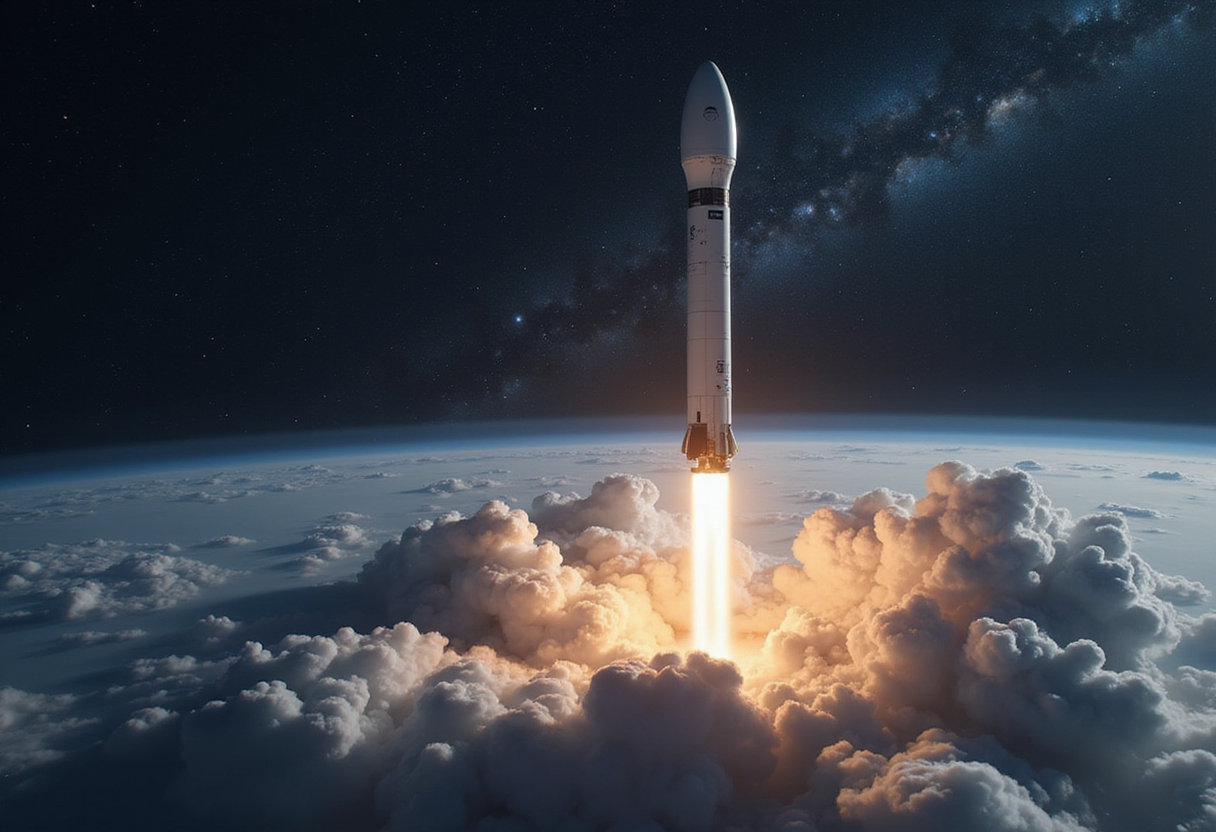
SpaceX Targets Orbital Launch for Google AI Silicon
SpaceX plans to launch Google-designed AI chips into orbit for space-based data centers, per a CoinGape report. Neither company has confirmed a chip model, launch date, or contract value for the orbital compute effort.
- By
- Rebecca Stone
- Filed
- Channel
- AI & Compute
- Read
- 3 min read
SpaceX plans to launch Google-designed AI chips into low Earth orbit for use in space-based data centers, according to a CoinGape report published this week. The report, which did not specify a launch date, payload manifest or contract value, frames the effort as a step toward commercial orbital compute.
Specifics remain thin. Neither SpaceX nor Alphabet has disclosed which Google AI accelerator family — whether a current TPU generation or a future variant — would fly, how many units the first mission would carry, or what constellation architecture the partners envision. The CoinGape story carries no direct quotation from either company and no confirmation from SpaceX's launch manifest.
The plan, if confirmed in detail, would represent one of the first commercial attempts to pair dedicated AI silicon with a spacecraft bus and treat orbital infrastructure as a deployable datacenter tier.
What is the commercial rationale?
Two engineering arguments are typically cited for space-based compute. The first is power: satellites in sun-synchronous low Earth orbit receive near-continuous solar irradiation, sidestepping the grid constraints and multi-year interconnect queue associated with terrestrial hyperscale campuses. The second is thermal: hardware in vacuum can reject heat radiatively to deep space without the chillers and water consumption that terrestrial AI facilities require at 50–100 MW scale.
Neither argument is new. Startups including Lumen Orbit, Starcloud and Aetherflux have floated orbital compute concepts over the past two years, and Loft Orbital flew a small GPU payload in 2024 as a technology demonstrator. None has disclosed revenue-generating AI inference or training capacity in orbit.
What Google and SpaceX bring to the table?
Alphabet has spent more than a decade designing AI accelerators under the TPU program, with TPU v5p and TPU v6 (Trillium) currently shipping in its cloud regions. Google's custom silicon strategy now consumes a meaningful share of its internal training and inference workloads, alongside NVIDIA H100 and H200 deployments.
SpaceX operates the world's only heavy-lift launch cadence at industrial scale, with Falcon 9 reusing first stages and Starlink launches already averaging a flight every two to three days in 2024–2025. The company has also disclosed Starlink V3 satellites with backplane power budgets reported in the tens of kilowatts per spacecraft — sufficient to host accelerator payloads if thermal rejection can be solved at the system level.
What would change about the supply chain?
Mounting accelerators on a satellite inverts the usual datacenter build-out sequence. Instead of waiting two to four years for a 100 MW substation and a high-voltage interconnect, operators would need radiation-hardened or radiation-tolerant silicon, space-qualified power conversion, and orbital optical inter-satellite links to stitch a constellation into a single fabric.
Radiation is the gating constraint for commercial AI parts. Google designs its TPUs for terrestrial data halls, not for the total ionizing dose and single-event upset rates of low Earth orbit. Either Google would qualify an existing chip family against the relevant MIL-STD or ECSS radiation specs — an 18-to-36 month exercise — or a third-party rad-hard variant would have to be sourced. Neither company has disclosed such a qualification program publicly.
What are the open questions?
- Launch vehicle and timing: which Falcon 9 or Starship mission would carry the first payload, and in which quarter?
- Chip model and count: which TPU generation, fabricated at which process node — TSMC's N4 for v5p, N5 for v6 — and how many units per spacecraft?
- Latency assumption: which AI workloads benefit enough from orbital proximity to justify uplink and downlink round-trip penalties measured in tens of milliseconds?
- Regulatory licensing: the FCC and ITU would need to authorize radio-frequency plans for any inter-satellite AI traffic fabric.
The CoinGape report stops short of answering any of those questions, and SpaceX and Alphabet have not issued a joint statement. Until either company confirms the chip family, the launch window and the orbital architecture, the project remains a stated intent rather than a contracted program.
Source: Google News: AI chips
More from Rebecca Stone
Show full bio
Correspondent covering media and advertising at Chip Dispatch.
244 articles
Related articles
spacex-to-launch-google-ai-chips-into-orbit-2e4f6075
SpaceX to Launch Google AI Chips Into Orbit
spacex-to-launch-google-ai-chips-into-orbit-2963b082
SpaceX to Launch Google AI Chips Into Orbit
spacex-launches-google-ai-chips-to-test-orbital-data-centers-a49214e3
SpaceX Launches Google AI Chips to Test Orbital Data Centers
spacex-to-launch-google-ai-chips-for-space-based-data-centers-cb072fc3
SpaceX to Launch Google AI Chips for Space-Based Data Centers