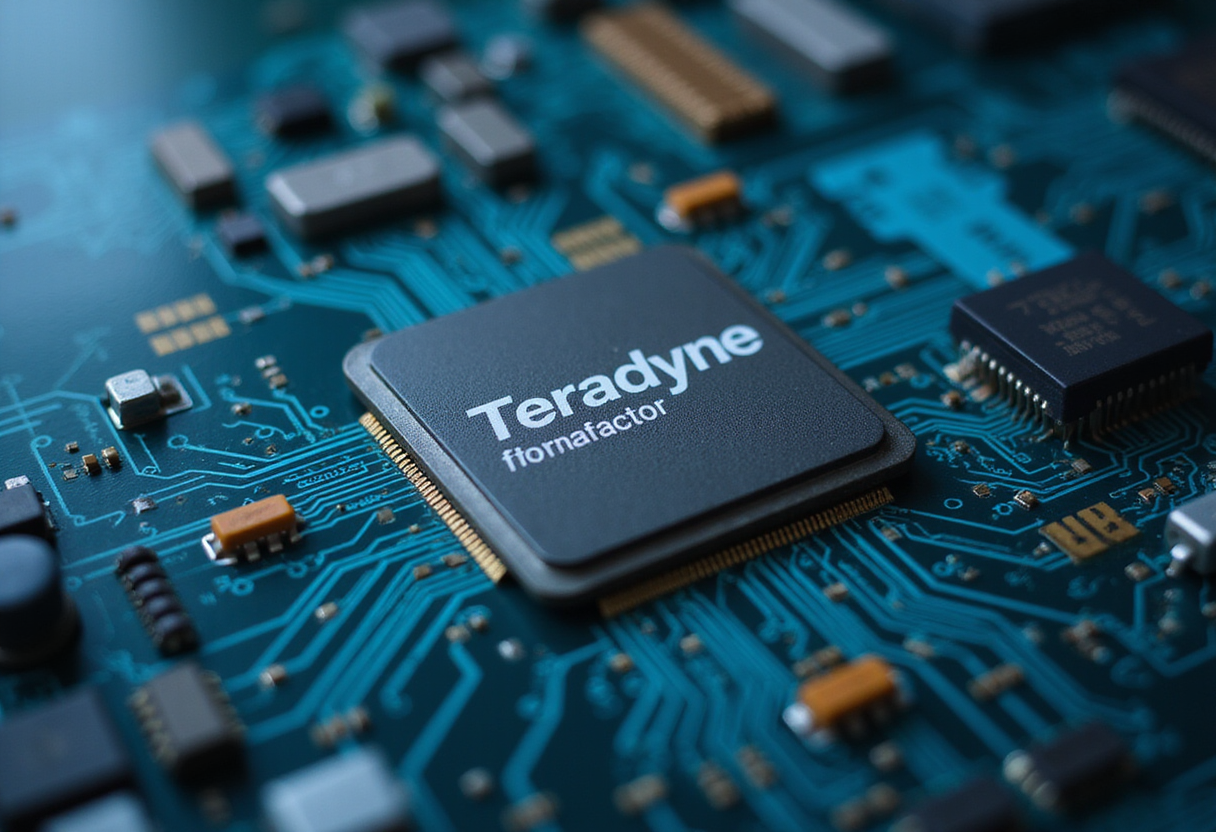
Teradyne and FormFactor Commit $300 Million to Test Collaboration
FormFactor and Teradyne have signed a $300 million strategic collaboration to advance semiconductor testing, with product scope and milestones still undisclosed.
- By
- Nathan Brooks
- Filed
- Channel
- Chip Manufacturing
- Read
- 3 min read
FormFactor and Teradyne have announced a strategic collaboration worth $300 million to advance semiconductor testing. The figure is the headline. Everything else, at this stage, is framework rather than detail — and the press release economy being what it is, the framework will matter only when it acquires dates, product names and revenue targets.
The pairing is logical in a narrow, structural sense. FormFactor supplies probe cards and advanced packaging test interconnects; Teradyne builds the automated test equipment those probe cards plug into. One company makes the consumable interface between a wafer and a tester, the other makes the tester. A $300 million arrangement between a tester maker and its key interface supplier is less a courtship than a supply-chain consolidation with a press release attached.
What does the collaboration cover?
The announcement names semiconductor testing broadly. It does not, on the information published so far, commit either company to specific process nodes, wafer sizes or product families. That restraint is itself informative. Deals of this type usually arrive with a named customer, a named device category, or at least a nod to artificial intelligence silicon. This one, as reported, keeps its particulars in the drawer.
What is confirmed:
- A $300 million strategic collaboration between FormFactor (NASDAQ: FORM) and Teradyne (NASDAQ: TER)
- A stated purpose of advancing semiconductor testing
- Strategic framing, which in this industry typically signals multi-year scope rather than a single procurement order
What is not yet confirmed:
- The split of the $300 million between the two companies
- Any timeline, milestone schedule or capacity commitment
- Specific test segments, from wafer-level sort through final packaged-device test
Analysts covering test equipment will note the context without needing much encouragement. Test has become the quiet bottleneck of the advanced-logic and advanced-packaging cycle. Chiplets, high-bandwidth memory stacks and 2.5D interposers all multiply the number of die boundaries that need probing before integration. Probe-card complexity has risen accordingly, and FormFactor sits near the top of that supply chain. Teradyne, for its part, has spent the past two years repositioning around robotics and semiconductor test as its legacy system-level business matured.
A collaboration that tightens the link between tester and probe card therefore reads as a hedge against the integration problem. Device makers do not buy testers and probe cards in isolation; they buy an assurance that the two will agree on yield data. The two suppliers have now priced that assurance, or at least its symbolism, at $300 million.
Is $300 million a large number here?
By capital-expenditure standards, no. A leading-edge fab costs roughly two orders of magnitude more. By test-equipment standards, it is a serious commitment rather than a rounding error. Teradyne's semiconductor test segment alone generates revenue in the billions of dollars annually, and FormFactor's quarterly probe-card sales run in the hundreds of millions. Against those bases, $300 million is material to both without being transformative to either. It is the size of number that buys engineering alignment, not market share.
The strategic logic also has a defensive edge. Semiconductor test interfaces are a concentrated market, with FormFactor and a small set of rivals — Technoprobe and Micronics Japan among them — holding the bulk of advanced probe-card revenue. Closer technical integration with a major tester vendor can function as a moat. If tool roadmaps co-evolve, competitors without a comparable arrangement face a slower qualification path at exactly the moment customers are qualifying for next-generation packaging.
What comes next
The companies have not published milestones, so the market will judge the deal by its first concrete outputs: co-developed products, joint customer qualifications, or revised revenue guidance that cites the arrangement. Until then, investors have a number and a direction. In semiconductor equipment, that is usually enough to move a stock and rarely enough to move an industry.
By Nathan Brooks, Chip Dispatch
Source: Google News: semiconductors
More from Nathan Brooks
Show full bio
Senior reporter covering people, launches and day-to-day practice in Semiconductors, chip manufacturing, hardware, AI compute at Chip Dispatch.
372 articles
Related articles
formfactor-and-teradyne-announce-300-million-test-collaboration-ebc2ced6
FormFactor and Teradyne Announce $300 Million Test Collaboration
formfactor-and-teradyne-sign-broad-semiconductor-test-collaboration-c50e84ac
FormFactor and Teradyne Sign Broad Semiconductor Test Collaboration
teradyne-commits-300m-to-formfactor-in-semiconductor-test-deal-26a7e9a2
Teradyne Commits $300M to FormFactor in Semiconductor Test Deal
tsmc-texas-terafab-buzz-pushes-taiwan-contractors-into-action-8f9312db
TSMC Texas 'Terafab' Buzz Pushes Taiwan Contractors Into Action