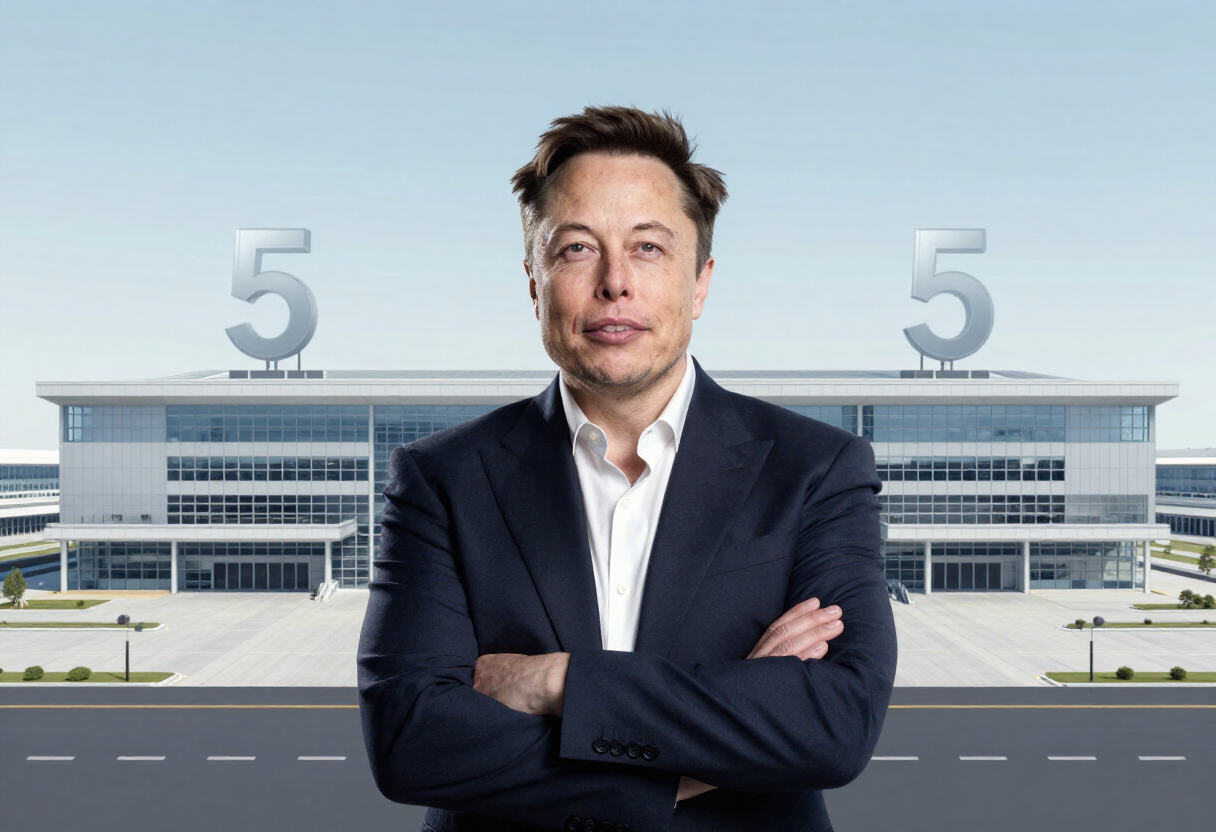
Tesla and SpaceX Reportedly Plan Their Own Chip Factory
Tesla and SpaceX want a chip factory staffed by 3,000 workers, TechRadar reports, signaling a push from captive chip design toward in-house manufacturing capacity at volume scale.
- By
- Sophie Lindqvist
- Filed
- Channel
- Chip Manufacturing
- Read
- 3 min read
Tesla and SpaceX want to build their own chip factory, a facility that would employ roughly 3,000 workers, according to a TechRadar report. The number matters more than the ambition. Three thousand employees is not the headcount of a design center or a packaging pilot line — it is the staffing profile of a volume manufacturing site, and it signals that the two Musk-controlled companies are thinking about fabrication capacity, not just architecture.
The report does not specify a location, a process node, a capital budget or a timeline for the plant. Until those details surface, the plan sits firmly in the category of roadmap rather than committed capacity. What is clear is the motivation behind it.
Both companies have spent years designing silicon in-house and depending on outside foundries to make it. Tesla ships its Hardware 4 self-driving computer and has trained its inference stack on custom accelerators since the original FSD chip, which debuted at 14nm on Samsung's line and later moved to TSMC at 7nm. SpaceX builds custom silicon for its Starlink broadband terminals, having replaced parts sourced from third parties with in-house system-on-chip designs to cut cost per terminal. In both cases, the design is captive. The manufacturing is not.
That asymmetry is the commercial crux. Foundry capacity for advanced nodes is allocated through long-term agreements, and automotive and consumer-satellite customers compete for the same leading-edge wafers as smartphone and AI accelerator makers. When AI demand surged, wafer allocations tightened across the industry, and customers without priority agreements absorbed the delays. A captive fab would remove Tesla and SpaceX from that queue for the specific chips they control end to end.
The 3,000-worker figure gives a sense of the intended scale. For comparison, leading-edge fabs from dedicated foundries typically employ considerably larger shifts across 24/7 operation, while specialty and mature-node plants run leaner. A facility of this size suggests mid-range volume — enough to supply automotive compute modules and satellite terminal chips internally, without competing with merchant foundries on capacity.
Cost is the open question, and the report does not answer it. Advanced-node fabs run into the billions of dollars per facility before yielding a single wafer, and the operating expense of running one is a discipline unto itself. Yield learning, equipment maintenance, chemical supply and cleanroom staffing are full-time businesses. It is one thing to design a chip in-house; it is another to match the yields that TSMC, Samsung and GlobalFoundries achieve after decades of volume production. Any move by Tesla and SpaceX into manufacturing would compete against that accumulated learning curve.
Geopolitics sharpens the logic, though the report does not address it directly. Supply-chain policy in the United States has shifted manufacturing incentives toward domestic fabrication, and companies that control their own production lines gain insulation from export controls and tariff regimes. A shared plant serving both an automaker and a satellite operator would also spread fixed costs across two distinct demand streams — vehicles and ground terminals — which do not peak and trough together.
Investors and supply-chain analysts will want three numbers before treating this as capacity rather than aspiration: a site, a capex commitment and a process node target. None of the three appears in the report. Without them, the plan resembles the early stages of other captive-fab efforts that either narrowed into packaging and test operations or broadened into partnerships with established foundries.
For now, the strongest confirmed fact is intent. Tesla and SpaceX, according to TechRadar, want their own chip factory staffed by 3,000 people, and the scale of that workforce implies they are pricing in volume output. Whether that intent converts into a funded construction schedule will determine whether the automaker and the satellite operator become true manufacturers — or remain designers renting time on other companies's lines.
Source: Google News: chip factory investment
More from Sophie Lindqvist
Related articles
spacex-wages-16-8-billion-campaign-for-chip-independence-4e722ae1
SpaceX Wages $16.8 Billion Campaign for Chip Independence
sifive-banks-400m-as-custom-silicon-draws-heavy-capital-6bcb1705
SiFive Banks $400M as Custom Silicon Draws Heavy Capital
san-jose-chip-startup-raises-21m-for-ai-data-center-power-d5645e0a
San Jose Chip Startup Raises $21M for AI Data Center Power
musk-plans-16-8-billion-megafactory-five-times-world-s-largest-building-fd42550e
Musk Plans $16.8 Billion Megafactory Five Times World's Largest Building