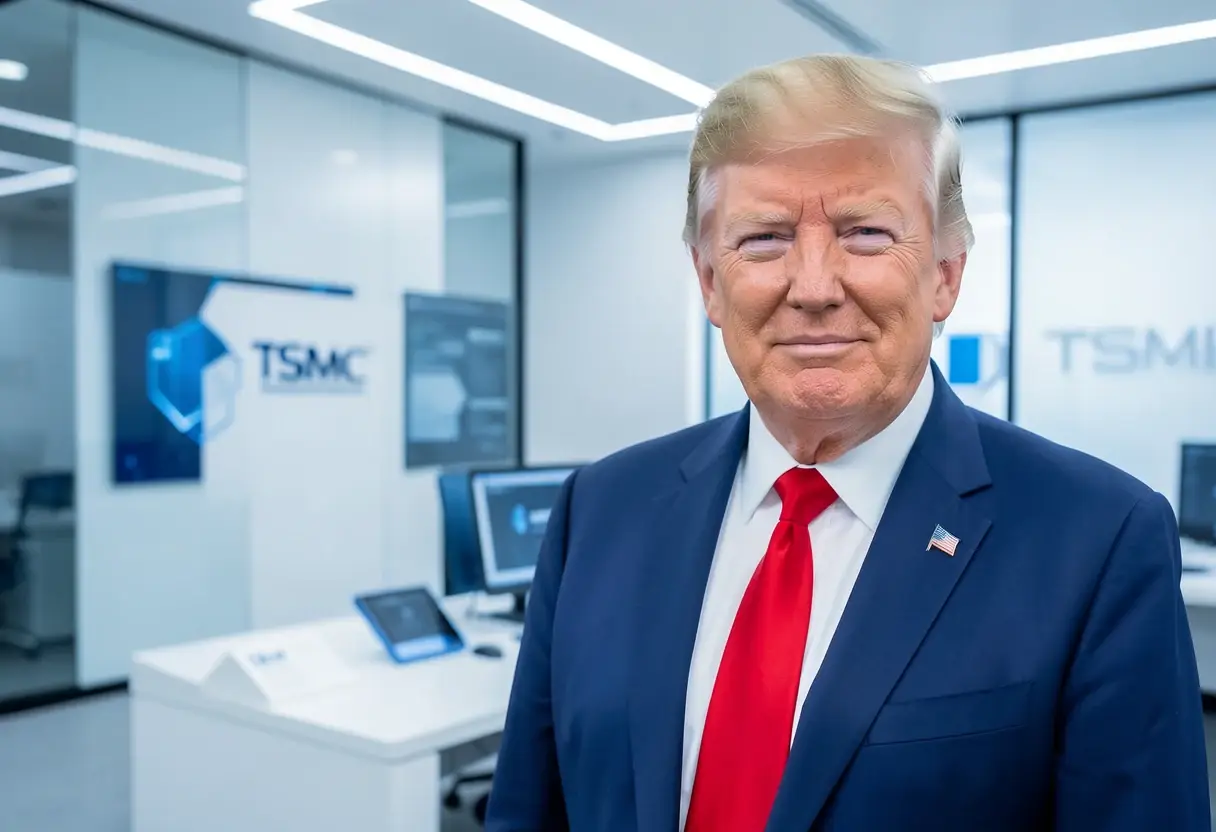
TSMC Commits $100 Billion to US Chip Manufacturing Push
TSMC plans to pour $100 billion into U.S. chip manufacturing, CEO C.C. Wei and President Trump announced, the largest foreign commitment to American fabs to date.
- By
- Rebecca Stone
- Filed
- Channel
- Chip Manufacturing
- Read
- 3 min read
TSMC plans to invest $100 billion in U.S. semiconductor manufacturing, an announcement made jointly by CEO C.C. Wei and President Donald Trump. The figure makes the Taiwanese foundry's American buildout one of the largest single commitments ever pledged to domestic chip production.
The announcement came from the White House, with Wei presenting the plan alongside the president. TSMC, the world's dominant contract chipmaker, already stands at the center of the global supply chain for advanced logic. Its customers include nearly every major designer of high-performance silicon, and its process leadership on leading-edge nodes has no full substitute among Western foundries today.
What does the $100 billion actually buy?
At this stage, the company has framed the number as a total planned investment in U.S. chip manufacturing rather than a single-fab budget. Building leading-edge fabs in the United States carries costs that routinely run into the tens of billions of dollars per site, once cleanrooms, lithography tools and supporting facilities are counted.
Details on how the $100 billion splits across:
- New fabrication plants versus expansion of existing sites
- Advanced packaging capacity
- Timeline and phasing of the spending
Those specifics will determine whether the pledge translates into wafer output on a defined schedule, or into a roadmap subject to demand, labor availability and construction realities. TSMC has previously found U.S. fab construction slower and costlier than its Taiwanese baseline, a factor that shapes execution on any American commitment of this scale.
Why the timing matters
The announcement lands amid sustained Washington pressure to move advanced chipmaking onto U.S. soil. Chips act subsidies, export controls on China and tariff threats have all pushed semiconductor makers to localize production. For TSMC, deepening its American footprint buys political goodwill in its most important export market. It also hedges the geopolitical risk that surrounds Taiwan, home to the overwhelming majority of the company's leading-edge capacity.
For the Trump administration, the deal delivers a headline number that ties directly to its manufacturing agenda. The president has pressed chipmakers, including TSMC's customers, to build in America or face tariff consequences. Monday's announcement gives that campaign its most valuable trophy yet: the world's most advanced foundry, committing capital at a scale no other chipmaker has matched.
What it means for the supply chain
TSMC's decision reshapes the map of advanced logic capacity. Today, the bleeding edge of semiconductor manufacturing sits almost entirely in Taiwan. Every increment of leading-edge capacity built in Arizona shifts a slice of that concentration westward, which matters to customers designing AI accelerators, smartphone processors and data-center silicon.
The move also pressures rivals. Samsung and Intel are both racing to expand advanced foundry capacity in the U.S., and a $100 billion TSMC commitment raises the bar for anyone hoping to win American customers with domestic supply. Samsung's Texas expansion and Intel's own foundry push now compete against a player with unmatched process yield and the deepest customer roster in the industry.
What comes next
Execution is the question. Turning a $100 billion pledge into operating fabs requires years of construction, thousands of skilled workers and a steady pipeline of tool installations. Customers will watch wafer allocations, qualified process nodes and ramp schedules — not announcements — before they commit their most advanced designs to U.S.-made silicon. How quickly TSMC converts this pledge into shipped wafers will set the competitive terms for American chipmaking for the rest of the decade.
Source: Google News: chip factory investment
More from Rebecca Stone
Show full bio
Correspondent covering technology and product news in Semiconductors, chip manufacturing, hardware, AI compute at Chip Dispatch.
594 articles
Related articles
tsmc-commits-100-billion-to-u-s-chip-manufacturing-a22984e4
TSMC Commits $100 Billion to U.S. Chip Manufacturing
tsmc-s-u-s-investment-commitment-rises-to-265-billion-a63c22d6
TSMC's U.S. Investment Commitment Rises to $265 Billion
tsmc-lifts-planned-us-investment-to-165-billion-ffec0989
TSMC Lifts Planned US Investment to $165 Billion
tsmc-poised-to-expand-its-165-billion-u-s-investment-db43b042
TSMC Poised to Expand Its $165 Billion U.S. Investment