Hardware & ComponentsLOT 261120 · 4 min read
18 Motors, 10 kHz: FPGAs Take Robotic Control and 4K Vision Center Stage at electronica 2026
At electronica 2026, an 18-motor robotic hand closed its control loop in one 10-kHz period using Lattice FPGAs and Inova networking, one of eight programmable-logic demos spanning 4K vision, eFuses and 112-Gb/s modules.
Key takeaways
- An 18-motor humanoid robotic hand demo at electronica 2026 closed its motion-control loop within one 10-kHz period, with under 10-µs sensor-to-command latency.
- Samtec's oHFM.c connectors reach 112-Gb/s PAM4 per lane under the Open Harmonized FPGA Module standard announced in January 2026.
- Efinix's Titanium portfolio, built on TSMC 16 nm, spans 35K to 2M logic elements and pairs with RISC-V Sapphire SoCs.
- Sony's IMX901 global-shutter sensor streams 16.41 Mpixels over four SLVS-EC lanes at 9.504 Gb/s into a Lattice Avant G/X FPGA, with no CPU in the acquisition path.
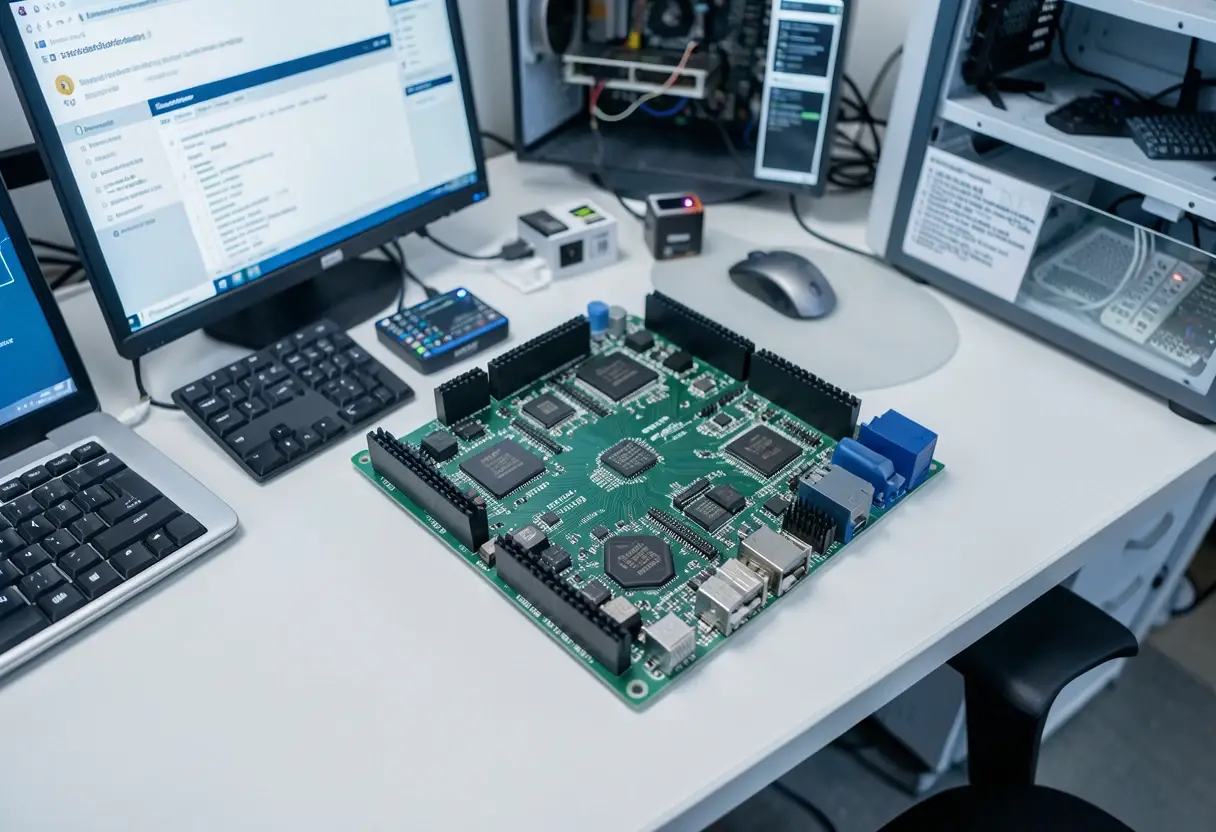
A robotic hand with 18 motors, synchronized to within one 10-kHz control period, anchored the FPGA demonstrations at electronica 2026 in Munich. Inova Semiconductors, Lattice Semiconductor and the German Aerospace Center (DLR) jointly built the distributed motor-control platform, and it shows why programmable logic keeps winning precise real-time work: communication latency between sensor sampling and updated motor commands stays below 10 microseconds.
The hand combines Inova's APXpress high-speed networking with Lattice CertusPro-NX and CrossLink-NX FPGAs. Together they coordinate 18 motors, joint sensors and a 10-sensor tactile array over a deterministic network. Each motor runs local field-oriented control integrated on an FPGA, while a daisy-chain topology cuts wiring around the moving joints. The result, according to the demonstrator's design, is reduced finger-to-finger timing skew and more precise manipulation.
What did each vendor bring to Munich?
- Lattice: CertusPro-NX offers up to 100K logic cells and up to 7.3 Mb of embedded memory; CrossLink-NX reaches 39K logic cells. APXpress links run at selectable rates from 4 to 32 Gb/s, with up to 500 virtual data channels.
- Samtec and Adiuvo Engineering: At edge lab LIVE!, Adiuvo introduced the Explorer Board, a USB-C prototyping platform built with Samtec connectivity. It carries an AMD Artix UltraScale+ AU7P in an FCVA289 package — 37K LUTs, 75K flip-flops, 216 DSP slices and 3.6 Mb of block RAM — plus four GTH transceivers rated to 12.5 Gb/s, a Raspberry Pi RP2040 for power management, on-board HyperRAM, and four Pmod connectors. Samtec's QSH/QSE board-to-board connectors provide two HSIO interfaces, so engineers can experiment with high-speed I/O without a custom board per project.
- Macnica, Sony and Lattice: Macnica demonstrated CPU-free image acquisition using Sony's IMX901-AMR global-shutter CMOS sensor — 16.41 Mpixels at 8016 × 2048 — streaming over four SLVS-EC lanes at 9.504 Gb/s per lane into a Lattice Avant G/X FPGA. The sensor delivers 134.7 fps at 10-bit output and 91.5 fps at 12-bit, with processed video shown over HDMI at 1920 × 1080, 60p, using Macnica's Luminous evaluation kit and SLVS-EC v3.1 receiver IP.
- Vishay and Altera: Vishay showed a bidirectional FPGA-based electronic fuse developed with Altera's help, targeting systems with reversible power flow such as battery-powered architectures. Programmable logic enables programmable control and fast fault response; Vishay also unveiled a unidirectional MCU-based eFuse built with NXP.
- Rutronik and Altera: Rutronik presented an Altera Agilex 5 SoC platform that merges ROS 2 integration, 4K camera processing and deterministic motor control on one chip. The FPGA fabric handles sensor interfacing and camera preprocessing, a containerized ROS 2 environment processes frames, and Nios V soft processors plus Arm cores run sensor fusion and path planning.
- Future Electronics and Microchip: The PolarFire Avalanche development kit, aimed at aerospace and reliability-critical embedded systems, uses the MPF300TS-FCG484I with 300K logic elements, 20.6 MB of embedded memory, 924 math blocks and SerDes from 250 Mb/s to 12.7 Gb/s. Microchip states PolarFire FPGAs are unaffected by single-event-effect-induced configuration upsets, which suits radiation-exposed systems where a corrupted configuration could disrupt operation. The board adds 4-GB DDR3, Gigabit Ethernet, Wi-Fi, Arduino headers, mikroBUS and Pmod interfaces.
- Samtec again, for oHFM: Samtec showed high-speed interconnects for the Open Harmonized FPGA Module standard, announced in January 2026 and making its electronica debut. Connector-based oHFM.c modules in Size-L and Size-XL reach 112-Gb/s PAM4 per lane; Size-S and Size-M reach 64 Gb/s. The standard lets developers keep carrier boards while swapping processing modules or mixing suppliers.
- Efinix: In Hall B5, Efinix introduced its Titanium portfolio — Titanium, Titanium Edge and Titanium Transceiver series — built on TSMC 16 nm with the proprietary Quantum compute fabric made of configurable XLR cells. The family spans 35K to 2M logic elements; the Ti35 through Ti375 provide 93 to 1,344 DSP blocks, and the Ti375 supports 1.25 to 16 Gb/s per channel across four four-lane transceiver banks. Titanium devices pair with Efinix's RISC-V-based Sapphire SoC solutions in both soft and hardened forms.
Why the common thread matters
Across the eight demonstrations, the pattern repeats: FPGAs absorb sensor interfacing, deterministic control and high-speed data movement that would otherwise burden a conventional processor. Motor loops close in microseconds, 16-megapixel sensor streams enter programmable logic directly, and modular standards such as oHFM extend that flexibility across whole product families.
The commercial direction is clear: vendors are pushing FPGAs deeper into robotics, edge AI, aerospace and power protection, and the electronica 2026 floor suggests programmable logic will keep displacing fixed processors wherever timing precision and sensor bandwidth decide the design.
wwwlegacy.vishay.com (Original)
More from Tom Whitfield
Show full bio
Staff writer covering companies, deals and strategy in Semiconductors, chip manufacturing, hardware, AI compute at Chip Dispatch.
1,141 articles