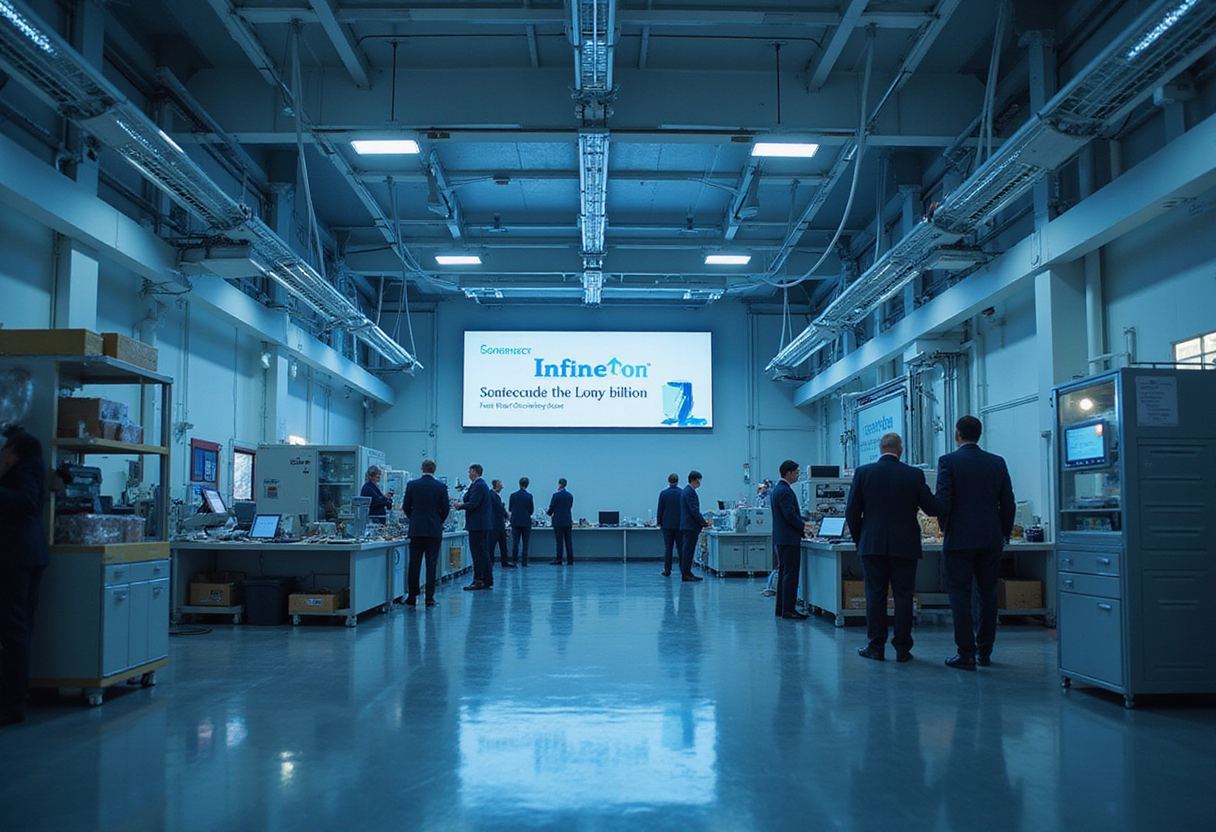
Infineon Calls Thailand an Attractive Semiconductor Manufacturing Hub
Infineon Technologies tells CNBC that Thailand is an attractive semiconductor manufacturing location, reinforcing Southeast Asia's role in power-chip supply chains.
- By
- Tom Whitfield
- Filed
- Channel
- Chips & Policy
- Read
- 3 min read
Infineon Technologies has publicly described Thailand as an attractive location for semiconductor manufacturing, in remarks reported by CNBC — a signal that the German chipmaker sees Southeast Asia as more than a low-cost backwater and as a credible pillar in its global production footprint.
The endorsement matters because of who is giving it. Infineon is Europe's largest semiconductor maker by revenue and one of the world's dominant suppliers of power semiconductors — the MOSFETs, IGBTs and silicon-carbide devices that go into electric vehicles, industrial drives, power supplies and renewable-energy infrastructure. Where Infineon places wafer fabrication and assembly-and-test capacity, suppliers and competitors tend to follow.
Thailand is not a newcomer to this industry. The country hosts a mature back-end ecosystem — assembly, packaging and test operations — anchored by Japanese and European manufacturers that built discrete-power and analog production there over decades. Infineon itself operates in the country, and its public praise of the location, as reported by CNBC, aligns with that established presence rather than signaling a greenfield bet from nothing.
The commercial logic behind the statement is straightforward. Power semiconductors are less dependent on leading-edge lithography than logic chips, which makes them well suited to distributed, cost-competitive manufacturing bases. At the same time, Infineon's automotive and industrial customers are pressing suppliers to shorten supply chains and reduce concentration risk in any single geography. Thailand offers a combination that few Asian locations can match: an existing skilled electronics workforce, established industrial clusters, government incentives for advanced manufacturing, and a position outside the flashpoints that complicate capacity planning in the Taiwan Strait and, increasingly, on the Korean peninsula.
The geopolitical context changes the commercial picture here, and Infineon's comments should be read against it. Washington's export controls and Washington- and Brussels-subsidized fab construction have pushed every large chipmaker to articulate a de-risked footprint — often described as a "fab to fab, and region to region" strategy. For a European supplier heavily exposed to automotive customers in Europe, the US and China, capacity in a politically neutral, treaty-allied Southeast Asian state is a hedge that costs less than building equivalent front-end capacity in Dresden or Austin.
Thailand's government, for its part, has been courting semiconductor investment explicitly, positioning the country as a destination for both back-end expansion and selected front-end and advanced-packaging projects. An endorsement from Infineon — a company that invests billions of euros a year in capacity across Europe and Asia — gives Bangkok a reference point few other marketing efforts can buy.
For competitors such as ON Semiconductor, STMicroelectronics and Japan's power-device makers, the signal is that competition for Southeast Asian manufacturing talent, land and incentives will stay intense as power-electronics demand from EV and grid applications keeps pressure on supply. Discrete and analog parts rarely make headlines, but capacity for them was among the most persistent bottleneck categories during the 2021–2023 shortage, particularly for automotive customers.
Infineon's statement, as reported by CNBC, does not commit the company to a specific new fab, investment figure or timeline. What it does confirm is intent: Thailand will remain in Infineon's manufacturing calculus, and the company expects the country to play a durable role as power-semiconductor demand grows — a dynamic that should keep pricing and capacity competition in the region tight for years to come.
Source: Google News: semiconductors
More from Tom Whitfield
Show full bio
Staff writer covering consumer brands and retail at Chip Dispatch.
153 articles
Related articles
infineon-opens-thailand-plant-as-bangkok-accelerates-chip-push-6a66b6d2
Infineon Opens Thailand Plant as Bangkok Accelerates Chip Push
infineon-names-thailand-an-attractive-semiconductor-manufacturing-hub-b19e743d
Infineon Names Thailand an Attractive Semiconductor Manufacturing Hub
infineon-opens-1-4-billion-semiconductor-plant-in-thailand-be0aa8aa
Infineon Opens $1.4 Billion Semiconductor Plant in Thailand
infineon-opens-1-4-billion-plant-in-thailand-ea3d5373
Infineon Opens $1.4 Billion Plant in Thailand