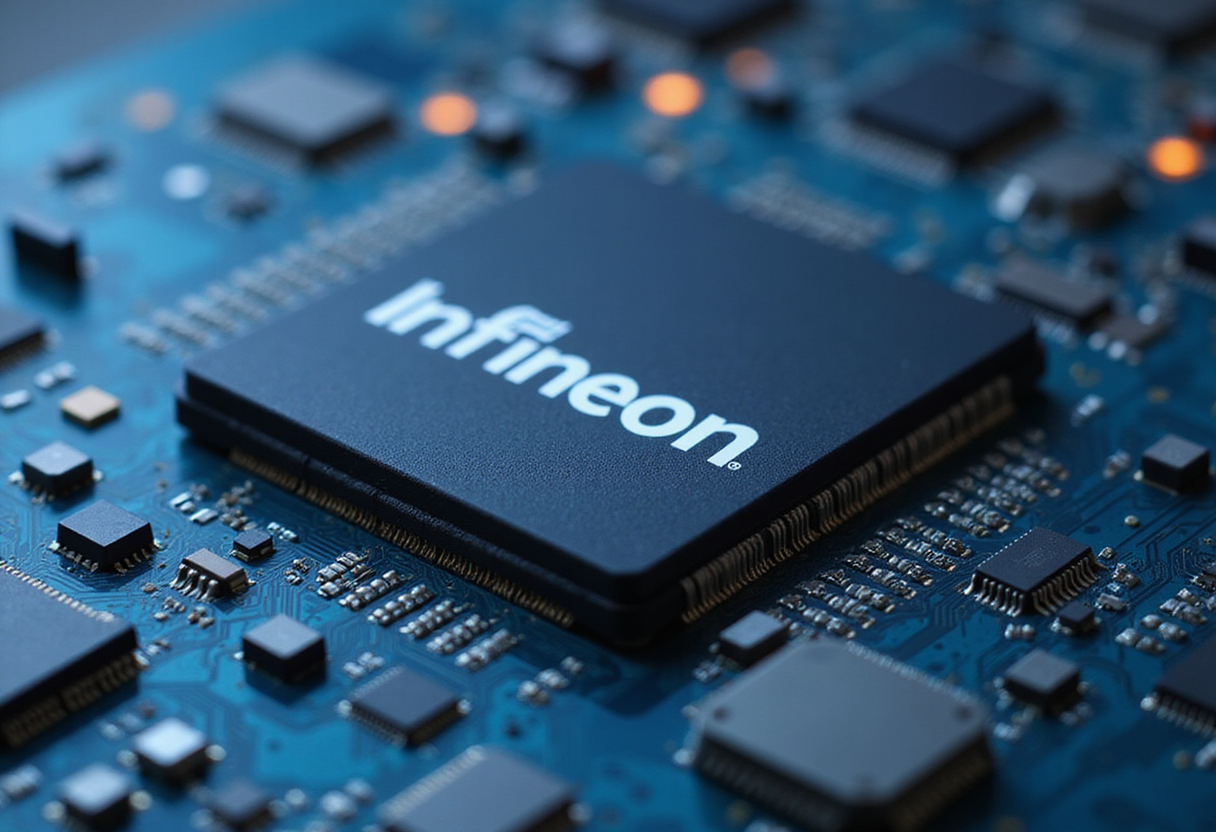
Infineon Names Thailand an Attractive Semiconductor Manufacturing Hub
Infineon Technologies has called Thailand an attractive location for semiconductor manufacturing, signaling potential capacity growth in Southeast Asia's automotive supply chain hub.
- By
- Nathan Brooks
- Filed
- Channel
- Semiconductors
- Read
- 3 min read
Infineon Technologies has publicly described Thailand as an attractive location for semiconductor manufacturing, a statement that signals where one of Europe's largest chipmakers sees room to build out capacity beyond its established production networks in Europe and East Asia.
The company's endorsement, made in remarks covered by CNBC, positions Thailand as more than a low-cost assembly destination. For Infineon, the appeal rests on the country's combination of an established electronics manufacturing base, supportive industrial policy, and a location that sits outside the region's most acute geopolitical pressure points. That calculus matters for a company whose product portfolio — power semiconductors, microcontrollers, and sensor products serving automotive and industrial customers — depends on resilient, high-volume backend and module manufacturing.
Thailand already hosts a deep contract electronics and component ecosystem built around hard-disk drive production and automotive supply chains. Infineon's own footprint in Asia includes manufacturing and assembly operations spanning Malaysia, Singapore, China, and Indonesia, giving the company direct experience weighing the trade-offs among Southeast Asian sites: labor costs, engineer availability, infrastructure reliability, logistics connectivity, and the terms offered by national investment-promotion agencies.
The German chipmaker's positive assessment of Thailand comes as governments and manufacturers across the industry redistribute capacity in response to supply chain shocks and export-control regimes that have concentrated risk in Taiwan, South Korea, and China. Chipmakers with automotive exposure face particular pressure to diversify, since carmakers have demanded more geographically dispersed sourcing since the shortage years of 2021 and 2022.
Infineon's statement aligns with a broader pattern of multinational semiconductor investment flowing into Southeast Asia. The region has attracted a string of assembly, test, and module expansions as companies seek to balance cost competitiveness against the resilience benefits of a wider manufacturing footprint. Thailand's investment-promotion framework has actively courted such projects in electronics and advanced components.
For Infineon specifically, the significance of the endorsement lies in the product mix. Power semiconductors — including the silicon carbide devices the company is pushing into electric-vehicle drivetrains and industrial power systems — require substantial packaging and module capacity, and backend operations of this kind are the most geographically flexible part of the chip value chain. Frontend wafer fabrication remains concentrated in the company's fabs in Dresden, Villach, and Kulim, but module assembly can scale in locations such as Thailand without the multibillion-euro capital commitments that new fabs demand.
The statement also carries weight because Infineon has demonstrated willingness to concentrate large investments where it sees durable advantage. Its Kulim, Malaysia site anchors silicon carbide capacity ambitions, and European fabs continue to draw funding tied to the EU Chips Act framework. A favorable view of Thailand suggests the company sees complementary — rather than competing — value in additional Southeast Asian capacity.
What remains unspecified in the company's remarks is any concrete commitment: Infineon has not tied its endorsement of Thailand to a named facility, investment amount, or timeline. The statement reads as an evaluation of the country's standing as a manufacturing location rather than an announcement of a specific project.
Infineon's public backing nonetheless gives Thailand a visible reference point in the competition for semiconductor investment, and any subsequent capacity commitment from the Munich-based company would mark one of the clearest signs yet that Southeast Asian diversification is extending beyond Malaysia and Singapore into the region's automotive manufacturing heartland.
Source: Google News: semiconductors
More from Nathan Brooks
Show full bio
Senior reporter covering industry trends and analytics at Chip Dispatch.
131 articles
Related articles
infineon-opens-thailand-plant-as-bangkok-accelerates-chip-push-6a66b6d2
Infineon Opens Thailand Plant as Bangkok Accelerates Chip Push
infineon-opens-1-4-billion-plant-in-thailand-ea3d5373
Infineon Opens $1.4 Billion Plant in Thailand
infineon-to-acquire-semiconductor-startup-c2i-a18965ba
Infineon to Acquire Semiconductor Startup C2i
singapore-launches-sg-semiconductor-to-anchor-national-chip-push-6e3736c3
Singapore Launches SG Semiconductor to Anchor National Chip Push