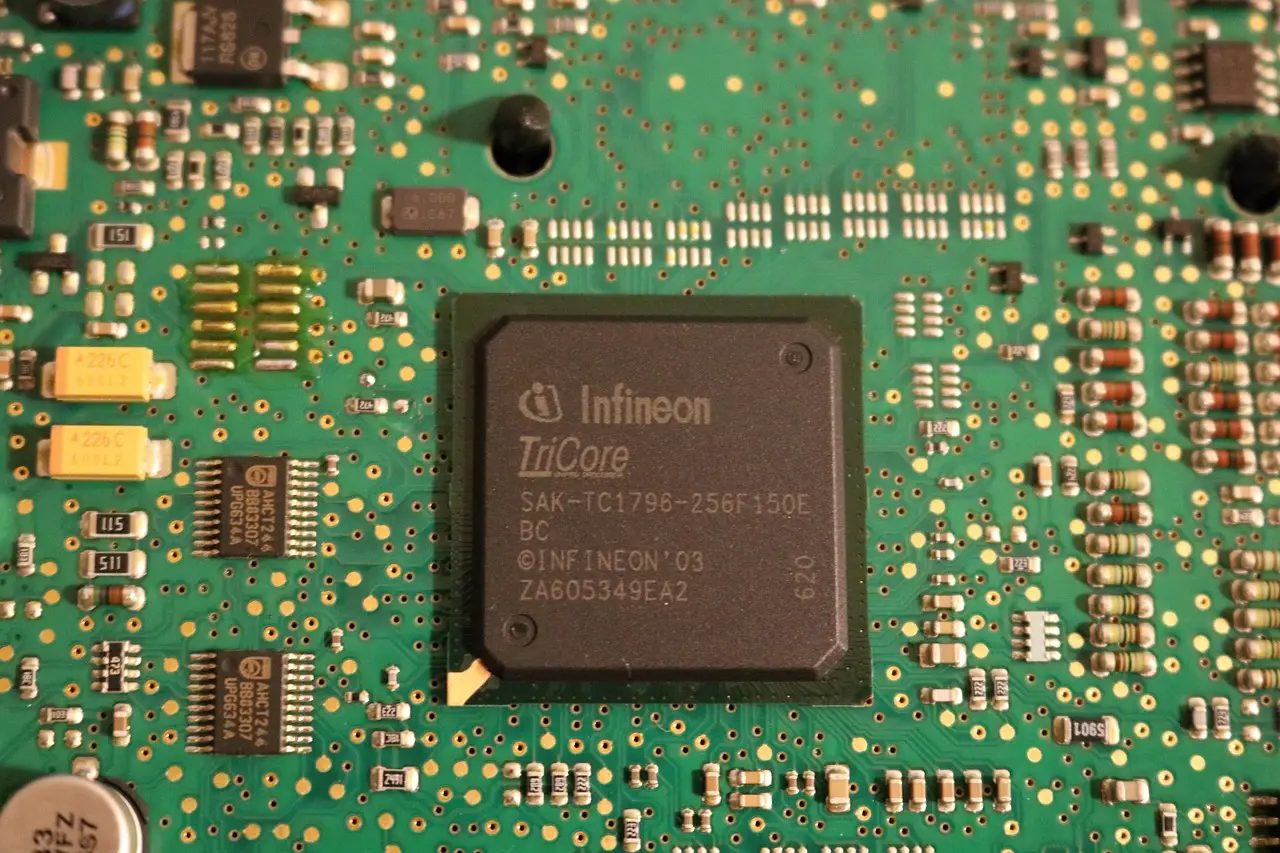
Infineon's 12-Core RISC-V Aurix RC1 Leads electronica 2026 Silicon Slate
Infineon's Aurix RC1 packs twelve RISC-V cores for ASIL D vehicles, while SECO ships a 40 TOPS Qualcomm module and TI targets industrial Ethernet at electronica 2026.
- By
- Grace Kim
- Filed
- Channel
- Semiconductors
- Read
- 3 min read
Infineon has put up to a dozen 32-bit RISC-V cores into a single automotive chip. The Aurix RC1, unveiled at electronica 2026 this week, anchors a product slate that stretches from software-defined vehicles to industrial networking and hobbyist-grade Linux boards.
What does the Aurix RC1 bring to automotive designers?
The RC1 belongs to the RISC-V-based branch of Infineon's Aurix family. It targets software-defined vehicles and what Infineon calls physical AI. The chip is designed to meet ASIL D functional safety requirements and the cybersecurity standards ISO/SAE 21434 and the Cyber Resilience Act. Communication interfaces include CAN-XL and 10BASE-T1S, both aimed squarely at in-vehicle networks.
The move matters commercially. RISC-V gives Infineon an architecture free of Arm licensing costs, and the safety and security qualifications position the part for the next generation of zonal and central compute platforms in cars.
How much compute fits on a SMARC module?
SECO answered that question with the SOM-SMARC-Dragonwing-IQ8, a SMARC-compatible system-on-module built around Qualcomm's Dragonwing IQ8 SoC. The package combines a 2.35 GHz, 8-core Qualcomm Kryo CPU, an Adreno 623 GPU and a Hexagon NPU rated at 40 TOPS.
Memory and I/O are equally specific:
- Up to 32 GB of soldered LPDDR5 DRAM
- UFS 3.1 Gen 4 storage up to 1 TB
- 1 G and 2.5 G Ethernet ports
- x4 PCIe ports
- TPM 2.0 support
The module runs Linux, including SECO's own Clea OS, which the company builds on Yocto Linux. That software stack gives developers a supported route from prototype to deployed edge AI systems without porting effort.
What is TI doing for factory networks?
Texas Instruments showed the TICS100MOD, a multi-protocol industrial communications module. It is built around TI's AM261 SoC, which pairs a 500 MHz Arm Cortex-R5F with programmable real-time units. Those PRUs drive two 10/100 Ethernet ports with built-in PHYs and handle real-time industrial Ethernet protocols, including EtherCAT, PROFINET and EtherNet/IP. One module can therefore serve multiple protocol environments, a practical advantage for machine builders shipping into mixed-protocol plants.
Can Ubuntu land on an edge board in fifteen minutes?
Grinn says yes. Its GenioBoard now supports Ubuntu Linux, with installation taking about fifteen minutes according to the company. Canonical's Ubuntu Pro provides long-term security maintenance. Details are published on the Grinn Developer Portal.
The board hosts a MediaTek Genio 700 with two Cortex-A78 cores and six Cortex-A55 cores, plus a GPU and an NPU delivering 4 TOPS. Capacity reaches 8 GB of DRAM and 64 GB of eMMC flash. Expansion is generous for a board this size:
- M.2 E slot for Wi-Fi, Bluetooth, cellular and satellite communication
- M.2 M slot for edge AI accelerators and SSDs
- 40-pin GPIO header compatible with Raspberry Pi HATs
The HAT compatibility gives Grinn immediate access to the largest add-on ecosystem in hobbyist and prototyping hardware.
Who is pairing Qualcomm with an ST microcontroller?
Distributor TME is backing the Arduino UNO Q, a module that combines a Qualcomm Dragonwing QRB2210 microprocessor with an STMicroelectronics STM32U585 microcontroller for real-time control. The board keeps the familiar Arduino headers on top and adds two high-speed connectors on the bottom.
The STM32U585 is built on a Cortex-M33 with a DSP and a floating-point unit. The QRB2210 runs Linux on a quad-core Qualcomm Kryo CPU and integrates:
- Adreno 702 GPU
- Dual 13 Mpix image signal processors
- MIPI-DSI output for up to 1080p/60 displays
- Wi-Fi, Bluetooth 5.0 and GNSS wireless support
The split design assigns hard real-time tasks to the STM32U585 while the Kryo cores handle Linux, connectivity and vision workloads, mirroring the architecture pattern now common in robotics and industrial vision products.
Taken together, the electronica 2026 launches show vendors pushing AI acceleration, from 40 TOPS modules down to 4 TOPS boards, into ever smaller and cheaper form factors, and the spread of RISC-V into safety-critical automotive silicon suggests the architecture battle will extend well beyond general-purpose processors.
Original: infineon.com
More from Grace Kim
Show full bio
Market editor covering people, launches and day-to-day practice in Semiconductors, chip manufacturing, hardware, AI compute at Chip Dispatch.
715 articles
Related articles
texas-instruments-and-infineon-upgrade-to-zephyr-project-platinum-6e5c2692
Texas Instruments and Infineon Upgrade to Zephyr Project Platinum
india-s-semicon-2-0-backs-full-chip-value-chain-with-rs-1-27-lakh-crore
India's Semicon 2.0 Backs Full Chip Value Chain With Rs 1.27 Lakh Crore
infineon-closes-c2i-semiconductors-deal-to-bolster-ai-data-center-power-portfoli-24753901
Infineon Closes C2i Semiconductors Deal to Bolster AI Data Center Power Portfolio
nextsilicon-spends-8-years-and-303-million-shipping-maverick-2-cee00c17
NextSilicon Spends 8 Years and $303 Million Shipping Maverick-2