Intel CEO Lip-Bu Tan Recasts TSMC as Partner, Not Rival
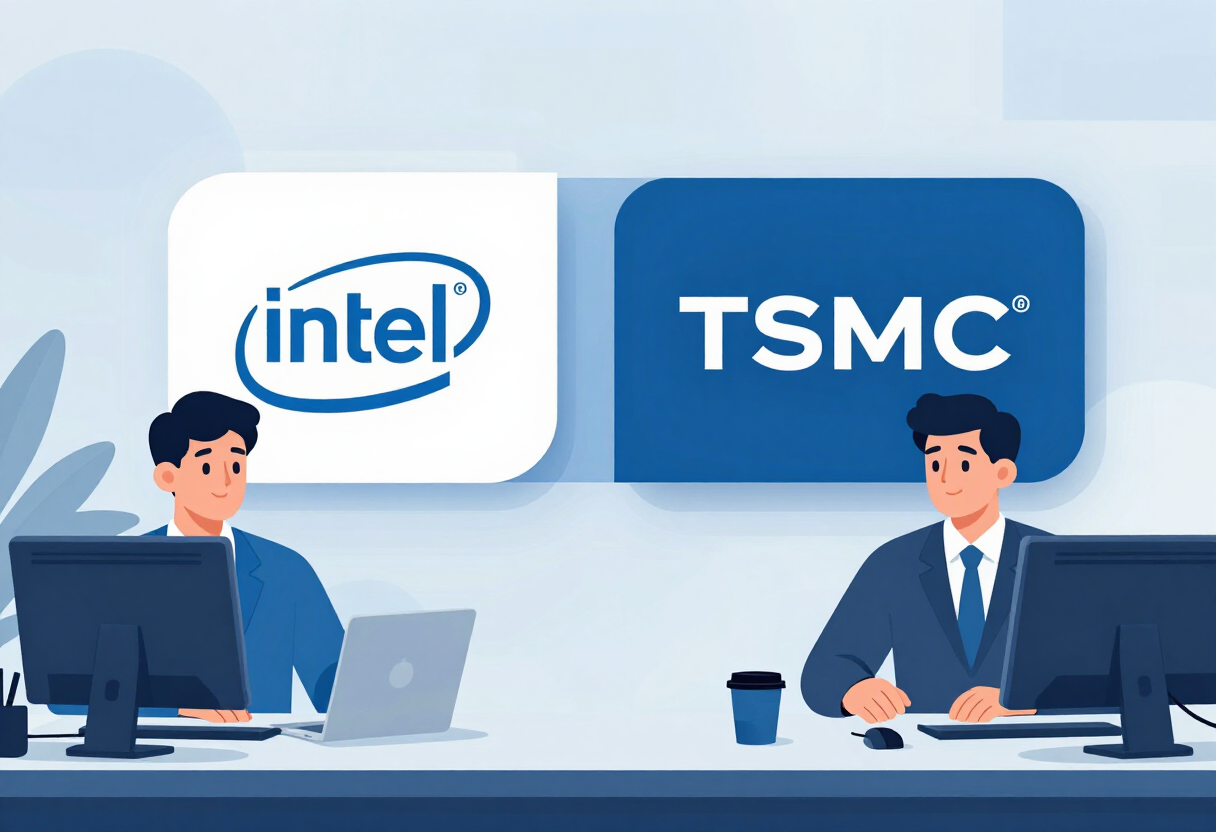
Intel CEO Lip-Bu Tan has publicly reframed TSMC as a partner rather than a rival, a shift in posture that arrives while he works to rebuild Intel's contract manufacturing arm.
- By
- Sophie Lindqvist
- Filed
- Channel
- Chips & Policy
- Read
- 3 min read
Intel CEO Lip-Bu Tan has publicly repositioned TSMC as a partner rather than a competitor, a rhetorical shift that comes while he works to rebuild the company's contract chipmaking arm, Intel Foundry.
The statement, reported by Wccftech, marks a deliberate softening of the framing that has defined the relationship between the two companies for most of the past decade. Under previous leadership, Intel treated TSMC as the benchmark to beat — the foundry whose process leadership Intel vowed to reclaim with an aggressive five-nodes-in-four-years roadmap. Tan's choice of words signals something different: an acknowledgment that engagement with the Taiwanese foundry, rather than head-to-head confrontation, is the more useful commercial posture while Intel's own manufacturing business remains in turnaround.
The timing gives the remark its weight. Tan took the top job at Intel earlier this year amid one of the most difficult stretches in the company's history, with the foundry unit carrying heavy capital burdens and Intel's board under pressure from investors over the pace of the manufacturing revival. Calling TSMC a partner in that context is not a throwaway line. It tells customers, suppliers and Wall Street that Intel does not intend to frame every wafer as a battle with Hsinchu.
In practice, the two companies have long been simultaneously rivals and counterparties. Intel ships flagship products fabricated at TSMC while continuing to manufacture most of its volume in-house, and TSMC supplies packaging and leading-edge capacity that Intel's own fabs do not currently match at scale. That interdependence makes the "partner" framing more description than diplomacy. Intel's product groups depend on TSMC to ship competitive client and data-center silicon on schedule; severing that link prematurely would damage Intel's own revenue before its internal roadmap could absorb the load.
The harder question is what the word "partner" means for Intel Foundry, the contract manufacturing business Tan is trying to rebuild. External foundry customers evaluate suppliers on process maturity, capacity commitment and neutrality — three areas where TSMC's incumbency is deep. A potential customer designing a chip at Intel Foundry must weigh whether a company that also designs its own CPUs and, in Tan's framing, partners with TSMC can offer the stable, neutral supply that pure-play foundries provide. Tan's comment does not resolve that tension; it works around it.
For TSMC, the remark changes little in the near term. The company remains the dominant supplier of leading-edge logic, and its order books reflect that position regardless of how Intel characterizes the relationship. But the framing matters for the longer competitive arc. If Intel Foundry stabilizes and begins winning external business at advanced nodes, the two companies will compete directly for the same design wins. Tan's language leaves that door open without promising a fight.
The statement also fits Tan's broader style since taking charge: pragmatic, relationship-oriented and focused on execution over slogans. He has spent his tenure confronting Intel's cost structure and engineering pipeline, and a public quarrel with the industry's largest foundry would serve no visible purpose in that effort. Framing TSMC as a partner keeps Intel's options open — it can buy capacity where it needs to, sell capacity where it can, and avoid framing its turnaround as a zero-sum contest it is not yet positioned to win.
Investors and industry watchers will read the comment against results rather than rhetoric. The credibility of "partner, not rival" rests on whether Intel Foundry can land external customers, hit its process milestones, and give Intel's product groups a reason to bring more of their volume back in-house. Until those markers appear, the remark stands as positioning: a signal that Intel intends to compete on execution, not on declarations — and that, for now, Tan sees more value in coexisting with TSMC than in casting it as the enemy.
Source: Google News: TSMC
More from Sophie Lindqvist
Related articles
panther-lake-teardown-intel-18a-lands-near-tsmc-n3e-abc6fa43
Panther Lake Teardown: Intel 18A Lands Near TSMC N3E
tsmc-plans-five-additional-advanced-packaging-plants-in-southern-taiwan-6c2b6e0c
TSMC Plans Five Additional Advanced Packaging Plants in Southern Taiwan
powerlattice-raises-25m-with-former-intel-ceo-in-its-corner-3996af3b
PowerLattice Raises $25M With Former Intel CEO in Its Corner
panther-lake-teardown-puts-intel-18a-under-the-microscope-0ed3066f
Panther Lake Teardown Puts Intel 18A Under the Microscope