Microsoft to Scale Custom Azure Maia AI Chips by 2027
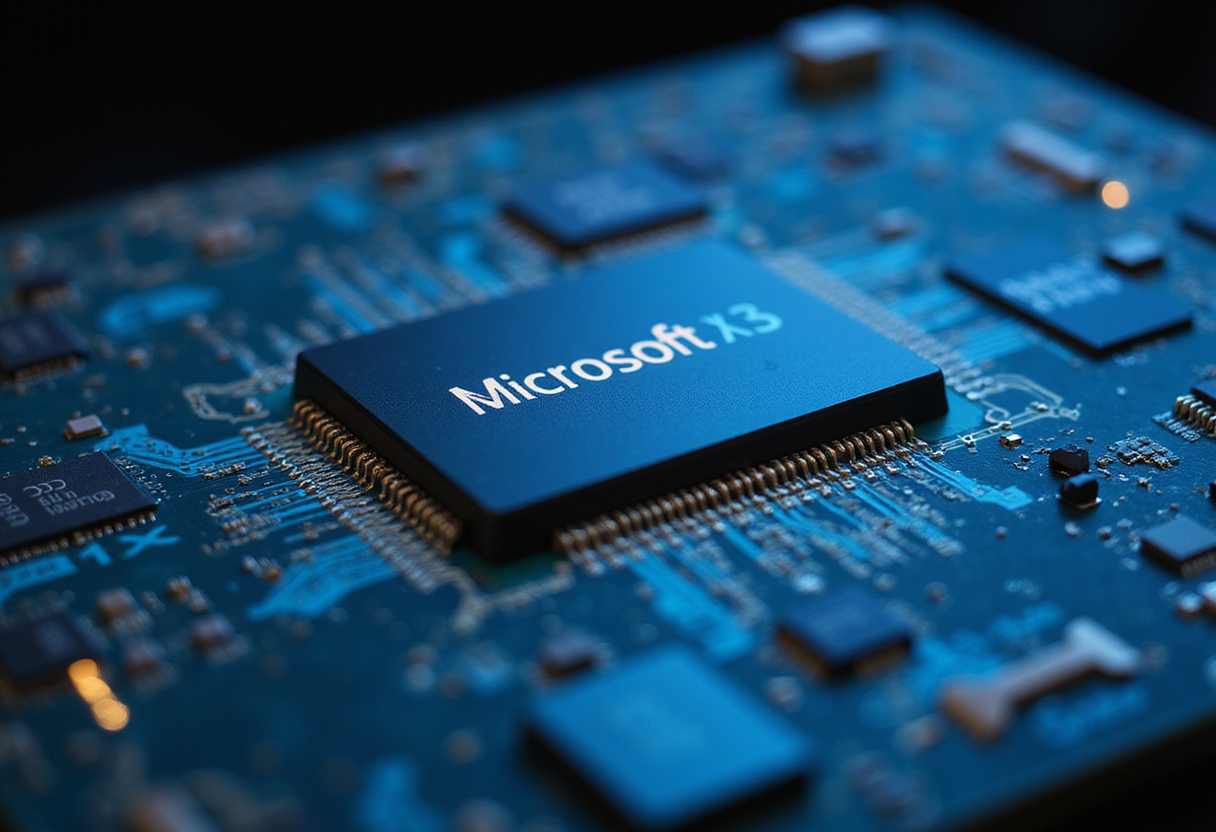
Microsoft will scale its custom Azure Maia AI accelerators by 2027, deepening the hyperscaler push into first-party silicon for AI workloads in its own cloud.
- By
- Nathan Brooks
- Filed
- Channel
- AI & Compute
- Read
- 3 min read
By Nathan Brooks
Microsoft intends to scale production and deployment of its custom Azure Maia AI chips by 2027, Electronics For You reports. The date matters. It places Microsoft's in-house accelerator roadmap squarely inside the window in which hyperscalers expect compute demand for large AI models to outrun the merchant supply of GPUs.
The company has framed Maia as an accelerator designed for its own cloud workloads rather than as a product for sale. That distinction shapes the commercial picture. A chip built for internal consumption does not need to win on price or performance per watt against Nvidia's catalogue; it needs only to reduce Microsoft's own capital spend on rented silicon.
What does the 2027 target signal?
A stated scale-up date implies several things at once. First, Microsoft expects its AI inference and training demand to remain large enough in 2027 to justify volume deployment of first-party silicon. Second, the company judges that its design and supply chain partnerships — the foundry capacity, packaging and memory supply that any modern AI accelerator requires — can be secured on that timeline.
Third, and less comfortably for incumbent GPU vendors, Microsoft is telling the market that its silicon programme has moved past the experimental stage. Hyperscale customers rarely announce scale-up targets for chips they expect to cancel.
How does Maia fit the custom-silicon trend?
Microsoft is not alone in this. The major cloud providers have each concluded that workloads running at their scale justify purpose-built silicon, and AI accelerators are the most expensive workload of all to leave on general-purpose parts.
The logic is straightforward arithmetic. When a cloud operator buys accelerators by the hundred thousand, the margin embedded in each merchant GPU becomes a line item large enough to fund an internal design team many times over. The trade is design risk against long-term cost, and Microsoft has now publicly picked a side.
There is a second-order effect worth noting. Every wafer allocated to hyperscaler custom silicon is capacity the merchant market cannot buy, at a moment when advanced packaging and high-bandwidth memory remain the tightest links in the AI supply chain. Foundries and memory makers, not cloud architects, may hold the effective throttle on how far Maia scales by 2027.
What remains unconfirmed?
The report does not specify production volumes, process nodes, foundry partners or a revenue impact. Readers should treat the 2027 figure as a roadmap commitment rather than a confirmed shipment plan. Microsoft has published no capacity targets alongside the announcement.
Nor is it clear how the balance between Maia and merchant GPUs will evolve inside Azure. Most hyperscalers that build their own accelerators continue to buy external parts in large quantities, because no internal design covers every workload and because customers demand specific hardware. Microsoft's public positioning has been complementary rather than replacement, and nothing in the report suggests that has changed.
The competitive question now falls to timing. If Maia reaches meaningful volume in 2027, Microsoft will have spent the intervening years converting a cost problem into a design capability — and the merchant GPU vendors will have spent those same years watching their largest customers become, in slow motion, their most patient competitors.
Source: Google News: AI chips
More from Nathan Brooks
Show full bio
Senior reporter covering people, launches and day-to-day practice in Semiconductors, chip manufacturing, hardware, AI compute at Chip Dispatch.
432 articles
Related articles
microsoft-plans-production-boost-for-its-ai-chips-bloomberg-reports-09f31965
Microsoft Plans Production Boost for Its AI Chips, Bloomberg Reports
microsoft-unveils-new-maia-ai-chips-to-cut-nvidia-reliance-1b944e25
Microsoft Unveils New Maia AI Chips to Cut Nvidia Reliance
microsoft-commits-to-maia-300-for-ai-services-from-2027-a3cde903
Microsoft Commits to Maia 300 for AI Services From 2027
microsoft-targets-nvidia-dependence-with-maia-300-ai-chip-bf806ff4
Microsoft Targets Nvidia Dependence With Maia 300 AI Chip