Minisforum's $263 Wildcat Lake Mini PC Trades Power for Silence
Minisforum's $263 barebones Elite Mini M2 Air-304 puts Intel's 18A Wildcat Lake Core 3 304 into 0.47 liters. Quiet and frugal, but a rise to $699 would sink it.
- By
- Nathan Brooks
- Filed
- Channel
- Consumer Tech
- Read
- 5 min read
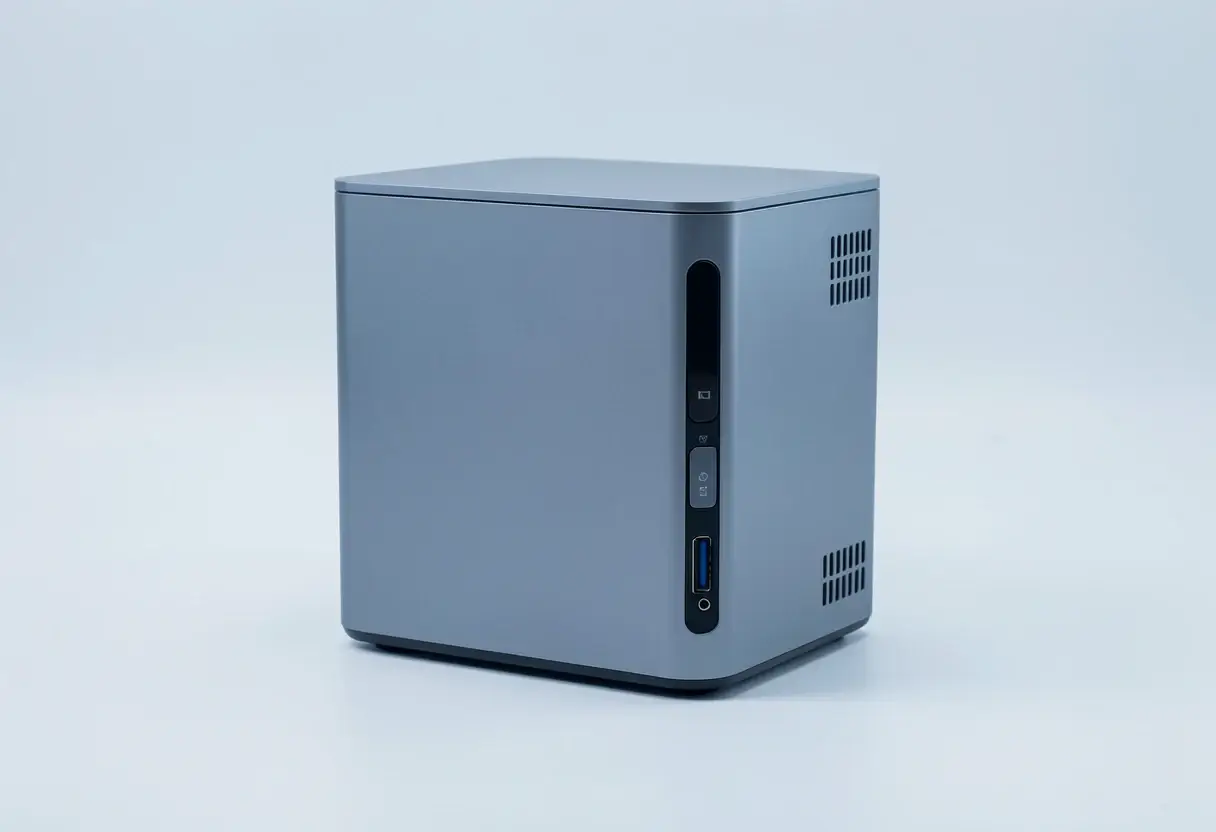
Minisforum sells the smallest and cheapest mini PC built on Intel's Wildcat Lake silicon for $263 in barebones form, and that number is the whole story. The Elite Mini M2 Air-304 pairs Intel's latest 18A manufacturing with just five CPU cores and a single Xe3 graphics core, producing a 0.47-liter box that Tom's Hardware describes as quiet, compact and easy to stow away, but suited only to light workloads.
The review unit, with 16GB of DDR5-5600, a 500GB SSD and Windows 11 Pro, lists at $559 as an introductory price. Minisforum's own product page warns the configuration will rise to $699, and B&H Photo has already moved to $729. The reviewer's verdict on that trajectory is blunt: such a rise would put the product on very shaky ground.
What sits inside the 0.47-liter chassis?
The Core 3 processor 304 runs up to 4.3 GHz within a 15W envelope. Its 5C/5T layout combines one Cougar Cove P-core with four Darkmont LP efficiency cores. The integrated GPU carries a single Xe3 core clocked up to 2.3 GHz and drives up to three displays. That is a deliberate step down from siblings in the M2 line, which offer the Core Ultra X7 358H with 16C/16T and B390 graphics, or the Core Ultra 7 356H, also 16C/16T.
The chassis measures 112 x 112 x 37.15 mm and weighs 440 grams. A 65W power brick comes in the box, connected by a figure-eight cable, though the machine also accepts USB-C power for travelers who prefer a smaller brick. Thermal pads link the RAM and SSD to the metal base plate, which matters more here than the silver plastic top shell, an actively cooled design does not need the lid as a heatsink.
How does it perform?
Single-threaded results hold up respectably. In Cinebench 2024 single core, the machine scored roughly 107 points, within touching distance of the 120 points posted by high-performance rivals such as the Beelink SER10 MAX on Gorgon Point and the MSI Cubi NUC AI+ 3MG on Panther Lake. In POV Ray single-core rendering it beats its AMD-based competitors outright.
Multithreaded work exposes the design's limits. Every other mini PC tested this year carries 12C/24T AMD or 16C/16T Intel silicon, so rendering and encoding benchmarks make the Air-304 look weak. The single-channel RAM compounds the problem. The reviewer notes it remains acceptable for occasionally transcoding a short video, provided the user is not in a rush, and that anyone upgrading from an i7-7700K or i5-10400 desktop will see gains in both single- and multicore performance.
Can it game?
Barely. Some 3DMark tests refuse to run at all: Solar Bay and Speed Way reject the iGPU because Intel has pruned features the single Xe3 core cannot support. Steel Nomad did run, and the score of 135 compares with 1,624 for the GMKtec Evo-T2, whose B390 graphics carry twelve Xe3 cores, nearly a twelvefold gap. Cyberpunk 2077 and Shadow of the Tomb Raider managed 10 to 12 FPS at standard settings; dropping to 720p and low settings reached 25 to 30 FPS.
Retro emulation is the honest use case. The reviewer ran Wipeout Pure through the PPSSPP emulator at 6x render resolution on a 1440p monitor at a steady 60 FPS.
What about power, noise and expandability?
Idle power draw sits around 9W, with a observed maximum near 31W under full load. CPU temperatures stayed in the low 30s Celsius during browsing and never exceeded the low 70s under sustained stress. Noise measured under 30 dBA at idle, below the meter's threshold, and just over 37 dBA under combined CPU and GPU load.
The port selection is generous for the size:
- Front: 2x USB-A 3.2 Gen 2, 3.5mm audio
- Rear: USB4 at 40Gbps with DP Alt Mode and PD, USB-C 10Gbps, USB 2.0, 2x HDMI 2.0, 2x 2.5GbE LAN, DC-IN
- Side: microSD card slot
- Wireless: Wi-Fi 6E and Bluetooth 5.4 via a socketed M.2 2230 card
Upgrade paths are narrow. One SODIMM slot accepts up to a 64GB DDR5-6400 module, and a single M.2 2280 PCIe 4.0 x4 slot takes up to 2TB. Swapping parts requires peeling four rubber feet and undoing four long screws, with adhesive thermal pads resisting the metal base plate on the way out. Windows 11 Pro ships clean, with no bloatware found. The warranty runs two years, with a 30-day money-back guarantee. Only two configurations exist in the U.S.: the $263 barebones model, discounted from $329, and the $559 tested build.
Is it worth the money?
The reviewer's bottom line: the Air-304 is probably the smallest, cheapest and least power-hungry mini PC tested all year, which counts for something. The barebones price makes it attractive for anyone holding a spare DDR5 SODIMM and SSD from a laptop upgrade. The fully configured version adds $296 in parts and license, which the reviewer calls a bit painful.
At the threatened $699 MSRP, the recommendation turns firmly negative. Around that price, buyers can find far more powerful previous-generation machines, and the Geekom IT13 Max 2026 with a Core Ultra 9 185H and 24GB RAM has appeared under $600 with coupons in recent months, according to price trackers.
Source: Tom's Hardware
More from Nathan Brooks
Show full bio
Senior reporter covering people, launches and day-to-day practice in Semiconductors, chip manufacturing, hardware, AI compute at Chip Dispatch.
1,009 articles
Related articles
apple-s-m6-macbook-pro-posts-18-multi-core-gain-on-2nm-silicon
Apple's M6 MacBook Pro Posts 18% Multi-Core Gain on 2nm Silicon
acer-s-2-774-helios-neo-16s-ai-rtx-5070-ti-power-240-hz-oled-weak-battery
Acer's $2,774 Helios Neo 16S AI: RTX 5070 Ti Power, 240 Hz OLED, Weak Battery
hp-targets-macbook-neo-with-699-99-wildcat-lake-laptop-oled-standard-144a8346
HP Targets MacBook Neo with $699.99 Wildcat Lake Laptop, OLED Standard
apples-eighth-generation-ipad-mini-brings-oled-to-699
Apple’s eighth-generation iPad Mini brings OLED to $699