Musk Says Terrafab Chip Factory Could Outperform Rivals
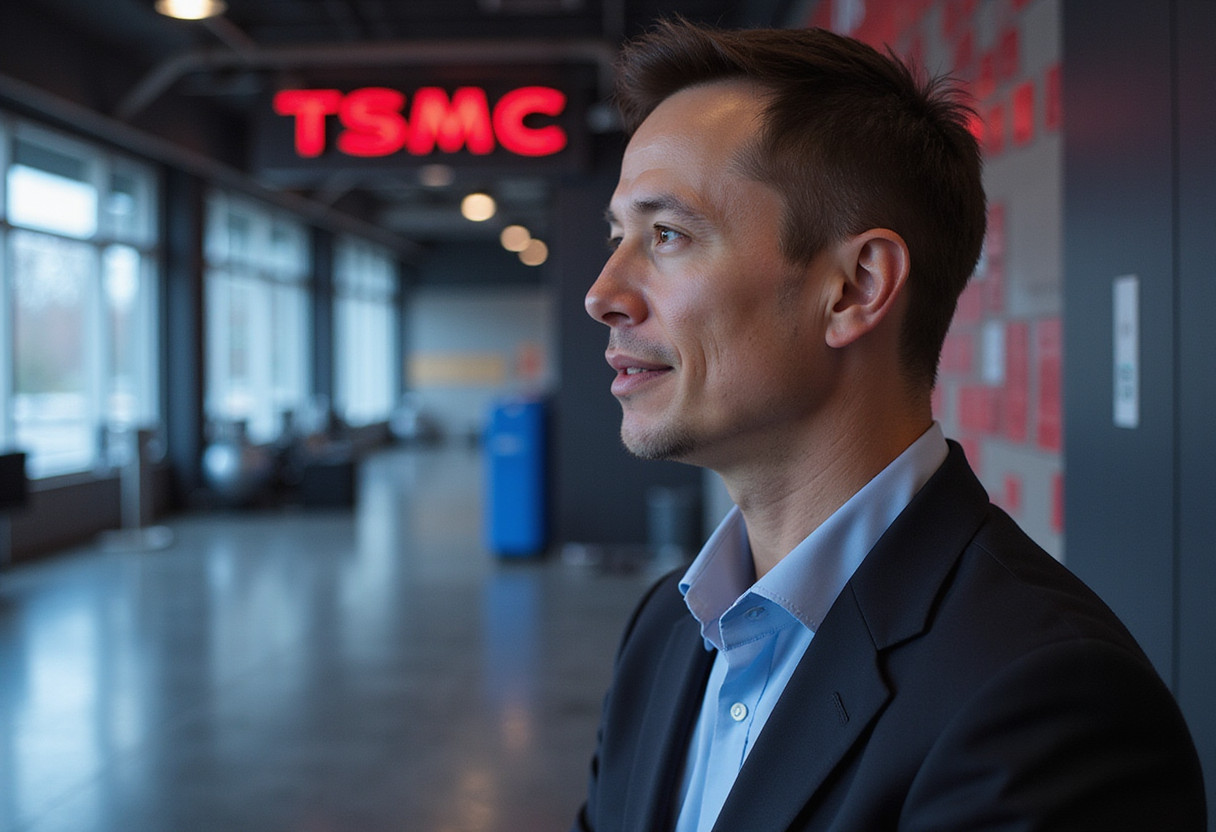
Elon Musk says his planned Terrafab chip factory could outperform established rivals despite facing major manufacturing challenges, according to Investing.com.
- By
- Rebecca Stone
- Filed
- Channel
- Chip Manufacturing
- Read
- 3 min read
Elon Musk says his planned chip fabrication venture, Terrafab, could outperform rival chipmakers even though the project faces significant challenges, according to a report from Investing.com.
The statement puts a new name into an already crowded advanced-manufacturing field. Musk did not lay out a detailed technical roadmap in the remarks reported by Investing.com, and the outlet's summary indicates he acknowledged the difficulty of what Terrafab is attempting.
Who is Elon Musk competing with in chipmaking?
Musk's companies already consume silicon at scale. Tesla designs its own training chips and has long bet that vertical integration in compute gives it an edge in autonomous driving. SpaceX builds custom silicon for its satellite and ground-terminal products. A dedicated fab operation would extend that integration one step further, from chip design into chip manufacturing.
The competitive set Musk would be entering is unforgiving. Taiwan Semiconductor Manufacturing Company, Samsung Foundry and Intel operate the leading-edge fabs that define today's most advanced logic manufacturing. Each has spent decades and tens of billions of dollars building process technology, equipment relationships and customer qualification pipelines.
Musk's claim, as reported by Investing.com, is that Terrafab could nonetheless outperform these rivals. The report did not specify the metrics behind that claim — whether performance, cost per transistor, yield or output volume.
What challenges does a new entrant face?
Building a competitive fab from a standing start confronts several structural barriers:
- Capital intensity. Leading-edge fabs cost on the order of $20 billion or more per site at current industry benchmarks, before accounting for sustained R&D spending on process nodes.
- Equipment access. Extreme-ultraviolet lithography tools from ASML and other critical instruments are supply-constrained and allocated years ahead.
- Talent scarcity. Process engineers with leading-edge experience are concentrated at a handful of incumbents.
- Yield learning. Bringing a new process to competitive yields historically takes years of iterative refinement.
The Investing.com report confirms Musk is aware of these hurdles, noting the project faces challenges even as he argues it could come out ahead.
Why would Musk want his own fab?
Musk has repeatedly argued that control of the supply chain is decisive for his businesses. Securing guaranteed access to advanced compute — for Tesla's autonomy programs and for AI training workloads — has become a strategic concern across the technology industry, with demand for top-tier AI accelerators running ahead of foundry capacity.
Owning fabrication capacity, rather than buying from merchant foundries, would insulate Musk's companies from allocation squeezes. It would also carry the full capital and operational risk of running a fab, which is precisely why most fabless and even many integrated companies have exited leading-edge manufacturing over the past two decades.
What remains unconfirmed?
The report contains no confirmed figures on Terrafab's investment size, site selection, target process node, wafer size or production timeline. No capacity commitments, revenue projections or partner agreements have been disclosed. Until Musk's companies publish concrete plans, Terrafab exists as an ambition rather than a scheduled fab project.
Musk's public statements about his manufacturing ventures have historically preceded formal announcements by months or years, and timelines he projects have often shifted. Investors and supply-chain planners will need engineering milestones — groundbreaking, tool orders, pilot wafers — before treating Terrafab as capacity that will actually reach the market.
The competitive question now is whether Musk can translate his record of disrupting automotive and rocket manufacturing into a sector where process physics, not just factory design, sets the pace.
Source: Google News: chip factory investment
More from Rebecca Stone
Show full bio
Correspondent covering media and advertising at Chip Dispatch.
271 articles
Related articles
musk-says-terrafab-chip-plant-could-outperform-rivals-91bd5ffb
Musk Says Terrafab Chip Plant Could Outperform Rivals
musk-s-16-8-billion-chip-ambition-explained-2f409414
Musk's $16.8 Billion Chip Ambition, Explained
musk-confirms-terafab-is-in-talks-with-tsmc-over-texas-fab-project-27ee25d6
Musk Confirms Terafab Is in Talks With TSMC Over Texas Fab Project
tsmc-reportedly-in-talks-over-role-in-musk-s-terafab-project-bb0873b0
TSMC Reportedly in Talks Over Role in Musk's Terafab Project