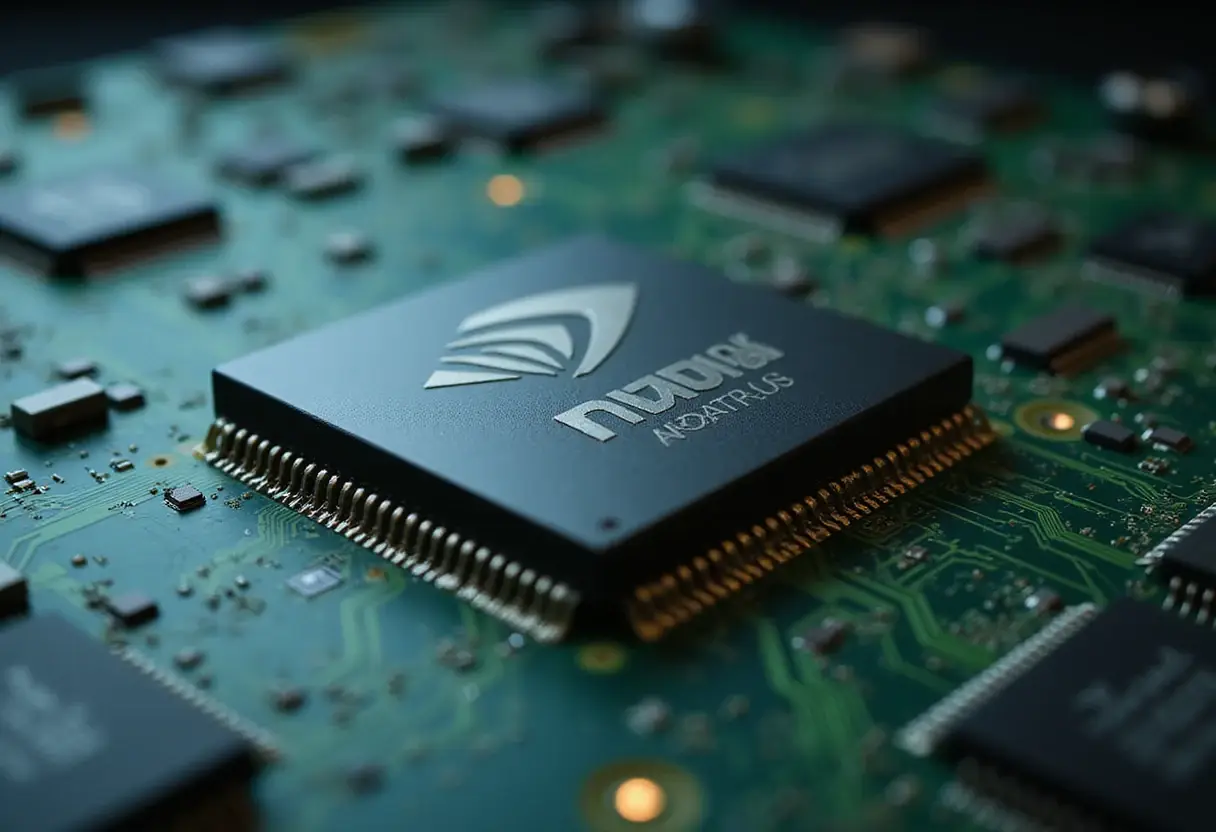
Nvidia targets 2028 availability for Rubin HPC science GPU
Nvidia expects Rubin HPC in 2028 with more than 50,000 CUDA cores. Vera Rubin NVL72 posted early MLPerf wins as partners prepared CPU racks and quantum tools.
- By
- Grace Kim
- Filed
- Read
- 3 min read
By Grace Kim
Nvidia expects Rubin HPC to be available in 2028, with more than 50,000 CUDA cores on a single GPU, the company said at the SC26 supercomputing conference on Monday.
Nvidia calls the core count a record. The new accelerator belongs to the Vera Rubin platform and targets simulation and data processing across science, engineering and analytics. Sparse data acceleration aims to keep the cores supplied with data. Seventh-generation NVLink provides links between GPUs.
What does Rubin HPC target?
Nvidia positioned the part for operations that pull scattered values from very large datasets. Its named workloads were:
- Climate models
- Engineering simulations
- Genomic analysis
- Financial risk
- AI agents that run simulations to test ideas
“For agents tackling science and engineering, faster simulation means faster discovery,” said Ian Buck, Nvidia’s vice president of hyperscale and high-performance computing.
StorageReview noted that Nvidia had not published Rubin HPC memory capacity, FP64 throughput, power consumption or performance comparisons. The announcement therefore stops short of a performance or efficiency comparison for the 2028 part.
What do Vera Rubin’s first MLPerf results show?\n
MLPerf Training v6.1, released Monday, covered four workload classes:
- Large language models
- Image generation
- Recommender systems
- Reinforcement-learning post-training
Nvidia said Vera Rubin swept every benchmark and was the only platform with results on every test.
In its debut, Vera Rubin NVL72 delivered up to twice the per-GPU performance of GB300 NVL72, Nvidia said. On DeepSeek-V3, the system scaled from 256 to 1,024 GPUs at about 97% efficiency, which Nvidia said cut training time from 16 minutes to about four.
MLCommons, the industry group that runs the benchmarks, published the full training results. Those measurements apply to Vera Rubin NVL72, not the separate Rubin HPC accelerator scheduled for 2028. The endpoint submission carries a different status.
Nvidia also made its first MLPerf Endpoints submission with Vera Rubin NVL72. The company reported more than 10 times the throughput per watt of GB300 NVL72 on the Kimi K3 agentic workload at the same response speed. Nvidia’s own footnote marked that result provisional pending MLCommons verification.
Twenty partners submitted results on Nvidia hardware, including CoreWeave, Crusoe, Dell, Oracle and Supermicro.
Which Vera systems are planned for 2027 and 2028?
Nvidia announced a liquid-cooled Vera CPU rack for high-performance computing. The rack contains 192 Vera CPUs, connects them with Quantum-X800 InfiniBand and provides about 300 TB of memory.
StorageReview reported that Dell, HPE, Lenovo and Supermicro will offer the liquid-cooled rack from early 2027, while Germany’s DKRZ expects its HLRE-5 Vera CPU supercomputer in early 2028. DKRZ is Germany’s climate computing center, which selected Vera CPUs for HLRE-5. Both dates are availability forecasts, not installed-capacity figures.
How will quantum processors join supercomputer queues?\n
Slurm 26.11, due later in November, adds a common interface for scheduling quantum processors in supercomputing centers. The community-built workload manager already helps centers schedule jobs. Under the new interface, quantum processor builders can describe their hardware once and reuse that description at every center.
Alice & Bob, IBM, IQM, Pasqal, Quantinuum and MQSC are adopting it. Nvidia said nearly 30 supercomputing centers are deploying more than 50 quantum processors.
IBM, Nvidia and Fermilab plan a modular quantum codesign platform. The proposed platform will place Nvidia DGX B200 systems next to IBM quantum computers, including those using the Nighthawk processor, to test how several quantum processors work together.
Nvidia also pointed to work by Altera and Oxford Quantum Circuits on an FPGA controller linking a quantum processor to GPUs.
What is the business context?
Nvidia marked 20 years of CUDA. The company says the platform now counts more than 11 million developers.
The announcements came one day before Nvidia’s third-quarter results. The report will be the company’s first without Jensen Huang as chief executive.
The competitive picture remains unsettled until Nvidia publishes Rubin HPC specifications and MLCommons verifies Vera Rubin’s endpoint result, with no comparable Rubin HPC power or performance baseline available now.
Source: mlq.ai
More from Grace Kim
Show full bio
Market editor covering people, launches and day-to-day practice in Semiconductors, chip manufacturing, hardware, AI compute at Chip Dispatch.
1,035 articles
Related articles
nvidia-unveils-rubin-hpc-gpu-with-over-50-000-cuda-cores
Nvidia Unveils Rubin HPC GPU With Over 50,000 CUDA Cores
coreweave-puts-nvidia-vera-rubin-nvl72-into-production-with-cognition-first-d77d4696
CoreWeave Puts NVIDIA Vera Rubin NVL72 Into Production, With Cognition First
starburst-reports-three-to-seven-times-faster-queries-on-nvidia-gpus-1ee47a3e
Starburst reports three-to-seven-times faster queries on Nvidia GPUs
nvidia-ships-gpu-library-aimed-at-ai-inside-chip-design-and-fabs-aeb4d368
Nvidia Ships GPU Library Aimed at AI Inside Chip Design and Fabs