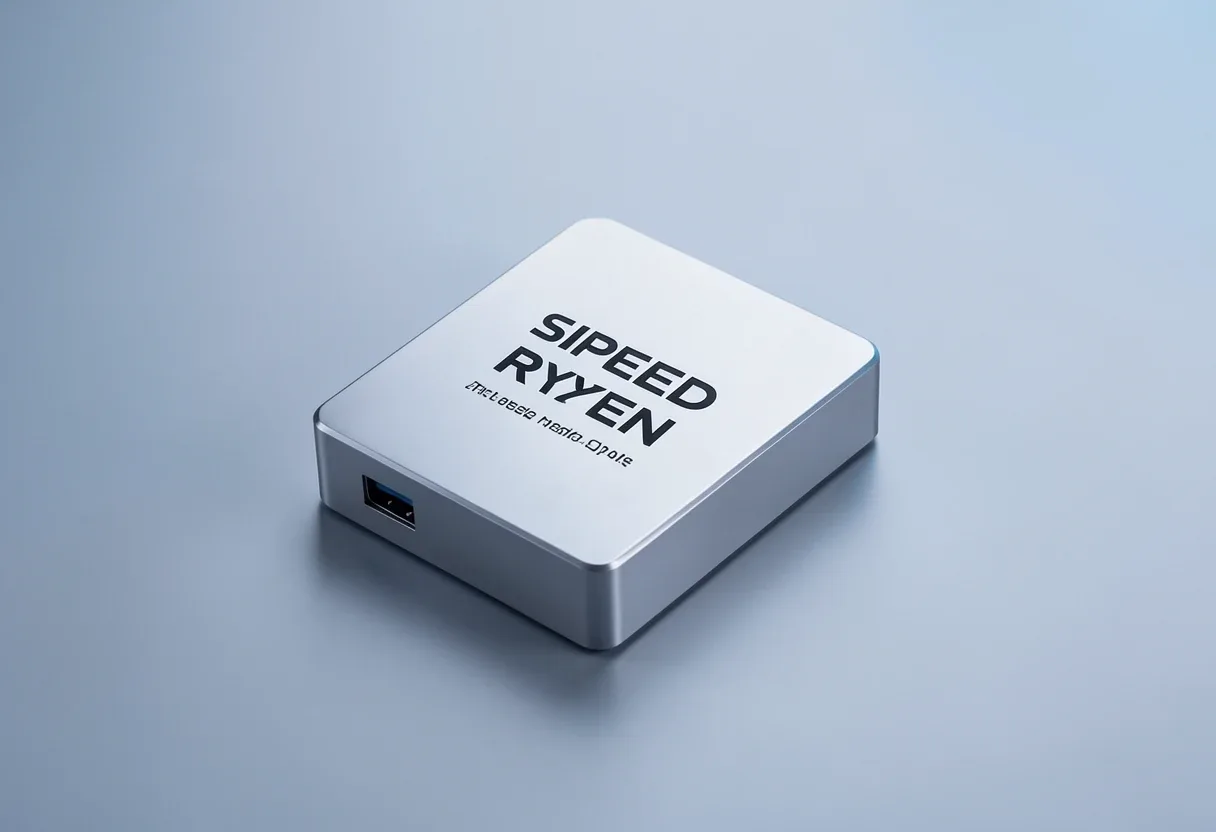
Sipeed's $3,999 MaixStation Takes Aim at DGX Spark With Chinese Silicon
Sipeed's MaixStation pairs Axera's 6nm AX8860P with 128GB of LPDDR5X at 273 GB/s for an expected $3,999 — undercutting Nvidia's $6,950 DGX Spark on price alone.
- By
- Rebecca Stone
- Filed
- Channel
- AI & Compute
- Read
- 4 min read
Sipeed expects its 128GB MaixStation to sell for about $3,999 — level with AMD's 128GB Ryzen AI Max+ 395 machine and far under Nvidia's $6,950 DGX Spark. The Guangzhou-based board maker told Tom's Hardware Premium the price, and it's the number that makes this announcement more than a curiosity. For the first time, a Chinese-built local-AI box is competing with Nvidia and AMD silicon at the same memory class: 128GB of LPDDR5X on a 256-bit bus at 273 GB/s.
Underneath sits Axera's newly launched AX8860P, a 6nm part with 16 Arm Cortex-A55 cores and an in-house NPU rated at 256 TOPS at native FP4 with no sparsity. Sipeed showed the chip off at an industrial fair in Shanghai on Tuesday. Sign-ups are open now; a Kickstarter closes the year out, and units ship within three months after that.
What does Sipeed claim on performance?
Plenty — some of it hedged. The company claims 25% faster prefill and 30% faster decode than the DGX Spark running Qwen 27B from a single node. In a follow-up email, though, Sipeed walked that back to roughly 10% ahead on both metrics, with FP4 on each machine and speculative decoding off, adding that newer runs showing a wider lead aren't official yet.
Sipeed didn't stop at numbers. "In fact you need [to] ask why DGX is so slow," the company said, suggesting Nvidia "just [wants to make] more money from users." It also stated "DGX Spark 1000TOPS is fake 'sparse'" — true in the sense that the 1 PFLOP figure relies on sparsity, but the Spark's dense rate of about 500 TFLOPS still doubles the AX8860P's 256 TOPS.
The decode claim holds up to arithmetic. A 4-bit 27B model weighs about 13.5GB, and comparable machines top out near 20 tokens per second, which works out to roughly 270 GB/s — right at the bandwidth ceiling. Prefill, being compute-bound, is a harder sell.
What's the catch?
Software, mostly. The NPU toolchain arrives only at the end of this month, and today neither Axera's V7.0 docs' operator list, the ax-llm runtime, nor the AXCL PCIe driver and runtime even mentions the chip. The end-of-October release, Sipeed says, brings AXDSL — a kernel-programming language — plus the Pulsar2 compiler source, with vLLM and SGLang running on a custom backend so Hugging Face models load without conversion.
The hardware is real regardless. The box measures about 11 × 11 × 3 cm, draws about 40W over USB-C, and offers a 10G SFP+ port, an M.2 2280 slot for a PCIe 5.0 SSD, and an MCIO 8i connector. A 256 Gbps C2C link — up to 384 Gbps — chains up to eight nodes with no switch, versus the Spark's four-system limit that, per Nvidia's datasheet, "requires [an] external switch" at full count. Two- and four-chip cascades reach a theoretical 512 and 1,024 TOPS at about 80% scaling efficiency. A MaixStation Pro with 512GB is planned, and a four-chip PCIe card also reaches 512GB.
How does the pricing work?
Memory dominates the bill of materials, and that's the risk. A 128GB DDR5 kit cost $3,399 in August at best U.S. pricing, and TrendForce expects conventional DRAM contract prices to rise another 10–15% this quarter. Sipeed says it based unit prices on current DRAM costs, not last year's stock, and notes buyers can supply their own SSD to cut the price further — the machine takes a standard M.2 2280 drive rather than the Spark's less common 2242.
Chinese vendors already sell AMD-based boxes — GMKtec's 192GB Evo-X5 Pro runs $6,799 to $7,099, and Minisforum ships the MS-S1 Max-P495. What's new here is Chinese silicon underneath. "Yes, bsp sdk is open, you can use AI to port any distribution on it!" Sipeed said of the platform, which ships Debian 13 and Linux 6.18. Sipeed has sold Axera boards since 2022.
Remote-access test units and review samples arrive during the Kickstarter. Until the toolchain lands and independent benchmarks run against the Spark's dense 500 TFLOPS, the MaixStation is a paper threat with an aggressive price — and a DRAM market heading the wrong way for anyone promising $3,999.
Source: Tom's Hardware
More from Rebecca Stone
Show full bio
Correspondent covering technology and product news in Semiconductors, chip manufacturing, hardware, AI compute at Chip Dispatch.
543 articles
Related articles
axera-claims-ax8860-beats-nvidia-dgx-spark-by-25-in-llm-workloads-b0486a9f
Axera Claims AX8860 Beats Nvidia DGX Spark by 25% in LLM Workloads
micron-lines-up-512gb-ddr5-rdimm-for-12tb-servers-in-h2-2027-e0f48421
Micron Lines Up 512GB DDR5 RDIMM For 12TB Servers In H2 2027
amd-buys-taalas-to-hard-wire-ai-inference-into-silicon-5aa48930
AMD Buys Taalas to Hard-Wire AI Inference Into Silicon
nvidia-flags-15-percent-nvl72-hike-as-memory-spot-prices-climb-sevenfold-92e6ff36
Nvidia Flags 15 Percent NVL72 Hike As Memory Spot Prices Climb Sevenfold