TI's 3 GSPS ADC Watches AI Server Power Rails in Nanoseconds
TI's ADC34DSO75 samples at 3 GSPS to catch nanosecond voltage glitches on Blackwell-era AI power rails, replacing FPGA-based monitoring with event-based telemetry at 1.6 W per channel.
- By
- Nathan Brooks
- Filed
- Channel
- Semiconductors
- Read
- 4 min read
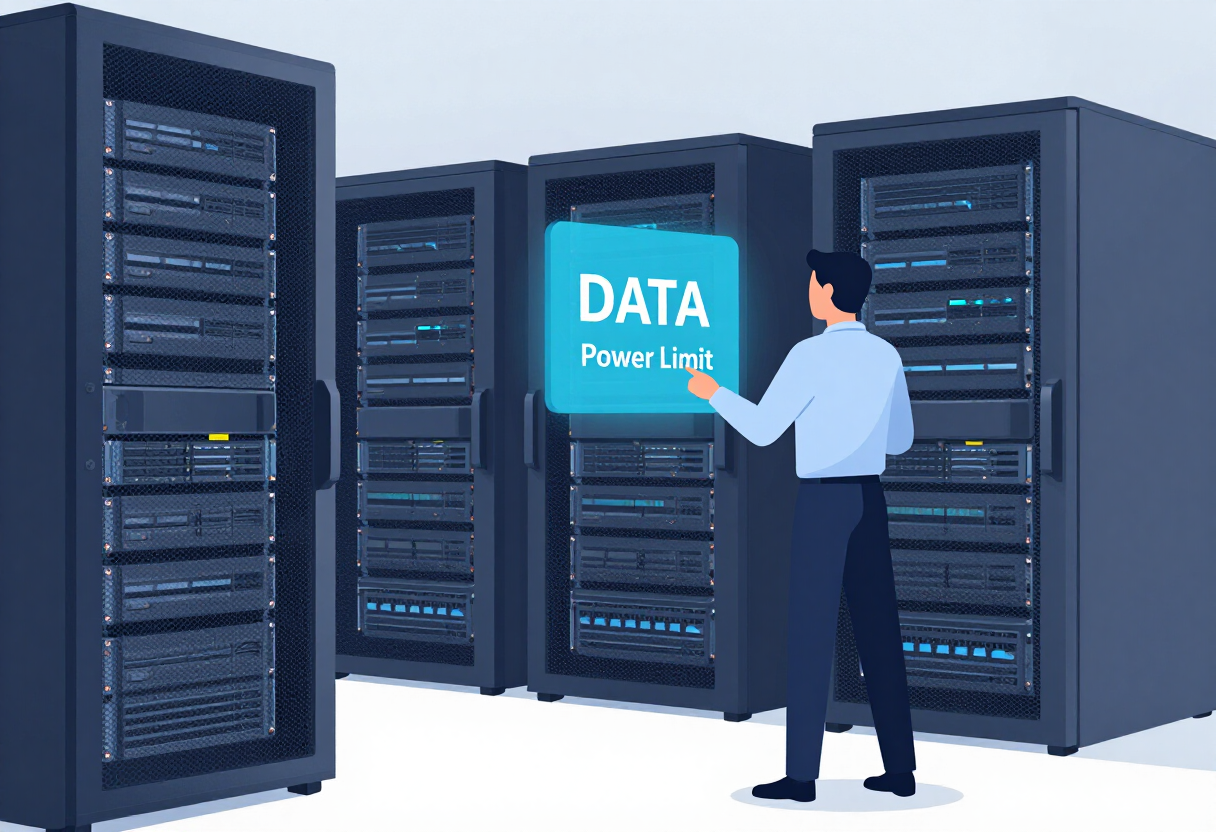
Texas Instruments has introduced a four-channel, 14-bit ADC that samples at up to 3 gigasamples per second, fast enough to catch nanosecond-scale voltage glitches on the power rails of NVIDIA Blackwell and AMD Instinct accelerators. TI claims the ADC34DSO75 is thousands of times faster than current power-monitoring solutions and is efficient enough to watch power rails continuously inside the server.
The device, introduced at the OCP annual conference, targets a problem that has grown with AI accelerator power ratings. Blackwell GPUs draw more than 1 kW each, with TDP ratings as high as 1,400 W. NVIDIA's Blackwell-based racks reach up to 120 kW, and next-generation Rubin-based racks are specified to scale to 600 kW. At full data center scale, thousands of such racks can consume gigawatts.
Why do fast load transients matter?
AI processors rarely consume power at a steady rate. During computationally intense phases of training or inference, they can jump from near idle to full power almost instantly, with peak levels reaching 50% to 60% above rated TDP. Karthik Vasanth, VP and GM of data converters at TI, said load transients can exhibit slew rates of more than 2,000 A/µs at the processor and more than 2.5 A/µs at the power supply unit.
These transients can outpace the response of rack-level supplies and board-level voltage regulators, producing undershoots, overshoots and glitches that unfold in nanoseconds — even when large numbers of decoupling capacitors sit close to the processor. The consequences are not theoretical. Undetected events can trigger resets, throttling and interrupted workloads, extending LLM training runs and, at the largest deployments where tens of thousands of GPUs ramp together, causing outages.
"When there's a blackout, that's a very dramatic event that can bring the entire AI data center down," Vasanth said. "But there is a more subtle problem, which is a brownout, where you have a small voltage glitch on one of these racks, and that puts the model or a portion of the model out of commission."
He added that these AI models no longer reside in a single rack but across the entire data center, so even brief downtime carries serious repercussions. A single outage can now cost hundreds of thousands of dollars per hour, and hyperscalers are targeting automotive-grade reliability or above.
What is the current blind spot?
Most telemetry systems sample at millisecond intervals. Matthew Hann, product line manager for high-speed data converters at TI, said they can identify server-level voltage droop but miss the transient events now occurring at processor power rails. The result is a blind spot where power, thermal and utilization metrics all look normal while elusive faults persist.
Nanosecond-scale monitoring exists today, but it typically depends on FPGAs, which add cost, power consumption and hardware complexity. Finding the fault itself is no small task either. "You're looking for a little needle buried somewhere in a massive haystack, which is the data center," Vasanth said.
How does the ADC34DSO75 work?
The converter combines 3 GSPS sampling with a full power input bandwidth of 3 GHz via buffered analog inputs. Advanced AI cores run at 0.8 V to 1.2 V, so tens of millivolts of fluctuation can cause instability; the device's 68-dB SNR and low phase and amplitude noise give it enough resolution to track those small variations. It consumes 1.6 W per channel at full sampling speed.
To avoid drowning the system in data, the ADC uses event-based telemetry. Each channel carries an independent event-detection engine that records only overshoots and undershoots programmers specify, offloading data to a small MCU and eliminating the FPGA. Key specifications include:
- Four 14-bit channels sampling at up to 3 GSPS
- 256 kB of on-chip memory, divisible among channels, storing pre-trigger and post-trigger samples
- Programmable detection of voltage limits and rates of change within a time window
- Daisy-chaining across multiple devices through the same octal SPI interface
"You can program what you're looking for, and when that event actually happens, you store the information in memory," Hann said. "It's like having an oscilloscope for each node without the bulkiness of an oscilloscope."
TI also introduced a system-on-module pairing two ADCs to monitor up to eight voltage rails, with external flash memory that preserves data through a blackout. "Think of this as a black-box recorder," Vasanth explained. Hann framed the device as "a high-speed, fully remote, and highly efficient watchdog for the most critical power infrastructure," adding that it brings intelligence to the edge — the GPU and CPU power rails.
Looking ahead, TI said nanosecond-level monitoring opens the door to predictive fault detection, letting hyperscalers build models that spot patterns preceding brownouts before they occur.
Original: edge.prnewswire.com
More from Nathan Brooks
Show full bio
Senior reporter covering people, launches and day-to-day practice in Semiconductors, chip manufacturing, hardware, AI compute at Chip Dispatch.
463 articles
Related articles
digitimes-trains-its-lens-on-800vdc-ai-s-next-bottleneck-is-power-37e2cc2f
DIGITIMES Trains Its Lens on 800VDC: AI's Next Bottleneck Is Power
amd-buys-taalas-to-hard-wire-ai-inference-into-silicon-5aa48930
AMD Buys Taalas to Hard-Wire AI Inference Into Silicon
power-not-accelerators-now-caps-data-center-ai-scaling-6bd78ff3
Power, Not Accelerators, Now Caps Data Center AI Scaling
ubs-power-supply-will-just-cover-ai-chip-boom-if-everything-gets-built-01689683
UBS: Power Supply Will Just Cover AI Chip Boom — If Everything Gets Built